

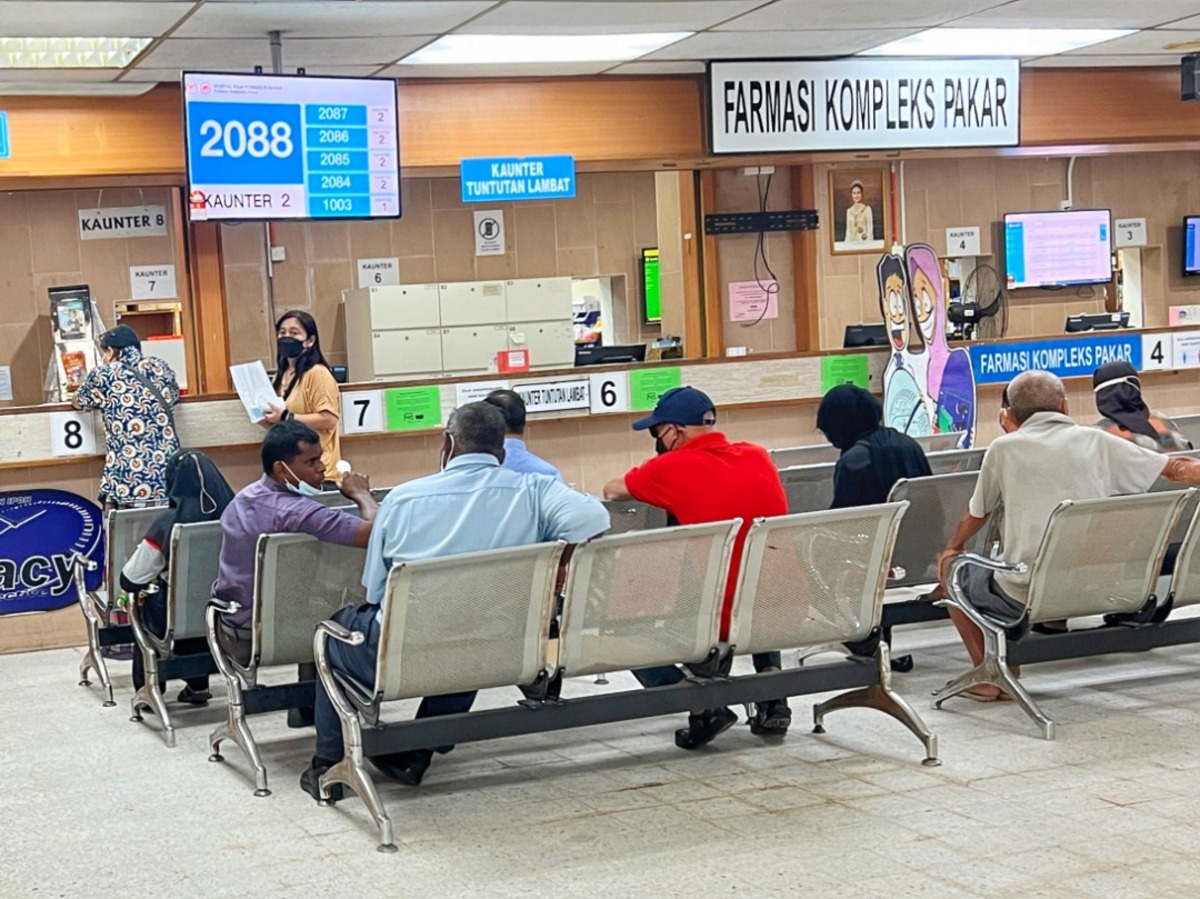
KUALA LUMPUR, May 4 — Health care workers are preparing for reductions of medicine dispensing, treatment regimen changes, and allowance cuts as the government prepares to slash its current health budget by RM4.65 billion.
Despite Health Minister Dzulkefly Ahmad’s pledge to protect “essential core services” from spending cuts, pharmacists and doctors believe the underfunded and understaffed public health care system will still be hit hard.
“The system is already under tight fiscal pressure even before any proposed budget cuts,” a pharmacist at a public health care facility told CodeBlue on condition of anonymity.
“It also depends on how ‘essential core services’ are defined. Even then, I do expect some spillover effects, i.e. they won’t cut the budget for drug procurement, but with the rising costs of fuel, the price of drugs will increase so drug procurement will be impacted anyway.”
She said diabetes and cardiovascular drugs will likely be affected because these are the highest-volume medications dispensed in the national health service.
Medicine dispensation at government health care facilities, she added, could be reduced from the current one-month supply to one or two weeks.
“Disruptions to drug supply will adversely affect patients’ medication compliance, which in turn increases the risk of complications from diseases. These complications (for example, hospitalisation, dialysis, and life support) will eventually cost the government more money to treat.”
The government pharmacist lamented that “drug supply is never consistent or reliable. It’s either budget cuts or the drug supplier is unable to meet our demand.”
She also stressed that all medicines were “essential” and “almost impossible to cut”, citing vitamins as an example that may be wrongly perceived as non-essential.
However, vitamins are usually prescribed in government facilities for pregnant women and patients with end-stage kidney failure (i.e. patients with higher requirements compared to the general population).
The pharmacist further expects potential cuts to new GLP-1 and dual GIP/GLP-1 medications for type 2 diabetes and obesity that are currently used in certain government hospitals, subject to an existing quota and certain patient criteria.
“These might be cut and substituted with other medications that are less effective.”
Another pharmacist in the MOH said core services or “basic treatment” could be maintained, but not the initially planned standard of care.
He explained that public health care facilities previously planned to convert a certain number of patients to SGLT2 inhibitors for diabetes, besides converting warfarin patients to direct oral anticoagulants (DOAC), a modern blood-thinning medicine used to prevent blood clots and stroke.
“These conversions will not be carried out this year since the new drugs are more expensive,” the pharmacist told CodeBlue on condition of anonymity.
“Converting certain populations to more effective drugs and people needing non-standard treatments – these for sure will be affected.
“Even for standard care, most hospitals would have used up 70 to 80 percent of the initial budget that reaches them. We can’t be sure how much more we will get. Most will initiate their cost-saving plans.”
The pharmacist also cited non-formulary therapies like cancer biologics that could be hit by spending cuts, saying although the number of patients on these innovative treatments isn’t a lot, “but they really need it”.
One-month supply of medicine dispensing will likely be strictly imposed for everyone, instead of a maximum two-month supply. Pharmacists might also ask patients about current stock levels and get them to come in only when their stock finishes.
“We may limit drugs for acute cases that need to be taken only when needed – paracetamol and other flu drugs, painkillers etc. We may limit the amount to be dispensed for each patient,” the pharmacist added.
Hartal Warns Of Potential Nationwide Strike If On-Call Claims Cut

The MOH received an RM46.5 billion allocation for this year under Budget 2026, comprising RM39.8 billion in operating expenditure and RM6.7 billion in development expenditure.
Emoluments comprised about 62 per cent (RM24.8 billion) of the MOH’s RM39.8 billion operating budget, followed by services and supplies at RM13.9 billion. Assets, fixed payments, and other expenses made up only about RM1 billion.
Dzulkefly told a recent press conference that he expected a 10 per cent cut to the MOH’s 2026 budget, equivalent to RM4.65 billion, five months into the year amid a soaring fuel subsidy burden due to the US-Iran war. The government’s proposed cuts for multiple ministries target their current year’s operational expenditure.
The Star reported recently that “overtime allowance” would be subject to tighter regulation as part of the ministry’s cost-saving measures, besides limiting events, official functions, and meetings; campaigns; and overseas travel, among others. Attending conferences for continuous professional development are usually paid for by doctors themselves.
On-call allowance (ETAP) rates for medical and dental officers were increased by about 40 per cent last November under Budget 2026, the first raise in 13 years. This increase was estimated to cost an additional RM120 million, on top of the previous annual RM288 million cost.
Hence, back-of-the-envelope calculations show that ETAP allowance for doctors and dentists costs about RM408 million this year – just about 9 per cent of RM4.65 billion, but not an insignificant amount.
Hartal Doktor Kontrak (HDK) warned the MOH that stopping on-call claims would trigger a strong backlash from doctors and the risk of another nationwide strike.
“Cutting or reducing on‑call claims will push more doctors towards resignation, especially those already frustrated by uncertain career paths and heavy workloads,” HDK spokesman Dr Muhammad Yassin told CodeBlue.
“If MOH and MOF (Ministry of Finance) want to retain talent, they must protect emoluments and incentives that reflect the real burden of clinical service, rather than treating them as easily trimmable budget items.”
The contract doctors’ group stressed that health care should be prioritised above expanding fuel subsidies.
“When the health care workforce is already under severe strain, further cuts to health care funding risk compromising both patient safety and the long‑term viability of the public health care system,” said HDK.
Dr Muhammad Yassin added that reducing or freezing new intakes of housemen, contract doctors, and other health care workers as part of spending cuts would increase doctor attrition from public service.
Dzulkefly told reporters last Saturday that he didn’t rule out savings in unfilled vacancies, provided that they don’t affect public services.
“If MOH prohibits on-call claims, we don’t do on-call, easy,” a senior medical officer at a government hospital in Selangor told CodeBlue bluntly. “Nationalism is why we all still remain in service.”
The senior doctor also expects cuts to medication budgets, besides the replacement of medical devices and consumables like surgical equipment and central vein catheters with cheaper but poorer quality brands.
“Do we need another pandemic to teach us a lesson? Clearly leaders have forgotten what Covid-19 taught us.”
A specialist doctor at a government hospital in Sabah said he might not mind performing on-call duties for free, but acknowledged that cutting on-call claims could be the “last straw” for his colleagues.
“On-calls are essential, hence claims should be too. They’re pretty much like salaries,” he told CodeBlue.

The Star also reported other cost-saving measures at the MOH like outsourcing to ensure that the exercise is carried out on a “demand-driven” basis, rather than being supply-driven.
CodeBlue recently reported that Sultan Idris Shah Serdang Hospital (HSIS) has begun outsourcing outpatient angiograms to private hospitals under the MOH’s Hospital Services Outsourcing Programme (HSOP) because the national heart centre is too overwhelmed.
Even if the ministry eliminated the entire HSOP programme, this would only generate RM140 million in savings this year, just 3 per cent of RM4.65 billion.
News about the proposed steep cuts to health spending have angered not just the medical fraternity, but also lawmakers and the general public.
A doctor wrote on Facebook that if the government could find “excess” to cut from health spending, this meant that the “excess” could be redirected to more critical areas instead of cutting it.
“At this point, I don’t think I should care anymore. We are working as hard as we can, while being backstabbed by the policymakers.”
Consultant paediatrician Dr Amar-Singh HSS, in commenting on the proposed RM4.65 billion cut to health spending, wrote on X: “When our MOH health services often do not have enough for essential needs, how can this cut not affect services?”
MOF has given all ministries about two weeks until May 15 to submit their proposals for spending cuts to the National Budget Office. Doctors and politicians alike have demanded that the MOH disclose its proposal to the public.


