

KUALA LUMPUR, May 14 — The government may only cut civil servants’ salaries in a reduction of operational expenditure to pay for surging fuel subsidies as an “absolute last resort”, said Nurhisham Hussein.
In an interview with radio station BFM’s “The Breakfast Grille” aired yesterday, the economic adviser to Prime Minister Anwar Ibrahim explained that under the Federal Constitution, the government cannot have a current account deficit, meaning that operational expenditure can’t exceed government revenue.
The government can only borrow for development purposes.
“In the context of subsidies, every dollar that we pay out in subsidies has to come from somebody. Generally speaking, given that a budget was set in 2025 this year, we’re having to adjust the budget in terms of expenditure to account for this massive increase in subsidies,” said Nurhisham, who is senior director of economy and finance at the Prime Minister’s Office (PMO).
He updated his previous figure of fuel subsidies costing RM2,300 every second in April to a current estimate of RM1,500 or RM1,700 per second, noting that the huge global scramble for oil last month led to Malaysia paying a premium.
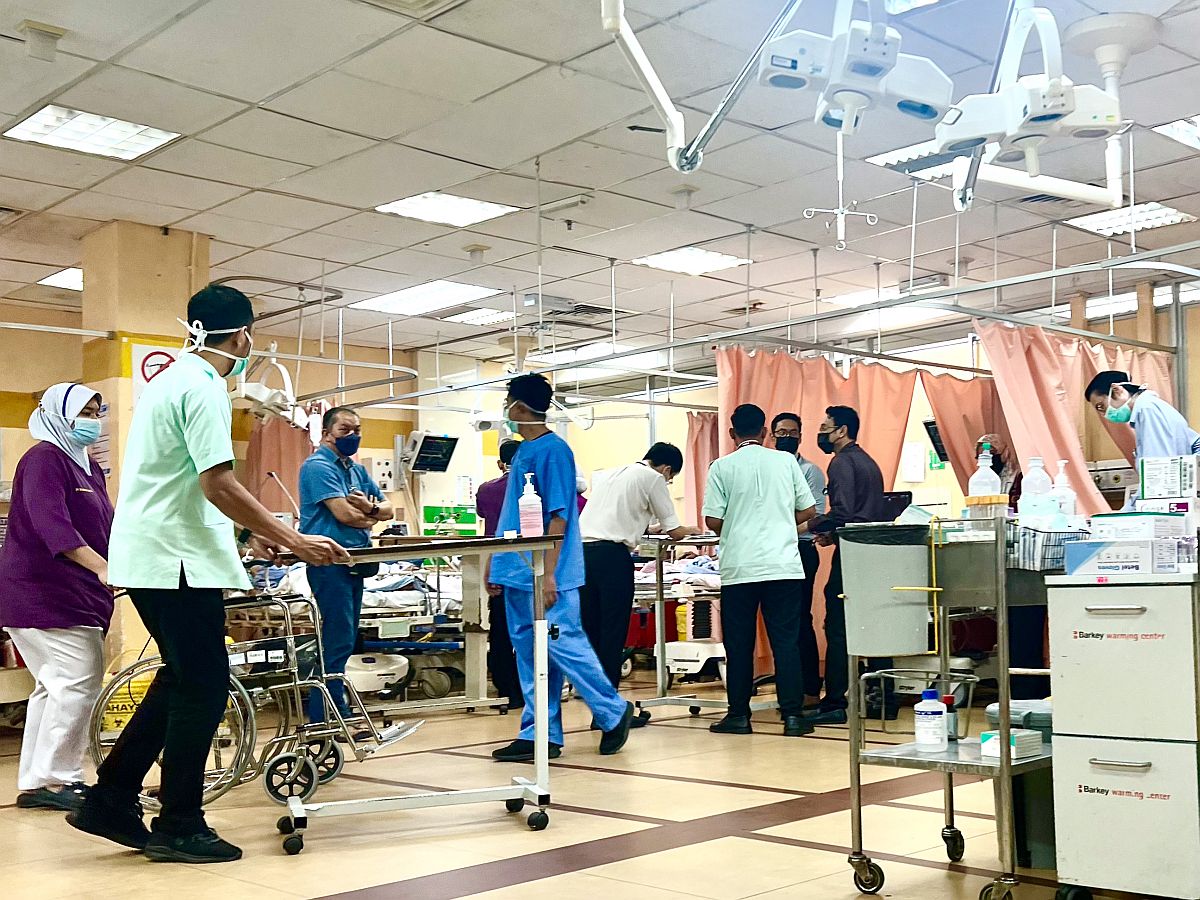
BFM producer Sharaad Kuttan questioned the RM3 billion cut directed by the Treasury for health and education each, citing the Galen Centre for Health and Social Policy’s warning that health spending cuts would result in delayed procedures, medicine shortages, deteriorating facilities, exhausted health care workers, and preventable deaths.
Nurhisham dismissed the think tank’s analysis as “sensationalism”.
“Whatever basic services that we provide is going to be guaranteed. You’re looking at cutting those expenditures that are more discretionary. There’s no thought within the government that we’re going to compromise basic services.
“That is the absolute last resort, well second last; the absolute last resort is cutting salaries entirely. We don’t want to do that either because that supports the economy as well.”
Malaysia’s federal civil service is about 1.5 million-strong.
The Public Service Department (JPA) previously told the Health parliament special select committee in February 2025 that the medical scheme, or U scheme, received among the highest salary scales in the public service compared to other service schemes.
Nurhisham explained that the government prioritised health and education for spending cuts because of a rapid expansion in the budgets for the Ministry of Health (MOH) and the Ministry of Education (MOE) over the last three years.
“Those are the two biggest budgets; that’s why we were looking at those first.”
While claiming that only “discretionary” health expenditure would be cut, Nurhisham said at the same time that trimming spending for events and travel, or freezing hiring of civil servants, was “not quite enough to cover the subsidies”.
The PM’s economic adviser further warned Malaysians that the current situation was akin to just before the Covid-19 pandemic hit.
“I feel like we’re in February 2020 – the virus is just about to hit, we’re hearing this news, but everything’s going on normally. But next month we’re in a major crisis,” Nurhisham told BFM.
“While I would say this isn’t something as dramatically impactful as that was, I do get the same feeling, I won’t say they’re taking this lightly, but people are going on and not changing their behaviours. That’s something we’ll need to try to address.”
He projected June or July as the “real point” when the global energy crisis from the United States-Iran war would be felt on the ground in Malaysia, as businesses would have run out of old stock in terms of raw materials and be awaiting fresh supplies.
“This is a supply crisis. It’s very different from the crises we went through before, which was demand. In a supply-side crisis, you can’t spend your way out of it. You can’t buy something that’s not there.
“I think it falls to the rakyat and businesses as a whole to be mindful about consumption. The more you consume, the less is available for your neighbour or business partner or friends or family. We don’t want to see panic-buying,” said Nurhisham, adding that hoarding is already occurring at the industrial level.
The MOH received RM46.5 billion under Budget 2026, the second biggest allocation after the Ministry of Education’s (MOE) RM66.2 billion.
Although MOH’s RM46.5 billion 2026 budget was a modest 2.8 per cent increase from 2025, the ministry’s 2024 budget marked a 13.5 per cent raise from its RM36.3 billion 2023 allocation.
After the Treasury’s suggestion of an RM3 billion cut, Health Minister Dzulkefly Ahmad said later that he expected higher cuts amounting to 10 per cent of MOH’s budget, or RM4.65 billion.
Former Health Minister Khairy Jamaluddin said yesterday that any amount of spending cuts would affect core services in the already underfunded public health care system, saying nothing in MOH was a “luxury” or an “add-on” that could be cut.
He explained that the MOH’s previous budget raises were used to increase capacity that is now considered core services.


