

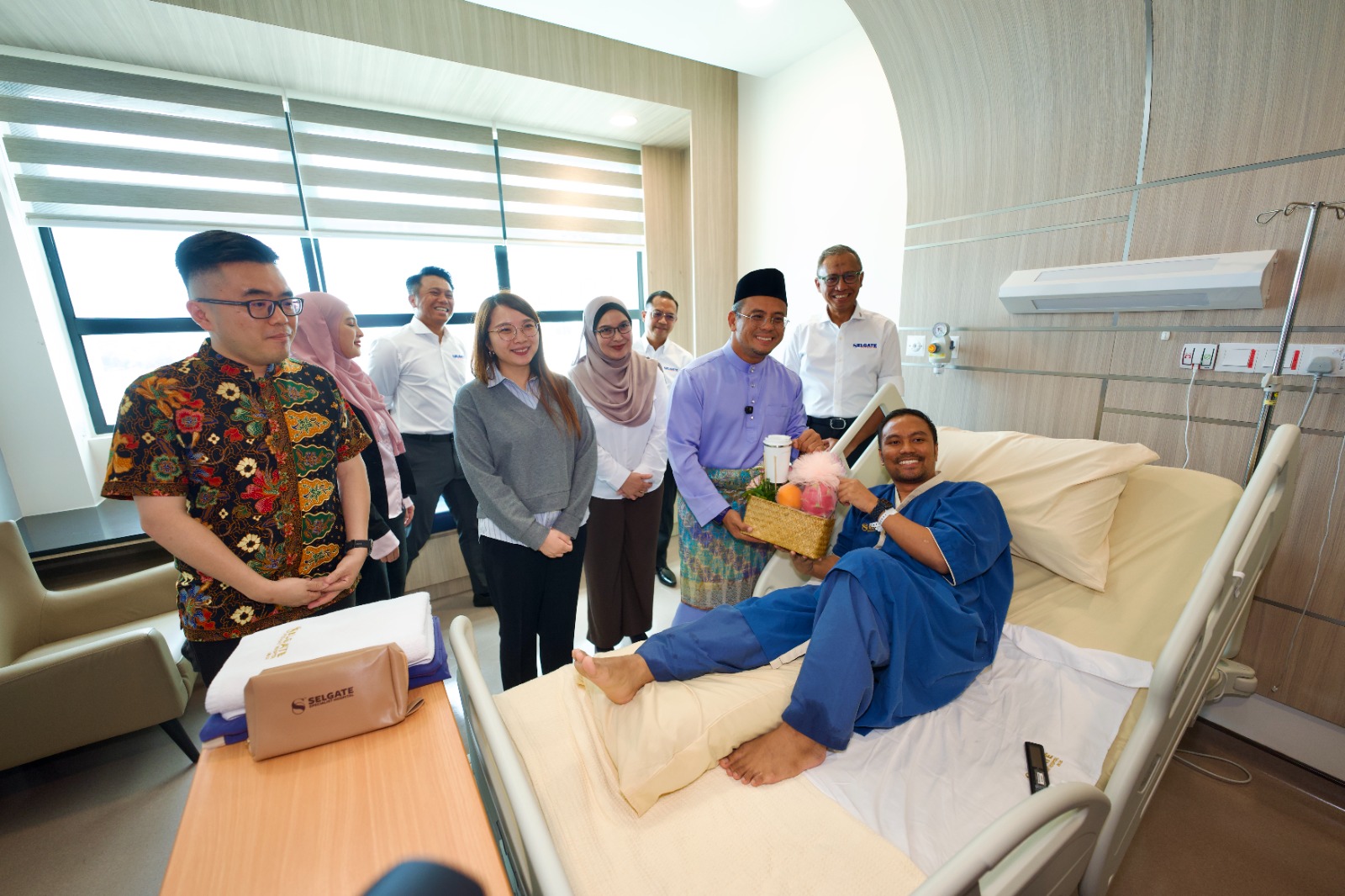
RAWANG, May 22 — Selgate Corporation has launched its first hospital with more than 30 specialist doctors covering over 20 specialty services in an expansion of its health care business.
Selgate Specialist Hospital (SSH) Rawang, a 224-bed multi-discipline facility that began operations last October, is Selgate Group’s first full-fledged hospital, following nearly a decade of operating clinics, pharmacies, laboratories, and health screening programmes across the state.
SSH Rawang is part of Selgate Healthcare’s broader network, which includes hospitals, primary care clinics, dental clinics, diagnostic services, pharmacies, digital solutions, and community programmes.
Selgate Group chief executive officer Noor Hisham Mohd Ghouth said at the official launch of SSH Rawang here today that Selgate’s focus was not merely on building hospitals, but on creating a sustainable health care network.
Selgate’s hospital network is expected to expand with Selgate Specialist Hospital Sepang in the fourth quarter of 2026 and Selgate Specialist Hospital Setia Alam in the first quarter of 2027.
SSH Rawang is also involved in the Ministry of Health’s (MOH) Hospital Services Outsourcing Programme that accelerates access to treatment through collaboration between government and private hospitals.
The hospital is expected to support the development of Integrated Cardiac Services with UiTM Sungai Buloh by the end of the year, combining clinical, academic, and research expertise in an integrated ecosystem.

Noor Hisham said heart disease remained one of Malaysia’s main health challenges, requiring faster and better access to treatment.
“Based on current statistics, heart disease remains one of the country’s main health challenges. Therefore, access to quality and timely cardiac treatment must continue to be strengthened, particularly in northern Selangor,” Noor Hisham said.
The Rawang hospital cost about RM148 million in infrastructure development.
Selangor Menteri Besar Amirudin Shari said SSH Rawang is expected to fill a significant gap in private health care access for residents in northern Selangor, including Rawang, Tanjung Malim, Bukit Beruntung, and nearby industrial areas.
Under the law, only hospitals operated by the MOH are considered government hospitals. Other hospitals, including the National Heart Institute (IJN), university hospitals, and state-owned hospitals, are legally private facilities subject to the Private Healthcare Facilities and Services Act 1998.
Selgate Corporation is a wholly owned subsidiary of the Selangor State Development Corporation (PKNS) that has been mandated by the Selangor state government to spearhead the state’s entry into the health care sector.
MB: Hospital Business Can Generate Revenue For Reinvestment Into Public Health

Selangor’s entry into state-owned hospital services is not intended merely to commercialise health care, but to create a new revenue stream that can eventually be returned to public health programmes without raising taxes.
Amirudin defended the Selangor state government’s move into hospital ownership, saying state-owned health care businesses could help fund public health initiatives if they become profitable.
Selangor’s approach is to build a health care ecosystem that could operate professionally and competitively, while also generating returns for the public.
“I believe that if Selgate becomes strong, part of its profits can be returned to public health programmes, in addition to strengthening its network, becoming an important player, and expanding its services beyond Selangor in the future,” said Amirudin at the launch of SSH Rawang.
“We can return it. The Selangor state government already has a free ambulance programme. I am also looking at a proposal for community-to-community treatment provided by several NGOs at a certain cost. We can invest in them and roll it out.”
Amirudin said demand for private health care services in Selangor showed that residents had the capacity and willingness to seek services beyond public hospitals.
He said the alternative to funding public health through state-owned business returns would be higher taxation.
“It’s not that the state government wants merely to commercialise health care. For us, this is a creative way to return it to the people. If we follow the usual method, then we have to tax more. We tax the people more, take that money, and use it to return it to health,” he said.
“But now, there is high demand for the health sector. We provide services that can be used, but if the margins are truly high and encouraging, then besides expanding the business, we can throw back or return it to the community through the health programmes that we have – Iltizam Selangor Sihat (ISS), eye treatment, critical illness treatment, and various other programmes.”
Amirudin said Selangor aimed to become an “entrepreneurial state” that develops an industry or subsector professionally, while still protecting public welfare.
“This is the balancing act. We are trying to strike a balance between growing as a business and as an industry, with professionalism, while also ensuring that groups in Selangor that need support are given support.”
Selgate’s Future Profits Can Support Health Treatment Programmes

Amirudin said any future return of Selgate profits to public health programmes would only come after Selgate stabilises financially.
“We will ensure that if Selgate makes a profit, there will be a programme that we can implement. Right now, Selangor’s overall public health budget is RM40 million, and all of it comes from taxpayer money through the state government budget,” he said.
“So in future, if it really succeeds and there are profits that can be shared – for example, RM2 million or RM3 million – we will look at how the money can be used, and Selgate can channel it back into programmes as part of its CSR initiatives, or as part of its contribution to the people.”
Amirudin compared the proposed model with Selangor’s use of revenue from plastic bag charges for recycling programmes, as well as Air Selangor’s contribution to the state’s free water programme.
“It’s the same as our collection from plastic bag charges. We collected almost RM20 million. Now, we are using part of that money – about RM6 million – for the SELkitar recycling programme. There are now 400,000 households participating in our recycling programme, with collections by KDEB, Nestle, and several other institutions,” he said.
“It is the same with how we manage Air Selangor. Air Selangor’s free water programme, or Skim Air Darul Ehsan (SADE), is no longer fully funded by the state. Air Selangor also takes out part of its own coffers, its operations, for the Air Selangor programme.
“So, that is what is meant by returning business activities – there is an element that is returned to the people.”
Amirudin said Selgate’s profits could eventually be used to support health treatment programmes, including critical illness and cardiac care, either funded by the state government or provided at cost.
“So, I don’t want to ask this of Selgate in its first year. It will take some time. When Selgate becomes strong, then we will return that money in the form of programmes, such as health treatment programmes and various others,” he said.
“The facilities here can also be used, for example, for critical illness treatment, heart treatment and so on, with the cost borne by the state government, or provided at cost, without the need for service charges and so on.
“All of that can be managed or governed in the future. That is the idea I set out from the beginning – that the profits from this can be returned, but we have to wait for Selgate to become stable first.”


