

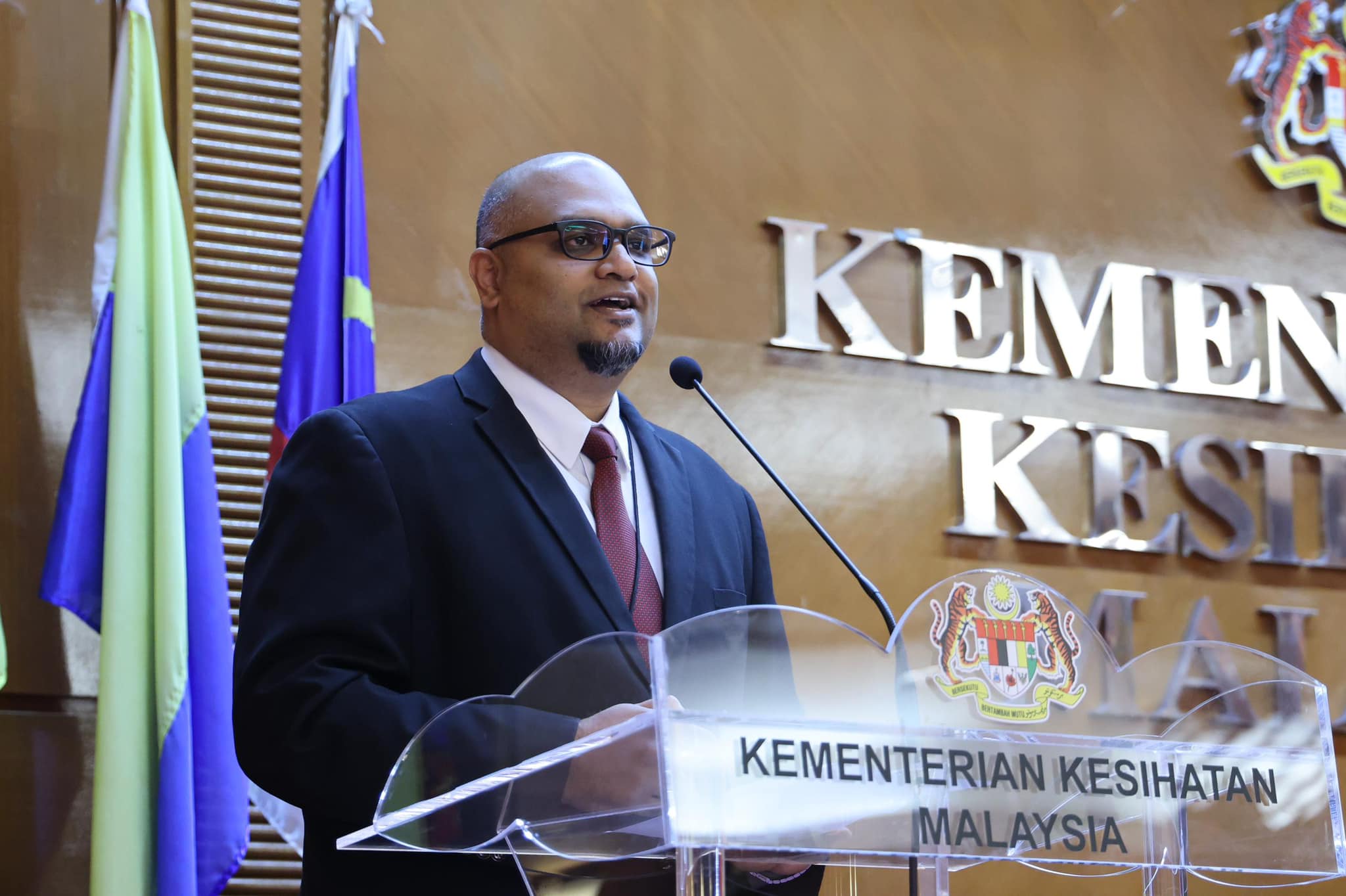
KUALA LUMPUR, Feb 4 — The Ministry of Health (MOH) is expected to implement subscription-based cloud digital systems across public hospitals and health clinics as part of its ambitious digital transformation agenda, a senior official revealed in Parliament.
Dr Mahesh Appannan, the ministry’s director of digital health, told the Health parliamentary special select committee (PSSC) during a July 16 briefing that the transition to off-the-shelf, cloud-based electronic medical record (EMR) systems would be more practical than developing custom systems from scratch.
“We already have experience building our own systems. However, technology evolves so quickly that we need sufficient capacity and capability to develop and maintain such systems,” Dr Mahesh said, according to the Hansard of the session.
“Currently, we have two internally developed systems, but both are at the end of their lifecycle. We simply cannot afford to keep up. Even though we will be subscribing to off-the-shelf systems, we will only use their services. But we are the owners of all the data, storage, and everything else,” Dr Mahesh explained.
“For example, today we may use System A. If we adopt and adhere to all standard protocols, in three years, we could potentially migrate to a better system because all our data tables and other specifications will already be defined. Easier said than done, of course, but looking at the advancements, we truly need external expertise to implement these systems.”
Dr Mahesh was responding to a question from Health PSSC member and Tanjong Karang MP Dr Zulkafperi Hanapi, who asked during the proceedings why the MOH doesn’t develop its own system. Dr Zulkafperi commented:
“Why don’t we develop a single system? From what was explained earlier, it seems like we’re relying on systems already available in the market. So, the MOH wouldn’t be the provider of the system. This means others would still be in charge and could potentially manipulate the system. Why not create one system, similar to Economic Minister Rafizi Ramli’s PADU project, which consolidates all government agencies under one platform?
“For MOH, why not develop one unified system — so that once it’s ready, it can simply be installed across all hospitals? That way, individual hospitals don’t need to develop separate systems again and again. Why not create one large system for all hospitals?”
Dr Mahesh acknowledged the appeal of a single unified system, but argued that leveraging existing market solutions would be more efficient. He highlighted the role of artificial intelligence (AI) in modern EMR systems, particularly in clinical decision support.
“For context, the use of AI in EMR, such as clinical decision support, is now a standard feature. Ten years ago, it was a complex science to develop, but today, it’s much more accessible. For example, if a patient comes in with an allergy, the system can detect it and alert the provider, saying, ‘Hey, this person has an allergy.’
“However, this type of clinical decision support requires a very robust system. At present, we don’t have the capability to build such systems ourselves,” Dr Mahesh said.
He added that nearly half of private clinics in Malaysia have already adopted digital systems available in the market, demonstrating the practicality of utilising existing solutions. “We don’t have to reinvent the wheel,” Dr Mahesh said, stressing that while the ministry will rely on external platforms for infrastructure, it will retain full ownership of its data.

Currently, only 14 per cent of public hospitals, 18 per cent of health clinics (klinik kesihatan), and 10 per cent of dental clinics in Malaysia have EMR systems, with the majority still reliant on manual processes.
“In hospitals, only 14 percent of them currently have EMR systems, and these cover four different types of systems. As of now, 86 per cent, or 128 hospitals, still operate manually. This includes 11 major hospitals, which are state hospitals.
“Secondly, the current status of health clinics. Only 18 per cent of our health clinics have EMR systems, while 82 per cent, or 893 clinics, are still operating manually. As for dental clinics, only 10 per cent currently have EMR systems, and 643 dental clinics are still relying on manual processes,” Dr Mahesh said.
Under the 12th Malaysian Plan, the federal government has allocated funding to digitalise 16 hospitals by 2024, including Kuala Lumpur Hospital (HKL). Additional funding will be sought under the 13th Malaysia Plan to expand the programme to larger state hospitals and ultimately cover all public health facilities by 2028.
“The phased implementation is needed to manage financial and logistical challenges,” Dr Mahesh said.
“Cloud-based systems are easy for us to deploy. However, to subscribe to these systems, we need budget allocations and to equip these health facilities with computers, we require financial resources.
“That’s why we are rolling this out in phases, so as not to overwhelm the financial resources of the MOH and the government.”
Dr Mahesh said the transition to digital systems is also expected to alleviate administrative burdens on health care workers, particularly nurses, who currently spend a large portion of their time on manual record-keeping.
Health PSSC chairman Suhaizan Kaiat shared that during a meeting with a nurses’ association, he was informed that 80 per cent of a nurse’s duties involve record-keeping tasks. He questioned whether this figure was accurate.
Health director-general Dr Muhammad Radzi Abu Hassan, who was also present at the proceeding, acknowledged that nurses are burdened with record-keeping tasks, particularly in health clinics, where they are required to document patient numbers and other information after providing care.
However, he felt that the figure of 80 per cent might be an overestimate, although he recognised that the process is still demanding for nurses.
“But with digital systems in place, these tasks would become more autonomous and less reliant on manual reporting,” Dr Muhammad Radzi said.


