

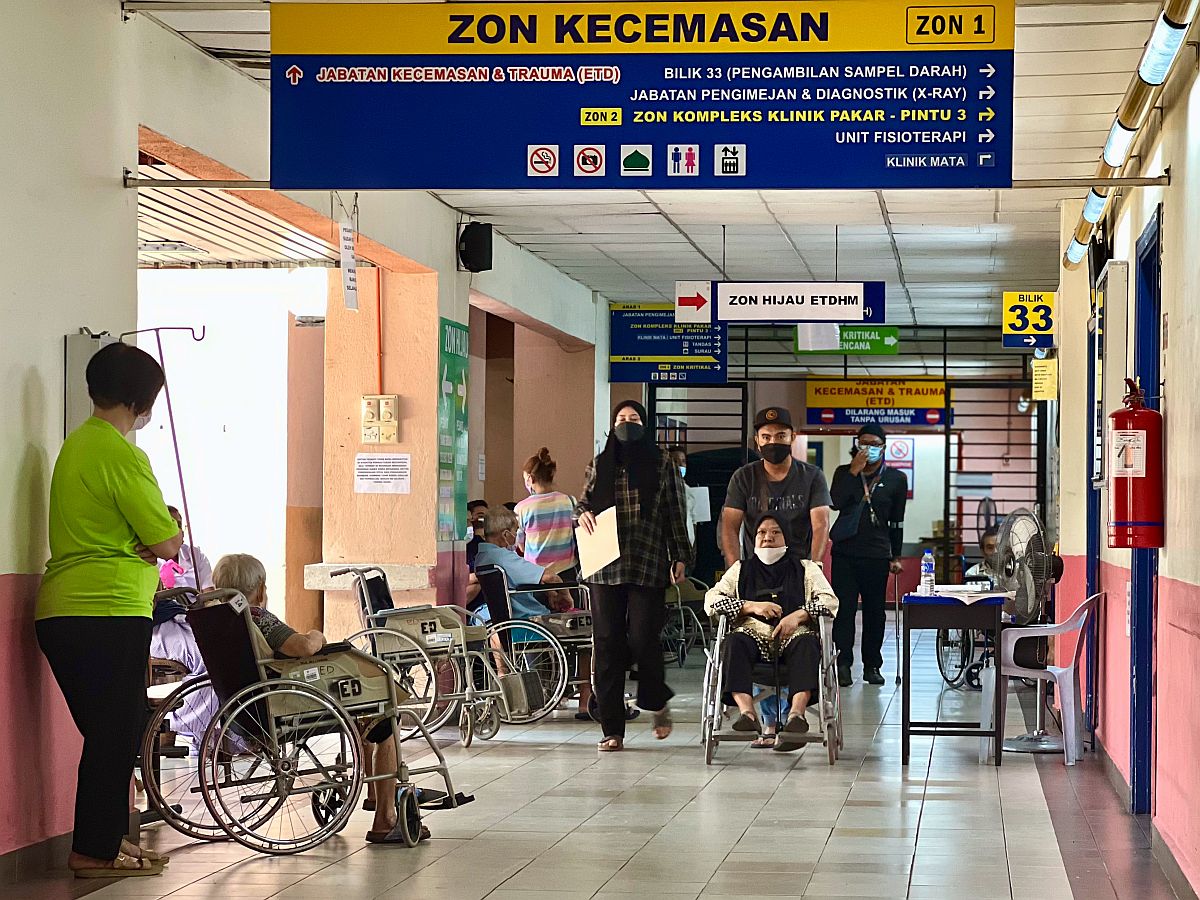
Malaysia’s health care workforce debate in recent weeks has been centred around one theme: systemic fragmentation.
Many view a new independent body as the solution, but before creating another institution, we should ask whether the real problem is governance failure within existing institutions.
Malaysia is certainly not suffering from too few institutions, but the core issue is weak coordination and accountability within the institutions we already have.
How Did We End Up Here?
The idea for a Health Service Commission (SPK) to appoint health care workers for the Ministry of Health (MOH) has been around for more than 15 years since 2009 to address the same issue: Lack of human resources.
The conclusion in 2009? The Cabinet decided that the development of such a commission was to be deferred with refinements recommended to be made by MOH, Public Service Department (JPA) and Public Services Commission (SPA).
More than 15 years later, after a bout of surplus of health care workers (medical doctors at least), the same issue repeats itself and we are back to square one.
The Health parliament special select committee (PSSC) subsequently held consultations with stakeholders in February 2025 to reconsider the proposal for SPK.
The conclusion in 2025? SPK was to be deferred with more refinement suggestions.
Now, a recent statement by Health director-general Dr Mahathar Abd Wahab suggests that the problem of our health care system is rooted in the inherent nature of the government system itself. Various ministries and departments. All operating in parallel silos, separated by bureaucracy.
The DG suggested the establishment of an independent “National Human Resource for Health (HRH) Governing Committee” with the development of a unified national health workforce information system.
The Malaysian Medical Association (MMA) suggested the same using a similar term. Hartal Doktor Kontrak (HDK) interpreted this as a call for the Health Service Commission idea to be reinstated. Ex-senator Dr RA Lingeshwaran opined the same.
SPK To Be Modelled According To SPP
The Ministry of Education (MOE) already has its own commission: the Education Service Commission (SPP), which appoints teachers in government schools as well as lecturers in polytechnics and community colleges in Malaysia.
By 1974, teachers comprised about 25 per cent of the whole public service (around 60,000) – the main reason why it was considered a necessity to have a separate commission. It took two to three years from the royal commission to the establishment of SPP in 1974.
According to JPA, as of 2024, MOH contributes to about 18 per cent (318,885) of the total civil servants, only behind MOE still who is at 31 per cent (543,608). To handle over 540,000 personnel, SPP needs 13 representative commission members and around 250 civil servants to run the whole commission.
A 13-member commission appears feasible, given that Malaysian Medical Council (MMC) is structured similarly (MMC needs 67 posts to run, by the way). Using simplistic logic, we therefore need 150 for SPK given the numbers. Can we afford the financial and opportunity cost?
SPK In Essence
The terms of reference (TOR) suggested (following the precedence of SPP) are as follows:
- Handling the appointment of civil servants to permanent, contract, temporary transfer and secondment
- Confirmation in service
- Emplace on pensionable establishment
- Permanent transfer of civil servants
- Acts as the Promotion Appeal Board
- As the Disciplinary Authority
In practical terms, it tells us that legally, SPK may be limited only to appointment and service matters of health care workers. It would not provide authority for structural reform or autonomy of in-service training. Perhaps this was the way MMA was referring to when they mentioned “a committee without teeth”.
This was exactly what the Health PSSC concluded. The power for new posts, service organisational structure, retirement, and in-service training still lies within JPA and the Ministry of Finance (MOF). Without wider reform, what practical problems would SPK thus resolve?
Role Of MOH?

DG Mahathar said blame must be placed on interagency misalignment.
On JPA’s side, they claimed to have increased the number of approved posts. On paper, it is well supported. In 2024, MOH has more than 24,000 new permanent posts compared to 2023.
Attentive readers would have noticed the filling of these posts has not kept pace in recent years.
Despite a sharp increase in approved positions, vacancy numbers rose from 10,419 in 2017 to 54,362 in 2024, while the fill rate fell from 96 per cent to 83 per cent, despite MOH having around 30,000 contract officers (across all schemes). This raises the question of why these vacant posts cannot be matched to the pool of contract officers.
The filling of posts usually falls under the jurisdiction of SPA.
However, in the Health PSSC meeting in March 2025, the Director of Medical Development Division mentioned that for medical officers, the power to appoint has been delegated to the MOH’s Human Resources Division (BSM) instead. It has the authority to appoint without SPA involvement.
This suggests that the challenge now is no longer creating new posts but filling them and retaining the workforce.
Role of MMC?

It is important to note that the Health DG of MOH is the president of MMC and MMC members include university representatives – well distributed between public and private universities.
This should already provide an avenue for dialogue and coordination in voicing opinions & concerns regarding medical faculties. The question then arises whether this existing platform to coordinate between MOH, MMC and universities is underused?
MMC is responsible for the registration of provisional, full registration and annual practicing certificate. The nature of it should allow us to have real time data of current practicing doctors in Malaysia to guide future planning and policy decisions.
Too few graduates? Maximising the capacity of medical faculties benefits universities.
Too many graduates? The government has shown that it can impose a moratorium quota and we can apply it again when it is needed.
Faculty worried about quality with high intake? MMC has published the 3rd edition of its Standards for Undergraduate Medical Education (effective after 1st August 2026) alongside the 1st edition Minimum Qualification for Entry into Medical Programme (Effective 29th October 2024). MMC has influence over not only the number of graduates produced but also the quality.
These recent MMC documents suggest that MMC is being utilised for coordination between MOH and the Ministry of Higher Education (MOHE). Whether DG Mahathar thinks it is not adequate, that there are some ways MOHE will interfere centrally perhaps, it is not entirely clear to me what he means by the pipeline being fragmented at this junction but the potential for expansion of use is already in place.
MOH Is Working On It

It would be unfair to say that MOH is doing nothing. However, the reality is after more than 15 years, clearly articulated workforce requirement data across medical facilities still appears absent – or at least appeared to be absent when the Health PSSC meeting was convened back in March 2025.
I hope we already have that “magic figure” of what enough posts mean to MOH with financially credible justifications. Without this, accountability must be taken by MOH in terms of human resource management.
With all the talks on health care facility norms, outfit, projection and health labour market analysis to be done by the Health Performance Unit (HPU) at MOH back in 2025, one can only hope this is the pipelines at least.
Where Reform Should Start
There are still areas I have not touched which would make this even longer than it already is, but I believe I should stop here. This article did not even touch on other health/allied health counterparts.
I opine as follows:
- I echo Dr Musa Nordin and Dr Zulkifli Ismail’s opinion that there exists “operational execution failure” within MOH itself – whether it is due to incompetence or complexity of the matter is up for debate.
- It is not wrong to say that the whole system has its flaws, but we must be accountable and improve upon what is within our jurisdiction.
- If we were to proceed with SPK, a major overhaul of the legalities needs to be done, including amendments to the Federal Constitution and the Service Commission Act 1957. The overhaul should expand the jurisdiction of SPK to be wider than that of SPP.
- Data is the way forward.
Malaysia already has the institutions it needs. What we need are clear responsibilities, coordination and accountability. Until then, any structural reform effort risks becoming just another fragment of an already fragmented system.
The author is a houseman. CodeBlue is providing the author anonymity because civil servants are prohibited from writing to the press.
- This is the personal opinion of the writer or publication and does not necessarily represent the views of CodeBlue.


