

I still remember his face. He was an elderly gentleman admitted with Covid-19 pneumonia.
During my afternoon review as the on‑call anaesthesiology medical officer, he was cheerful and talkative. He told me, with quiet pride, about his children — how they were also working in health care, how much they cared for him, how he was looking forward to going home.
I was only a few months into my posting, on call alone, and I reassured him that we would do our best. But in the middle of the night, everything changed.
His condition deteriorated rapidly. We made the decision to intubate. Looking back now, I can see how many things went wrong in that brief, chaotic window: my inexperience, system issues, the stress of managing a critically ill patient in the middle of the night when I was totally drained out. The intubation process was delayed, and he suffered a hypoxic event.
I still remember his jerky movements and facial twitching afterwards, signs of hypoxic ischaemic encephalopathy. The monitors kept beeping, but the loudest sound in the room was my own internal voice: this is my fault. Someone is going to lose their father because of me.
That night felt impossibly long. The days that followed blurred into each other, but the guilt did not. Even now, five years later, during long drives at night, the memory returns with painful clarity.
I know now that this experience has a name: the second victim phenomenon. At that time, all I knew was that I felt very alone.
After Kuala Krai: When Healers Are Left Behind
Earlier this year, I wrote an article for CodeBlue on the Kuala Krai tragedy — the death by suicide of a young house officer, and what it revealed about how we treat our own after adverse events and workplace trauma.
I wrote about how we mobilise entire systems for root cause analyses when a patient dies, yet often leave the clinicians involved to cope with their emotional fallout alone.
In many ways, I was speaking to my younger self — the medical officer who walked out of that ICU feeling like a failure.
Shortly after the article was published, I was approached by Dr Afifi Arshad, the honorary secretary of the College of Anaesthesiologists, on behalf of Dr Yong Chow Yen, the president of the College.
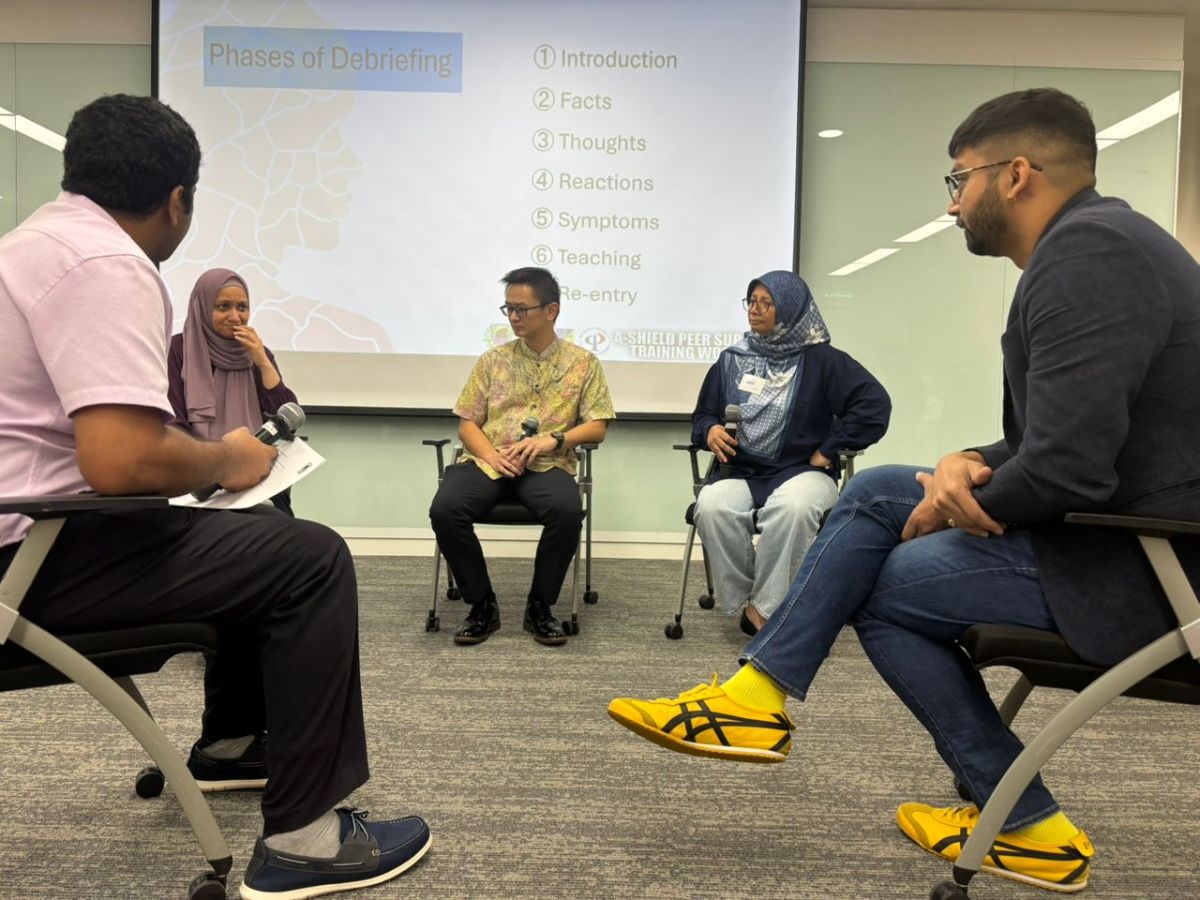
They invited me to attend the A‑Shield (Anaesthesiology – Supporting Healthcare Individuals with Empathy, Leadership and Dedication) Peer Supporter Train‑the‑Trainers Workshop, a two‑day programme held on April 25 and 26, 2026, at the Academy of Medicine Malaysia, Putrajaya, organised by the Malaysian Society of Anaesthesiologists (MSA) and the College of Anaesthesiologists (COA), in collaboration with the Malaysian Society of Clinical Psychology.
For me, it felt like a full circle: from writing about second victims to helping build a system that might finally support them.
A‑Shield: From Guidebook To Ground Movement
In 2024, MSA and COA launched the A‑Shield Peer Support After Adverse Events guidebook, a practical manual to help institutions establish second victim support programmes. It signalled a clear shift: from quietly acknowledging that adverse events harm clinicians too, to proactively doing something about it.
The recent Train‑the‑Trainers workshop was the next step in this journey. Over two days, anaesthesiologists and intensivists from all over the country gathered — the Head of Service of Anaesthesia, Heads of Department, senior consultants — and one somewhat nervous master’s trainee who felt very small in such distinguished company.
Yet the tone was strikingly open. Rather than a one‑way, top‑down course, it became a shared, honest conversation about pain, responsibility, and healing in our profession.
We explored core elements of the A‑Shield approach: understanding second victim experiences, communication and emotional support, psychological first aid, just culture and medicolegal issues, and the practical steps of setting up peer support programmes in our own institutions.
The Power of Validating Pain
The session that stayed with me most was about how we actually talk to a colleague after an adverse event.
A clinical psychologist reminded us that our first task is not to fix or minimise, but to validate their feelings. That means resisting the urge to quickly say: “It’s okay, it happens to everyone”, or “You did your best, don’t worry.”
Although well‑meant, these phrases can unintentionally shut down the person’s emotions. They act like emotional “jammers”, drowning out what the colleague is really trying to say.
The message received becomes “This is not as serious as you think,” or “We don’t have space for your feelings.”
What second victims often need instead is someone who can sit with their discomfort and say, “What you’re feeling makes sense,” or “Tell me what keeps replaying in your mind.” They need a listener, not a fixer.
During a role‑play on defusing after a critical event, I played the peer supporter. There was a moment when I nearly defaulted to “You did all you could,” but I stopped myself and said, “It sounds like you’re carrying a lot of guilt. What is the hardest part for you right now?”
That simple shift — from reassuring to genuinely listening — opened up the conversation. It showed me how easy it is to silence someone’s pain, and how powerful it can be to give that pain a safe place to exist.
Peer support is not easy work. It requires emotional maturity, boundaries, and knowing when to refer for formal psychological care. But the workshop made it clear that with good frameworks and training, it is both possible and essential.
Just Culture: Beyond Blame, Toward Learning
Another core concept that resonated with me was just culture. We often talk about “no blame culture,” but just culture goes further.
It recognises that both organisations and individuals have responsibilities, that most errors occur within systems that make it easy to do the wrong thing, and that the goal is to reduce risk and improve systems—not simply to find someone to punish.
Just culture does not excuse reckless behaviour, but it also does not equate honest human error with moral failure. For someone who has lived through intense self‑blame, this distinction matters deeply. It is the difference between a system that says, “You are the problem,” and one that says, “We have a problem; let’s understand it together.”
The A‑Shield framework sits comfortably within this philosophy: investigations focus on facts and processes, while peer support focuses on the person. Both are essential for a truly safe and humane health care system.
Feeling Small, Yet Seen
Being the only master’s trainee in a room full of senior distinguished leaders, I initially wondered if I belonged there.
But throughout the workshop, I was repeatedly encouraged and included. Consultants asked for my views, listened genuinely, and reminded me that as a trainee, I represent the future of our specialty.
Several said that my presence mattered precisely because younger doctors are often the ones most affected and least supported when things go wrong.
That experience — of being seen not just as a learner, but as a future leader and as someone who had personally walked through the second victim experience — was quietly healing.
A Call To Action For Our Fraternity
I am deeply grateful to Dr Yong and her team at the COA and to the MSA, for their leadership in championing second victim support.
The A‑Shield guidebook and this first Train‑the‑Trainers workshop mark the beginning of a cultural shift from silence to structured support.
My hope is that:
- Every anaesthesia and ICU department in Malaysia will work towards establishing a formal peer support programme.
- Clear referral pathways to clinical psychologists and psychiatrists will be developed and normalised.
- Other disciplines such as emergency, obstetrics, surgery, paediatrics, and internal medicine will be inspired to adapt similar programmes for their own teams.
Most of all, I hope that the next junior doctor who lives through a night like mine will not have to process it alone in the dark.
René Leriche wrote, “Every clinician carries within themselves a small cemetery, where from time to time they go to pray.” The A‑Shield workshop did not erase my cemetery.
The elderly patient I failed to intubate in time will always be there. But now, I no longer feel that I must stand there alone, condemned by my own guilt.
Instead, I see that these cemeteries can become places of learning, solidarity, and quiet hope, if we are brave enough to walk through them together.
For colleagues, departments or institutions who are interested to learn more, collaborate, partner, or seek advice on setting up a second victim peer support programme, I warmly encourage you to reach out to the A‑Shield steering committee through the MSA Secretariat at secretariat@msa.net.my.
This is a living movement, and the steering committee is keen to walk alongside teams at different stages of their journey.
Dr Muhammad Yassin is a third‑year anaesthesiology master trainee and a passionate advocate for health care reforms and improvements.
- This is the personal opinion of the writer or publication and does not necessarily represent the views of CodeBlue.


