

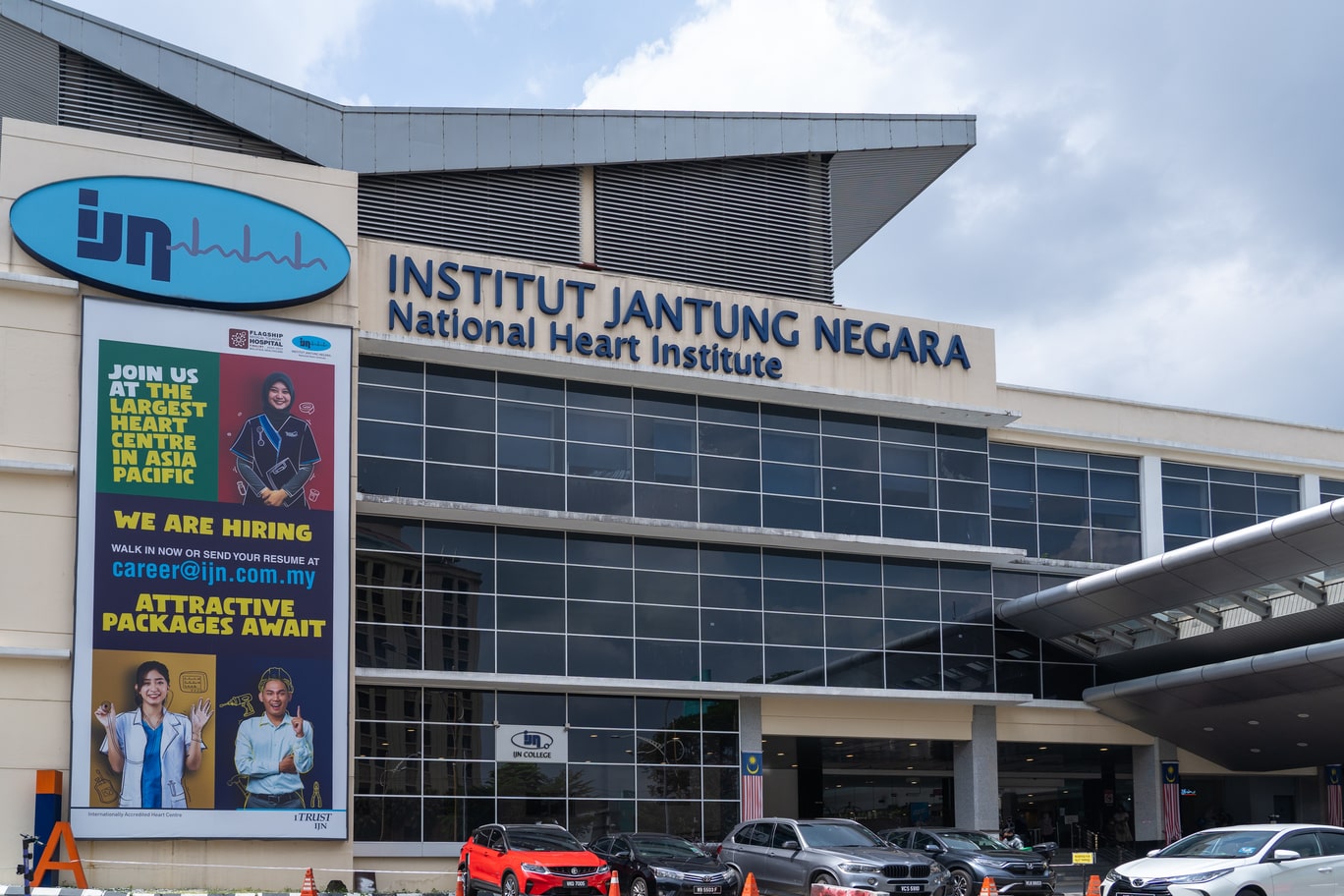
KUALA LUMPUR, Oct 21 — Prime Minister Anwar Ibrahim, in his Budget 2025 speech, surprisingly declared that government pensioners can continue their care at the National Heart Institute (IJN).
Anwar told the Dewan Rakyat last Friday that government patients – particularly those aged 65 years and older – would be allowed to stay at the top cardiac centre owned by the Minister of Finance Incorporated (MOF Inc.), possibly indicating a halt to IJN’s discharge exercise for pensioners to the Ministry of Health (MOH).
“By allowing patients to remain in our care, the government ensures uninterrupted, high-standard treatment for those who need it most,” IJN said in a statement last Saturday.
Since early this year, multiple pensioners have complained about their discharge from IJN and subsequent referral to public hospitals due to the government’s cost-cutting exercise.
CodeBlue reported that approximately 4,000 government patients from the MOH have been discharged from IJN’s outpatient services this year so far.
The MOH is the payer for government-dependent patients at IJN comprising three categories: federal civil servants, retired federal civil servants, and underprivileged patients.
According to data from the government’s data portal, pensioners comprised the biggest chunk of payments made by the MOH to IJN Sdn Bhd (IJNSB) from 2014 to 2018. Similarly, over the last two years, pensioners formed the largest group of patients compared to government servants and underprivileged patients.
In 2023, out of 48,144 government-dependent patients, 28,522, or 59 per cent, were pensioners.

The MOH’s payments to IJNSB jumped about 68 per cent in the past decade from RM361.8 million in 2013 to RM606.5 million last year. This rate of increase superseded the 37 per cent rise in patient visits covered by the MOH in the same period from 170,310 in 2013 to 233,885 in 2023.
Interestingly, even though patient visits dropped slightly from 2022 to 2023, MOH’s payments to IJNSB increased by 12 per cent.
Just before and after the Covid pandemic, the number of IJN patient visits paid for by the MOH was similar at 234,422 in 2018 and 233,885 in 2023. But the MOH’s payments to IJNSB rose 29 per cent in that period.
IJN Holdings group chief executive officer Prof Dr Mohamed Ezani Md Taib told the media last October 10 that IJN is planning to raise fees by between 10 per cent and 40 per cent for government patients, as its fee structure has been fixed at the same rate for more than two decades since 2003.
Given that IJN’s fees have remained unchanged, the jump in MOH’s payments to IJNSB – bigger than the rate of increase of patient visits – is possibly due to patients being sicker now than a decade ago and requiring more care, including medication. IJN often provides patients innovator drugs, as seen in prescriptions shared by pensioners with CodeBlue.
CodeBlue understands that based on a 2023 analysis of 10 drugs with the highest usage and claims by IJNSB totalling RM177 million, the prices of these innovator medications charged by the cardiac hospital to MOH are between 42 per cent and a whopping 4,323 per cent higher than the ministry’s procurement. If patients were to be treated in MOH facilities, the ministry estimates savings of RM130 million for the same period and drugs.
Statins that are used to lower cholesterol like atorvastatin (brand name: Lipitor), for example, are 4,323 per cent or 3,131 per cent more expensive at IJN, depending on dosage, than the prices paid by MOH procurement. IJNSB’s bill to MOH for pantoprazole (brand name: Controloc), a proton pump inhibitor which lowers stomach acid, is 2,010 per cent higher than MOH procurement. Empagliflozin (brand name: Jardiance) – which mainly treats type 2 diabetes, as well as heart failure and chronic kidney disease – is charged by IJNSB to MOH 201 per cent higher than MOH’s procurement.
A pensioner, who complained about his discharge from IJN and subsequent referral to an MOH cardiac centre in a letter to CodeBlue last February, had pointed out that the MOH did not have a number of the drugs that he was on at IJN.
Besides drugs, an increase in MOH’s payments to IJNSB may also be driven by the rising cost of consumables. Dr Ezani had said IJN can charge more for consumables, even as its fee structure for the government is fixed based on facility costs and staff numbers from over two decades ago.
In his October 10 media briefing, Dr Ezani, who is also a senior consultant cardiothoracic surgeon, noted that patients are increasingly presenting complex conditions, hence IJN’s plans to diversify into non-cardiovascular services like building a new stroke centre.

From 2013 to 2023, the number of government-dependent patients at IJN grew at nearly 3 per cent from 46,835 to 48,144, while patient visits increased by about 37 per cent from 170,310 to 233,885. Based on CodeBlue’s calculations, the number of visits per patient rose from 3.6 to 4.9 in that period.
Despite the significant reduction of nearly 10,000 government-dependent patients to 42,623 in 2022 from the previous year, 237,354 patient visits were recorded in 2022, translating to an average of 5.6 visits per patient. Hence, even though patient numbers fell about 19 per cent in 2022 from the previous year, MOH’s payments to IJNSB only dipped by 2 per cent.
This year, up to May 31, the MOH paid IJNSB about RM249 million for 93,495 patient visits, according to Health Minister Dzulkefly Ahmad’s written Dewan Negara reply on July 24 to Senator Mustafa Musa. From 2013 to September 2024, the MOH received claims totalling RM5.6 billion from IJNSB over the near 12-year period.
CodeBlue’s extrapolations from five months of data show that for 2024, the MOH may end up paying IJNSB about RM597.5 million for 224,388 patient visits – if the discharge exercise for government patients continues until year end and isn’t abruptly halted, following Anwar’s announcement.
These 2024 projections are lower than the RM606.5 million paid for 233,885 patient visits in 2023, presumably due to the IJN’s discharge exercise and not because patients are healthier and visit the hospital less frequently.
For Budget 2025, the MOH received an allocation of RM6.7 billion for development expenditure, an increase of just RM670.5 million from 2024. According to the 2025 estimated federal expenditure document, about RM2.4 billion has been allocated for PPP/PFI (public-private partnership/ private finance initiative).
Outsourcing to IJN alone may cost roughly RM600 million next year, based on 2023 and projected 2024 figures. The RM600 million payment to IJNSB for 2025 estimated by CodeBlue excludes IJN’s proposed fee increase of between 10 per cent and 40 per cent.
If MOF Inc. approves IJN’s fee review, then the MOH may very well have to pay IJNSB between RM660 million and RM840 million next year. This is 358 per cent to 483 per cent higher than the RM144 million allocation for the ministry’s patient outsourcing exercise to all other non-MOH hospitals: private, university, and military hospitals.
The 2025 payments to IJNSB may end up consuming the entire RM671 million increase for MOH’s development budget. Anwar, who is also finance minister, did not touch on IJN’s proposed fee hike in his Budget speech.
IJN has big plans for expansion, comprising not just another block at its facility at Jalan Tun Razak, but also a new integrated disease centre covering multiple specialties and establishing a network of partner hospitals both within and outside Kuala Lumpur.
During his October 10 media briefing, Dr Ezani repeatedly stressed the business pressures on IJN from mergers and acquisitions among private hospital operators like IHH Healthcare Bhd, KPJ Healthcare Berhad, and Asia OneHealthcare.
Even though MOH is the payer for government patients at IJN, the two entities are closely linked, as Health director-general Dr Muhammad Radzi Abu Hassan is on IJNSB’s board of directors, while the company chairman is his predecessor, Dr Noor Hisham Abdullah. Former MOH secretary-general Chen Chaw Min is chairman of IJN Holdings Sdn Bhd.


