

SUNGAI JAWI, June 13 — Rising feed costs, geopolitical uncertainty, and projections of prolonged market disruptions have not stopped one of Malaysia’s largest poultry breeding companies from expansion.
At Syarikat Sin Long Heng Breeding Farm Sdn Bhd’s (SLH) breeder farm near the Valdor Industrial Estate on mainland Penang, nine multi-storey breeder blocks are being developed as part of the company’s long-term expansion plans.
Each three-storey breeder house is designed to optimise land use and accommodate up to 18,000 breeder chickens. The buildings are equipped with automated feeding and watering systems, ventilation controls, and other technologies aimed at improving productivity and biosecurity.
“This is the direction the industry is moving towards,” SLH director Terry Tan Chee Hee told CodeBlue during an exclusive tour of the farm on June 23.

Newly constructed multi-storey breeder houses at SLH’s breeder farm in Sungai Jawi, Penang. Each three-storey breeder house is designed to accommodate about 18,000 breeder chickens. Photo by Saw Siow Feng for CodeBlue. 
Farm workers carry trays of hatching eggs collected from breeder hens at SLH’s breeder farm in Sungai Jawi, Penang. The eggs are transported to the nearby hatchery for incubation into day-old chicks. 
Day-old chicks await delivery to poultry farms. The chicks are typically dispatched within 24 hours of hatching. Photo by Saw Siow Feng for CodeBlue.
SLH’s expansion comes as the Agriculture and Food Security Ministry (KPKM) expects elevated agricultural input costs and supply-chain disruptions linked to geopolitical tensions and instability in the Middle East to persist for up to two years.
Yet Tan does not appear overly concerned by the current uncertainty. Although the project was delayed for nine months during the Covid-19 pandemic, which also saw construction material costs double, he expects all nine breeder blocks to be operational by next year.
“The first block started operations in 2024. We currently have two blocks that are operational, and a third block should be ready next month. We expect one new block to be operational roughly every two months,” Tan said.
The nine breeder blocks are designed to accommodate different batches of breeder chickens at various stages of their 18-month production cycle, allowing production to continue on a staggered basis throughout the year.
“We’re going to have nine batches per cycle. The whole cycle for the breeders is 18 months, so we divide that into nine batches across the nine blocks. That means we have a different batch entering the cycle about every two months.
“That includes the time needed for cleaning and sanitising between flocks,” Tan said. “That’s how we plan for one breeding season.”

Newly hatched chicks at SLH’s hatchery before being transported to broiler and kampung chicken farms across Malaysia. Photo by Saw Siow Feng for CodeBlue. 
Hatching eggs are stored under controlled conditions before incubation at SLH’s hatchery in Sungai Jawi, Penang. Unlike table eggs, these fertile eggs are incubated into day-old chicks supplied to poultry farms. Photo by Saw Siow Feng for CodeBlue. 
SLH director Terry Tan Chee Hee explains the hatchery’s expansion plans during CodeBlue’s visit in Sungai Jawi, Penang. The company plans to install additional incubators to increase monthly chick production. Photo by Saw Siow Feng for CodeBlue.
The expansion extends beyond the breeder farm.
At SLH’s nearby hatchery, the company is preparing to more than triple its incubation capacity with the installation of a new incubator next month, increasing monthly chick production capacity.
The upgrade is intended to support the expansion of the breeder farm and meet growing demand for day-old chicks. Renovation works are currently underway to prepare for the installation and scaling up of hatchery operations.
Tan said the investment could not be delayed despite ongoing economic uncertainty because the hatchery is an essential part of the production chain.
“This is something we cannot put on hold because production is ongoing,” he said. “We cannot have eggs but no incubators. We have no choice but to proceed.”
Inside A Poultry Breeder Farm

A farm worker collects fertile hatching eggs. The eggs are collected four times a day before being cleaned, fumigated and transported to the nearby hatchery for incubation. Photo by Saw Siow Feng for CodeBlue. 
Breeder hens begin laying eggs at around 25 weeks of age and produce about 180 hatching eggs over their production cycle. Photo by Saw Siow Feng for CodeBlue. 
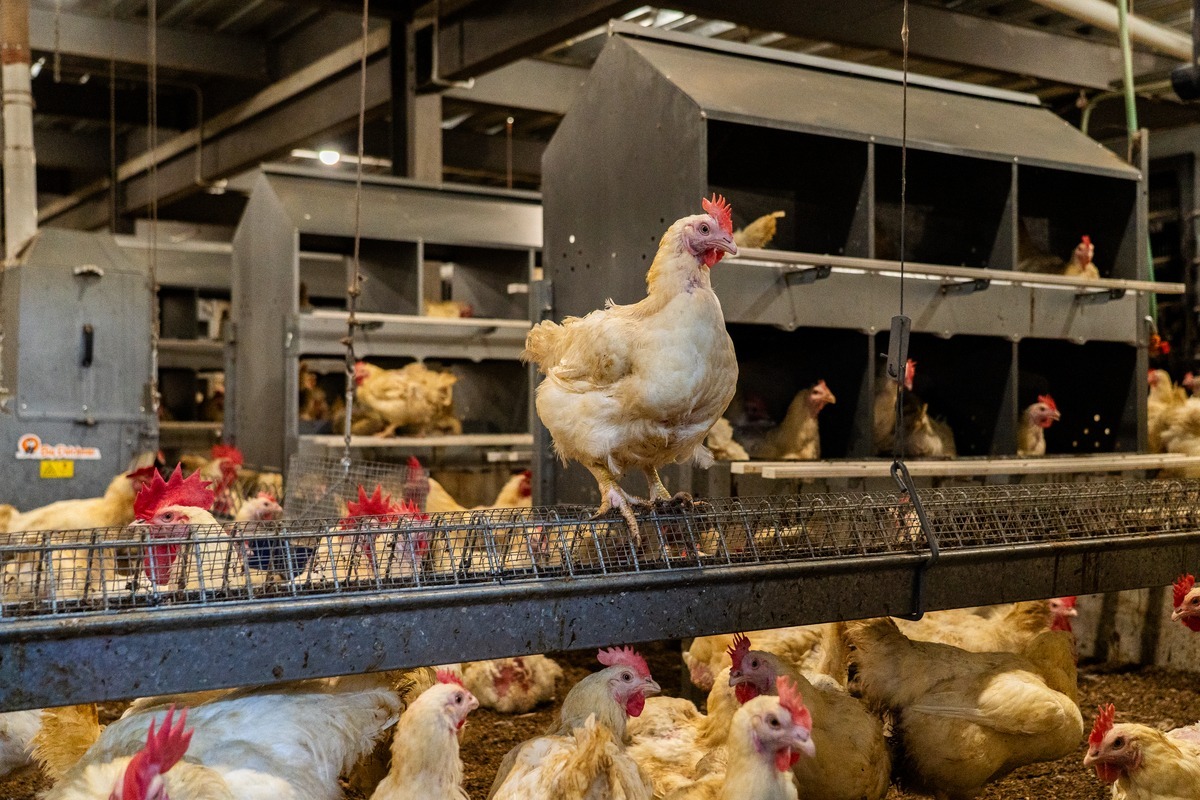
Inside one of SLH’s multi-storey breeder houses, where breeder hens are raised to produce fertile hatching eggs. About 10 per cent of the breeder flock are roosters, allowing the farm to rely on natural mating. Photo by Saw Siow Feng for CodeBlue.
Unlike broiler farms that raise chickens for meat, SLH’s breeder farm raises breeder chickens that produce fertile hatching eggs. These eggs are sent to the company’s nearby hatchery, where they are incubated into day-old chicks supplied to broiler and kampung chicken farms, rather than being sold for consumption.
Each three-storey breeder block is designed to house about 6,600 breeder chickens per floor, around 10 per cent of which are males, with 2 to 2.5 square feet allocated to each bird. Tan said stocking density is carefully managed because overcrowding increases stress and reduces productivity.
The farm uses natural mating instead of artificial insemination, while precision feeding and body weight monitoring help maintain bird health and egg-laying performance.
Tan said breeder hens begin laying eggs at around 25 weeks of age, with peak production occurring about six to eight weeks later. Each hen produces about 180 hatching eggs over its production cycle, with egg production following a bell curve from low initial laying to peak production before gradually declining.
After completing their production cycle, the birds are culled, with their meat commonly sold to restaurants for dishes such as soup and rendang.
Tan said the farm uses the white-feathered AA+ breed, one of the three main commercial broiler breeding lines used in Malaysia, alongside Cobb and Ross.
The farm collects between 4,000 and 5,000 hatching eggs a day during peak production. Farm manager Yusli said the eggs are collected in four batches throughout the day before being cleaned, fumigated, and sent to the nearby hatchery for incubation.
The birds are fed once daily, with each chicken receiving about 115g of feed. The total feed allocation is calculated based on the number of birds in each house and adjusted to account for any mortalities.
He added that sick birds are separated from the flock and treated individually.
Ukraine Drove Up Feed Costs, West Asia Conflict May Hit Fertilisers

Day-old chicks at SLH’s hatchery in Sungai Jawi, Penang. After hatching, the chicks are vaccinated before being transported to broiler and kampung chicken farms. Photo by Saw Siow Feng for CodeBlue. 
Breeder hens at SLH’s breeder farm in Sungai Jawi, Penang. The birds receive a controlled daily feed ration, with body weight closely monitored to support egg production. Photo by Saw Siow Feng for CodeBlue. 
A farm worker cleans fertile hatching eggs collected from breeder hens at SLH’s breeder farm. The eggs are cleaned and fumigated before being sent to the nearby hatchery for incubation. Photo by Saw Siow Feng for CodeBlue.
Feed remains the single largest operating expense for poultry producers, accounting for about 60 to 70 per cent of production costs, Tan said.
“The main cost is feed. The second biggest cost is utilities, especially electricity. We need electricity for the fans, lighting, and ventilation systems. Water is not a major cost,” he said.
Tan said feed costs had risen by about 6 to 8 per cent following the conflict in West Asia, but described the increase as relatively modest compared with the Russia-Ukraine war. “Iran is not a producer of the raw materials used in chicken feed. It’s totally different from the Ukraine war,” he said.
According to Tan, the Russia-Ukraine war had a much greater impact because Ukraine was a major global supplier of wheat, while corn prices also surged as demand shifted to substitute ingredients.
“Before the Ukraine war, corn was about RM900 per metric tonne. Within two weeks, it had doubled to about RM1,800 per metric tonne,” he said.
Tan said the conflict in the Persian Gulf was more likely to have knock-on effects on other agricultural inputs, particularly fertilisers, than on feed ingredients.
He added that government fuel subsidies had helped cushion some of the cost pressures faced by poultry producers. “The government fully subsidises transportation fuel for poultry farmers, and that has helped reduce some of the cost pressures,” he said.
On whether higher production costs have translated into higher prices for poultry products, Tan said selling prices are ultimately determined by market conditions.
“When supply is tight and demand is strong, prices may increase. When supply is abundant or demand is weaker, prices may decline,” Tan said. “We therefore sell according to prevailing market conditions, customer arrangements, product specifications and any applicable government policies.”
Tan added that higher production costs cannot always be passed on to consumers.
“If feed, fuel, labour, and logistics costs increase while the market price remains weak, producers must absorb the difference and operate with lower margins.”
Poultry Industry Remains In Expansion Mode

A white-feathered AA+ breeder hen at SLH’s breeder farm in Sungai Jawi, Penang. AA+ is one of the three main commercial broiler breeding lines used in Malaysia. Photo by Saw Siow Feng for CodeBlue. 
SLH director Terry Tan Chee Hee explains the company’s expansion plans during CodeBlue’s visit to the farm in Sungai Jawi, Penang. Photo by Saw Siow Feng for CodeBlue. 
Trays of hatching eggs are transported from the breeder house to the nearby hatchery, where they are incubated into day-old chicks. Photo by Saw Siow Feng for CodeBlue.
SLH’s expansion reflects a broader trend across Malaysia’s poultry industry, where medium and large producers continue investing in new capacity and converting open-house farms to closed-house systems despite ongoing geopolitical uncertainty and higher production costs.
The transition has been supported by government incentives and broader efforts to improve environmental standards, biosecurity, and production efficiency.
Tan, who is also an advisor to the Federation of Livestock Farmers’ Associations of Malaysia (FLFAM), said the recent conflict in the Middle East was unlikely to significantly affect larger poultry companies, which generally have stronger financial reserves to continue investing despite higher costs.
“I would say for medium to large companies in Malaysia, it will not affect them that much. The ongoing projects are still okay. They are still healthy,” he said.
He said smaller producers were likely to face greater challenges because they had less financial capacity to absorb rising costs. “What we are afraid of is the small farmers. They may not be able to sustain the price increases because their reserve funds are limited.”
Tan added that the cost of building a new poultry farm had risen sharply since the Covid-19 pandemic. “Before Covid, we could build one farm for about RM5 million to RM8 million. Nowadays, we are talking about more than RM10 million,” he said.
Despite the higher investment costs, Tan said the industry’s transition to closed-house systems was expected to continue as the government pushes producers to upgrade their facilities.
Overall, Tan said he did not expect poultry production to decline, although supply-chain disruptions could continue to delay imports of feed ingredients and farm equipment.
“There may be some delays in raw material imports due to vessel disruptions around the world. As you know, we are fully reliant on imported feed ingredients. But production-wise, monthly production is still being maintained.”
Beyond rising input costs, Tan said the industry continues to face longer-term structural challenges, including planning approvals and infrastructure needed to support the transition to closed-house systems.
He said simpler processes to legalise existing farms and better access to electricity infrastructure, such as substations in rural farming areas, would help reduce development costs and support further expansion.

