

To the Ministry of Health (MOH), Public Service Department (JPA), hospital administrators, politicians, and Malaysians who still believe public health care can run forever on sacrifice:
Let us stop pretending that Malaysia’s public hospitals are merely facing “isolated issues”, “temporary workload imbalance”, or the usual vague phrase of “challenging times”. What we are seeing is far more serious than that.
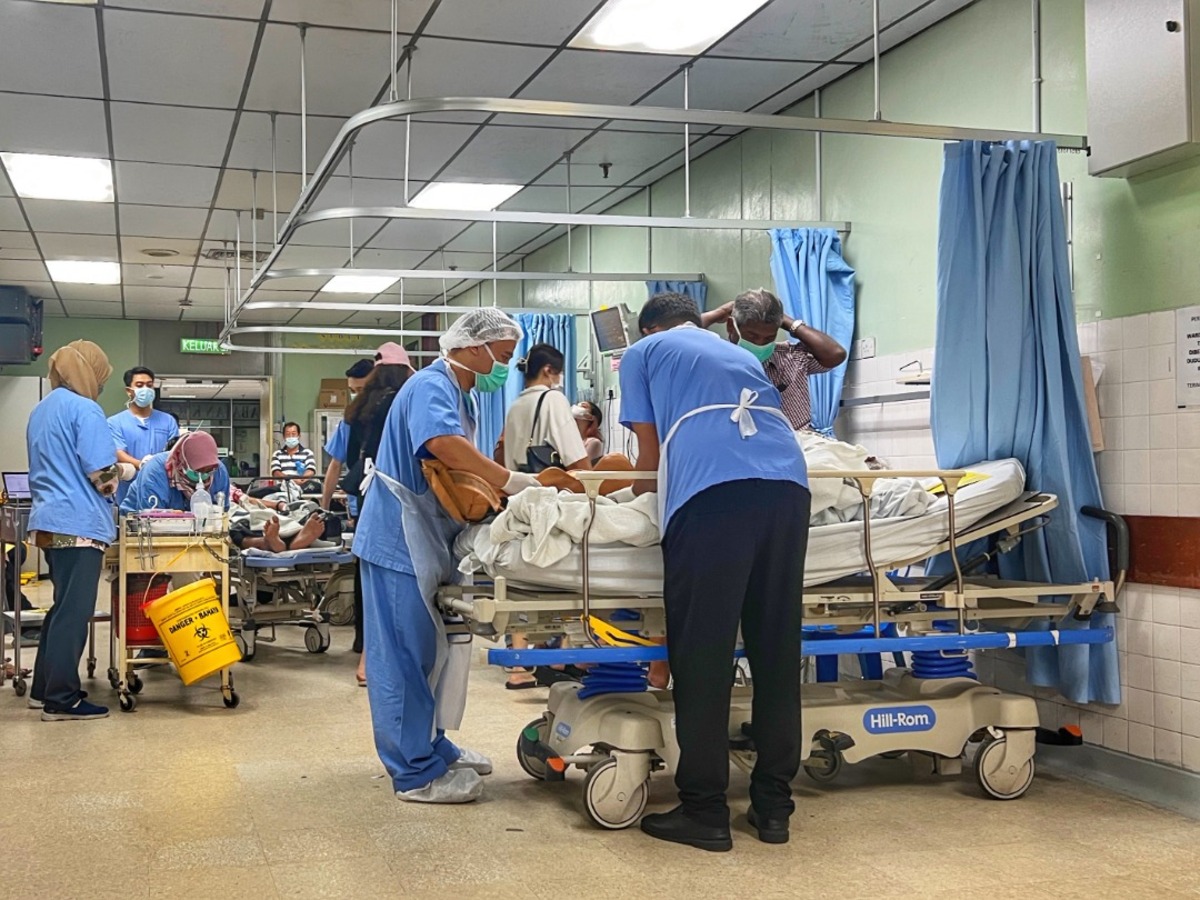
Our hospitals are being kept alive by exhausted health care workers who are overworked, underpaid, and expected to keep smiling because, apparently, patriotism is now supposed to replace sleep, manpower, safe staffing, functioning equipment, and reasonable pay.
Across Malaysia, the same alarm is ringing. Queen Elizabeth Hospital in Sabah has been reported to face overworked doctors, ageing equipment, and overcrowded facilities. In Johor Bahru, cardiothoracic services are split between Sultanah Aminah Hospital (HSA) and Sultan Ismail Hospital (HSI), about 20km apart, with doctors repeatedly travelling between both hospitals while trying to keep the service running.
There have even been reports of accidents after prolonged work and inadequate rest. In Klang, Sungai Buloh, Johor, Sabah, and Sarawak, different hospitals and different specialties are telling the same story in slightly different words.
This is no longer one department complaining. It is a national pattern.
The real disease is not “doctors complaining too much”. The real disease is a system that has normalised abuse and renamed it service. More than four on-calls per month is already inhuman when one call itself means more than 24 hours of clinical responsibility.
After that, many doctors still return to ward rounds, clinics, discharge summaries, family updates, referrals, procedures, operations, and administrative tasks that never seem to end.
In some departments, even the so-called post-call period is not respected. Doctors may still be chased for updates, interrupted over unresolved ward issues, or expected to continue working until evening. Apparently, a post-call doctor is not a human being recovering from sleep deprivation, but a vending machine with a stethoscope: press button, receive update.
This would be funny if it were not dangerous. Society accepts that pilots should not fly exhausted, lorry drivers should not drive exhausted, and machinery operators should not work exhausted. Yet somehow, doctors making life-and-death decisions after 24 to 33 hours awake are expected to continue functioning with heroic professionalism, as if human biology suddenly becomes optional inside a hospital.
Now let us talk about pay, because this is where the insult becomes almost artistic. Doctors’ on-call allowance was previously equivalent to about RM9.16 per hour. Even with the much-celebrated increase, the effective rate remains around RM12 to RM13 per hour for a 24-hour active call, still far below the RM25 per hour demanded by doctors’ groups.
Hartal Doktor Kontrak previously compared doctors asking for RM25 per hour with MPs receiving RM25,000 monthly remuneration. The contrast is almost poetic: RM25,000 monthly for those who debate national policy, but RM25 per hour for those resuscitating the consequences of national policy at 3am is apparently too ambitious.
RM12 to RM13 per hour covers resuscitation, septic shock, heart attacks, strokes, bleeding, emergency referrals, death certification, angry families, medico-legal risk, and clinical decisions that cannot be postponed to “the next working day”.
Private locum work in GP clinics can pay several times more per hour, and private hospital locum rates can go even higher. But in public hospitals, where some of the sickest patients arrive, doctors are still treated like cheap labour with an MMC number.
Then policymakers wonder why doctors leave.
Doctors are not short of nationalism. They are short of rest, fair pay, manpower, protection, training time, and administrators who understand that human beings cannot be stretched forever.
And please, spare us the emotional blackmail. If patriotism means working beyond human limits, being underpaid, losing family time, losing study time, damaging physical and mental health, and then being told to stay because “the country needs you”, then that is not patriotism. That is exploitation dressed up in national colours.
Sarawak is already showing the consequence. The Sarawak government itself reported that the state has fewer than 4,000 doctors despite needing about 6,000, while also acknowledging that young doctors are leaving for better training, specialisation, and more competitive remuneration overseas.
CodeBlue separately reported that 293 out of 542 newly posted medical officers failed to report for duty in Sarawak. When almost half of newly posted MOs do not show up, the issue is not merely attitude, discipline, or “young people these days”. It is a vote of no confidence.
So here is the message to government bodies in plain language: if you want doctors to serve, protect their welfare. If you want doctors to stay, pay them reasonably. If you want doctors to report for duty, stop treating postings like punishment. Nobody leaves a system that respects them, protects them, trains them properly, pays them fairly, and allows them to live like human beings.
Doctors leave when the system takes everything and gives back slogans. They leave when “service to nation” becomes a polite phrase for exploitation. They leave when loyalty is rewarded with more calls, more exhaustion, more harassment, more responsibility, and RM12 to RM13 per hour.
And while all this is happening, politicians continue promising more hospitals. More buildings, more ceremonies, more speeches, more manifestos, more photo opportunities with hard hats and rolled-up sleeves. Very touching. But who is going to run these hospitals?
Will politicians clerk patients? Will JPA intubate at 3am? Will administrators cover the emergency department? Will ministers do post-call ward rounds? These questions may sound sarcastic, but they expose a very real gap between political theatre and hospital reality.
A hospital is not concrete. A hospital is manpower, equipment, training, beds, supervision, and human beings who are not already half-dead from the previous call. Building more hospitals without enough staff is not reform. It is architectural theatre.
It looks good in a manifesto, sounds wonderful at a press conference, and photographs well before an election, but behind the concrete and glass, the same exhausted doctors will simply be stretched even thinner.
So, Malaysians, the next time someone proudly announces a new hospital, ask one simple question: who is going to run it? Because if the answer is “the same exhausted doctors doing more calls for insulting rates”, then this is not health care development. It is a bigger stage for the same collapse.
And when doctors resign, migrate, fail to report, leave public service, or simply stop believing in the system, do not call them unpatriotic. Call it what it is: cause and effect.
The author is a specialist doctor in a government hospital in Selangor. CodeBlue is providing the author anonymity because civil servants are prohibited from writing to the press.
- This is the personal opinion of the writer or publication and does not necessarily represent the views of CodeBlue.


