

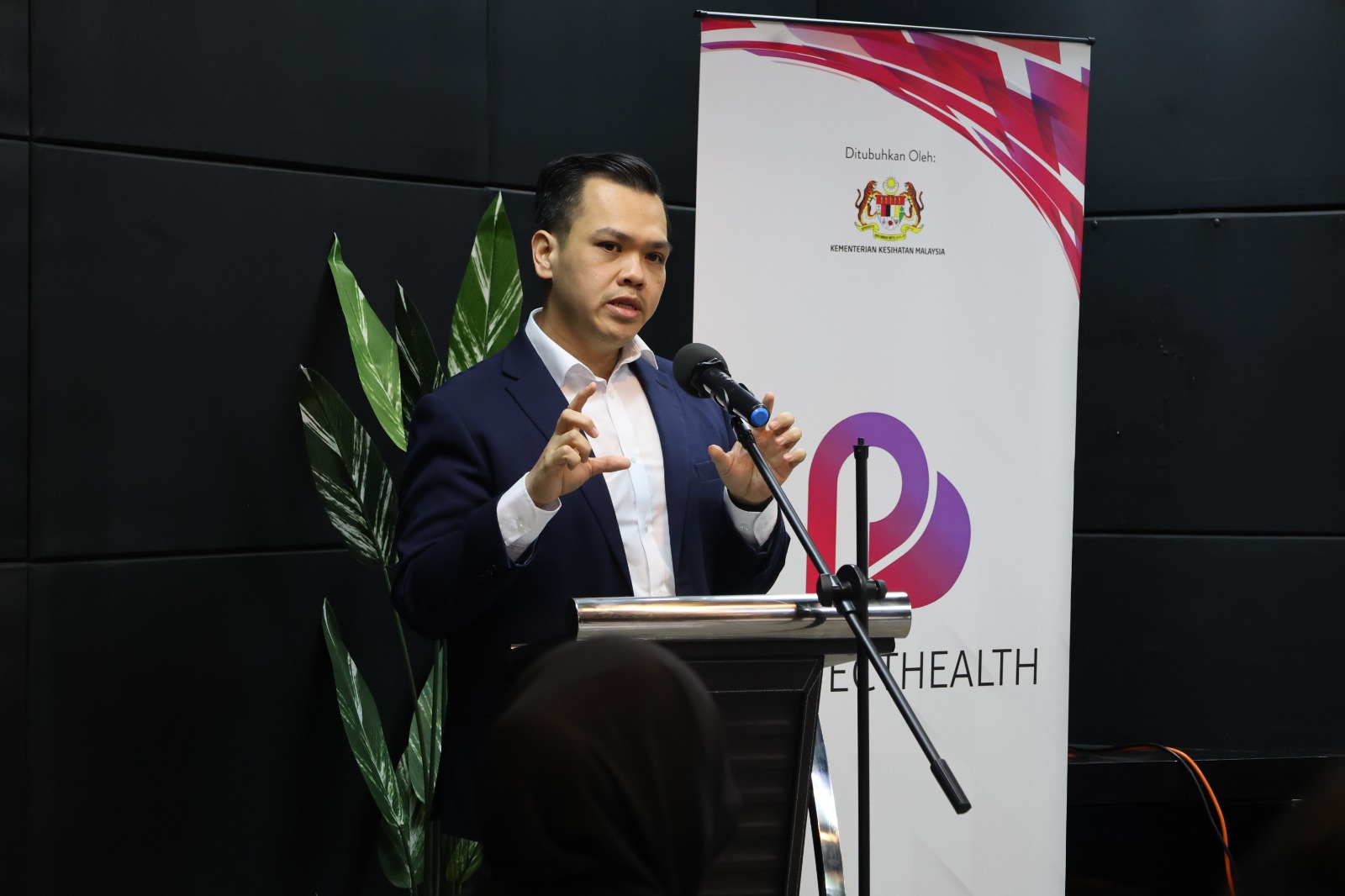
CYBERJAYA, May 15 — ProtectHealth Corporation Sdn Bhd says it has not received any instruction from the Ministry of Health (MOH) to cut or scale down its programmes, amid wider federal budget pressures linked to the Persian Gulf conflict.
ProtectHealth chief executive officer Wan Mohd Hazwan Wan Mohd Najib said the government-owned company’s programmes were continuing as usual, with no directive from MOH to reduce operations or optimise spending following Putrajaya’s austerity measures.
“We have not received any instruction on that,” Wan Mohd Hazwan told a media briefing here today. “As far as we know, everything runs as usual pertaining to all our programmes.”
ProtectHealth runs various programmes like its Peka B40 health screenings, the Madani Medical Scheme, and a Hospital Services Outsourcing Programme.
Health Minister Dzulkefly Ahmad previously said he expected a 10 per cent cut to MOH’s RM46.5 billion budget, amounting to about RM4.65 billion, as the government reviews operating expenditure amid rising subsidy pressures from the Iran war.
Dzulkefly said MOH was still negotiating with the Ministry of Finance (MOF) to protect essential core services, including basic health services, patient treatment, emergency care, and drug and medical device supplies.
The proposed cut has drawn concern from medical groups, with the Federation of Private Medical Practitioners’ Associations Malaysia (FPMPAM) warning that reduced health spending could worsen patient outcomes, delay elective procedures, lengthen waiting times, and strain health workers.
Former Health Minister Khairy Jamaluddin has also said “nothing” in the public health care system was a luxury, arguing that any cut to MOH spending would affect services in an already underfunded system.
Wan Mohd Hazwan said the Iran war had not caused any immediate impact on ProtectHealth’s programme costs, including prices negotiated with vendors, manufacturers, suppliers, and clinics for items and services such as hearing aids.
“We are always on the lookout for the best deal, the best prices. Also, there’s volume. So we’ve actually benefited from a very good purchasing power to contain those prices,” he said.
“No one has come back and said, look, we cannot deliver this hearing aid at this price because of the Iran war and all that. So far, no complaints, nothing.”
Wan Mohd Hazwan also said the Gulf conflict had not affected the planned rollout of the base medical and health insurance/ takaful product (MHIT), or the diagnosis-related group (DRG) price guidelines being developed to support the new product.
ProtectHealth has been tasked with developing the DRG mechanism for the base MHIT plan, a proposed payment framework that groups hospital cases by diagnosis and complexity to guide pricing for inpatient care.
Wan Mohd Hazwan said discussions with Bank Negara Malaysia (BNM) and other stakeholders had not centred on whether the war would affect the target premium.
“I think that is again in discussion with Bank Negara and other key stakeholders. But it’s not centred around, oh, will this affect the target premium for the base MHIT plan. It is not a concern,” he said.
“I think they have a certain target premium that they’re landing on. It’s just that, whatever the target is, we have to double down on how we could make it work – the price setting, making certain things a bit more optimum and so on.”
The base MHIT product is expected to be supported by DRG-based price guidelines, which ProtectHealth said remain on track for the national launch in January.
Wan Mohd Hazwan said the DRG system is ready, with more than 2,000 people trained to use it. ProtectHealth has also received substantial data from over 100 private hospitals, which will be used to develop DRG groupings and pricing.
“We are now working with various technical experts, MOH, BNM, and all that to look at those data,” Wan Mohd Hazwan said. “We expect it to be, I mean, the initial version of it, to be ready before the pilot and we’ll continue to refine it as we move towards the national launch. By the national launch, the DRG-based price guidelines should be ready.”
Wan Mohd Hazwan described the participation of private hospitals as encouraging, noting that both large and small hospitals had voluntarily submitted data.
“I think everyone knows that, at the end of the day, this will help everyone. It’s not just for the insurers, it’s not just for the hospitals. The whole exercise is going to help the whole industry,” he said.
Wan Mohd Hazwan said the DRG rollout would be introduced in phases, with details still being discussed.
He said one of the guiding principles was to avoid any “pricing shock” to hospitals or hospital bills, while creating more transparency and guidance on hospital and treatment charges.
The phased approach comes after private hospital representatives warned that DRG implementation would require sufficient data and time.
In March last year, the Association of Private Hospitals Malaysia (APHM) said the United States took four years to pilot DRG before adopting it for Medicare and Medicaid. APHM president Dr Kuljit Singh said Malaysia may need up to a decade to develop a reliable dataset for DRG.
Wan Mohd Hazwan also pushed back against the perception that DRG was intended as a price control mechanism for private hospitals.
“A lot of people may see DRG as a price control mechanism. It’s not. As an entity under MOH and the government, we are not looking at doing price control for private hospitals. It is a mechanism to really improve the way health care is delivered.
“Let’s say it costs RM10,000 for a particular treatment. We need to find a way for hospitals to deliver this more innovatively. Over time, hospitals could actually earn more by being more efficient. So that will drive certain behaviour and mindset change in the process.
“Our ultimate goal in enabling DRG is to improve care models and the quality of care for patients,” he said.
Wan Mohd Hazwan said the DRG strategy would also involve the institutionalisation of patient-reported outcome measures (PROMs) and patient-reported experience measures (PREMs), as key indicators to drive future efficiency.
PROMs refer to patients’ own reports of their health outcomes after treatment, such as pain, mobility, recovery, or quality of life, while PREMs refer to patients’ experience of care, such as communication with doctors, waiting time, discharge process, or overall satisfaction.


