

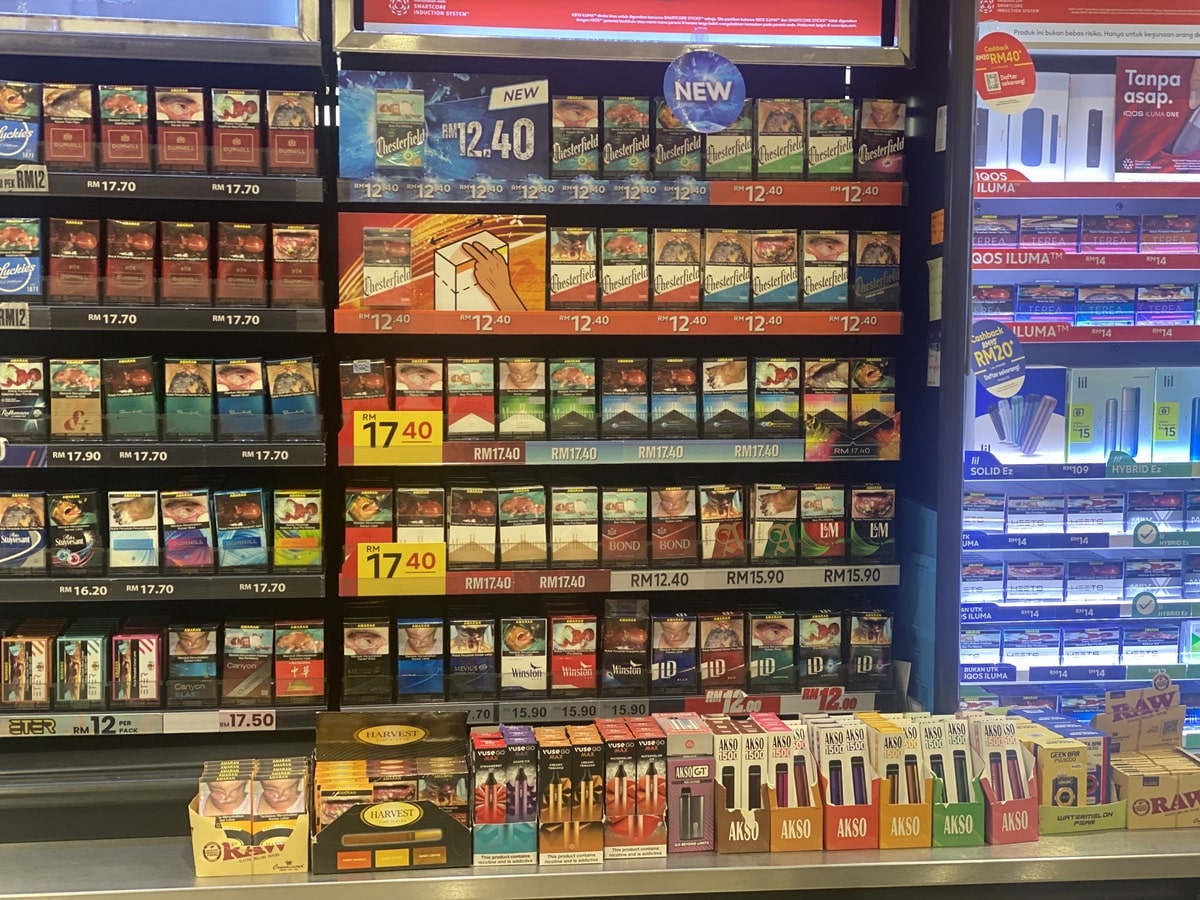
KUALA LUMPUR, April 29 — Anti-tobacco advocates have demanded bigger and annual increases in cigarette taxes in Malaysia beyond the minimal raise of two sen per stick last year.
Malaysian Women’s Action for Tobacco Control and Health (MyWatch) noted that the excise duty on cigarettes has been 42 sen per stick since November 1, 2025, just two sen higher than 40 sen per stick for many years prior.
“After the 2 sen increase, excise duty on an RM18.20 premium pack of cigarettes is RM8.40, which is 46 per cent of the retail price. The total taxes (excise plus other taxes) are roughly 60 per cent of the retail price.
“It’s still lower than the WHO (World Health Organization) benchmark of 75 per cent,” MyWatch president Roslizawati Md Ali, vice president Assoc Prof Dr Zarihah Zain, and public health expert Prof Dr Norashidah Mohd Noor told CodeBlue in a joint statement.
The anti-tobacco group urged Malaysia to go beyond “symbolic” adjustments by immediately imposing a one-off substantial hike in cigarette excise duty, subject to the optimal tax of 75 sen per stick, followed by automatic annual tax increases indexed to inflation and income growth.
Parallel tax increases should be imposed on all smoked and nicotine products, including heated tobacco and vape, to prevent users from switching products instead of quitting.
“The recent 2 sen per stick increase is directionally correct, but it is too small after more than a decade of relative stagnation,” said MyWatch.
Roslizawati described tobacco taxes as a “triple-win policy”.
“It works as a public health tool vis-a-vis price sensitivity, to combat health inequity vis-a-vis health/disease burden, and for revenue generation to address economic burden,” she said.
Citing WHO figures, MyWatch said Malaysia collected RM3.499 billion in total tobacco tax revenue at the federal level in 2023, comprising about RM3.074 billion in excise, RM372 million in sales taxes, and RM52.6 million in import duties.
Assoc Prof Dr Amer Siddiq Amer Nordin, a consultant psychiatrist and smoking cessation specialist from University Malaya Medical Centre (UMMC), similarly described the recent cigarette excise duty rate increase as “extremely modest”.
“As a result, the gains from the increase are hardly making much of a dent,” he told CodeBlue.
Dr Amer Siddiq stressed that tobacco taxes should be progressive, instead of anti-tobacco groups needing to “fight for the increase” every year.
Tobacco Price Hikes Linked To Reduced Smoking Rates
This relationship between price and consumption is backed by international data.
“In New Zealand and Australia, an increase of 10 per cent in tobacco prices usually is said to reduce smoking rates by 5 per cent. So there is already evidence supporting this strategy,” said Dr Amer Siddiq.
“In fact, in the MPOWER, which are the strategies for the present Framework Convention on Tobacco Control (FCTC), ‘R’ is raising taxes. And the raises should be consistent.”
MyWatch noted that, according to the WHO, a significant hike in tobacco excise taxes and prices are the single most effective and cost-effective measure for reducing tobacco use.
“That is precisely why tobacco taxation is embedded in WHO FCTC Article 6,” said the anti-tobacco group.
“Economic reviews conclude that tax/price increases reduce smoking prevalence and per-smoker consumption, reduce smoking-related disease and deaths, generate health care cost savings, and typically, increase government revenue.”
Protecting Young People And Low-Income Families
Young people, often lacking significant disposable income, are the most responsive to price changes.
“Yes, it has been shown to consistently reduce smoking rates amongst children and young people especially,” said Dr Amer Siddiq, when asked if higher cigarette taxes curb youth smoking.
MyWatch echoed this sentiment, saying: “Youth are generally more price-sensitive than older, established smokers, so higher prices can help deter initiation, reduce casual uptake, and encourage cutting down.”
The anti-tobacco group added that youth smoking studies have shown that a 10 per cent price increase can reduce smoking or consumption among young people by roughly 8 to 12 per cent.
Contrary to the perception that tobacco taxes are “regressive” for low-income households, MyWatch pointed out that more expensive cigarettes are actually beneficial for poorer families by reducing smoking and preventing illness that is costly to treat, from both medical and productivity perspectives.
“World Bank analyses show that over time, tobacco taxes can have progressive long-run effects because poorer households gain more from reduced spending on cigarettes, lower medical expenses, fewer workday losses, more productive years of life, and lower risk of being pushed deeper into poverty by illness,” said MyWatch.
“From a Malaysian equity perspective, tobacco tax is not just a fiscal measure; it is also a pro-poor health protection measure.”
Poor people are less able than wealthier people to take time off work to seek health care; the public health care system generally has much longer wait times than private health care facilities.
Offsetting RM1 To RM4 Economic Imbalance Of Tax Revenue To Health Care Expenditure
The most staggering aspect in the tobacco tax debate is the inequality between tax collection and health care expenditure on smoking.
For every ringgit the government collects from tax revenue on cigarette sales, the country pays out four times that amount to treat the resulting diseases.
“Several Malaysian public health commentaries have repeated the estimate that the country spends about RM4 treating smoking-related disease for every RM1 collected in tobacco tax, and recent reporting has also cited treatment costs in the billions of ringgit annually,” said MyWatch.
“Even if one treats the exact ratio cautiously, the policy direction is clear: tobacco imposes a major net burden on the health system and wider economy.”
MyWatch added that increasing tax revenue is a sweet bonus if the nation’s smoking addiction is reduced.
“So the best way to frame it is this: higher tobacco taxes are not solely a deterrent, but deterrence is their most important public health function. If smoking falls, that is success. If revenue rises at the same time, that is an added benefit.
“And if Malaysia eventually earmarks part of the tobacco tax for cessation, prevention, or health services, the policy becomes even stronger and more publicly defensible.”
Dr Amer Siddiq similarly said tobacco tax revenue could be used to fund smoking cessation programmes and treatment of smoking-related illnesses.
“However, the present rate is low, so the country is losing in terms of health harms and the harm is not yet solved.”


