

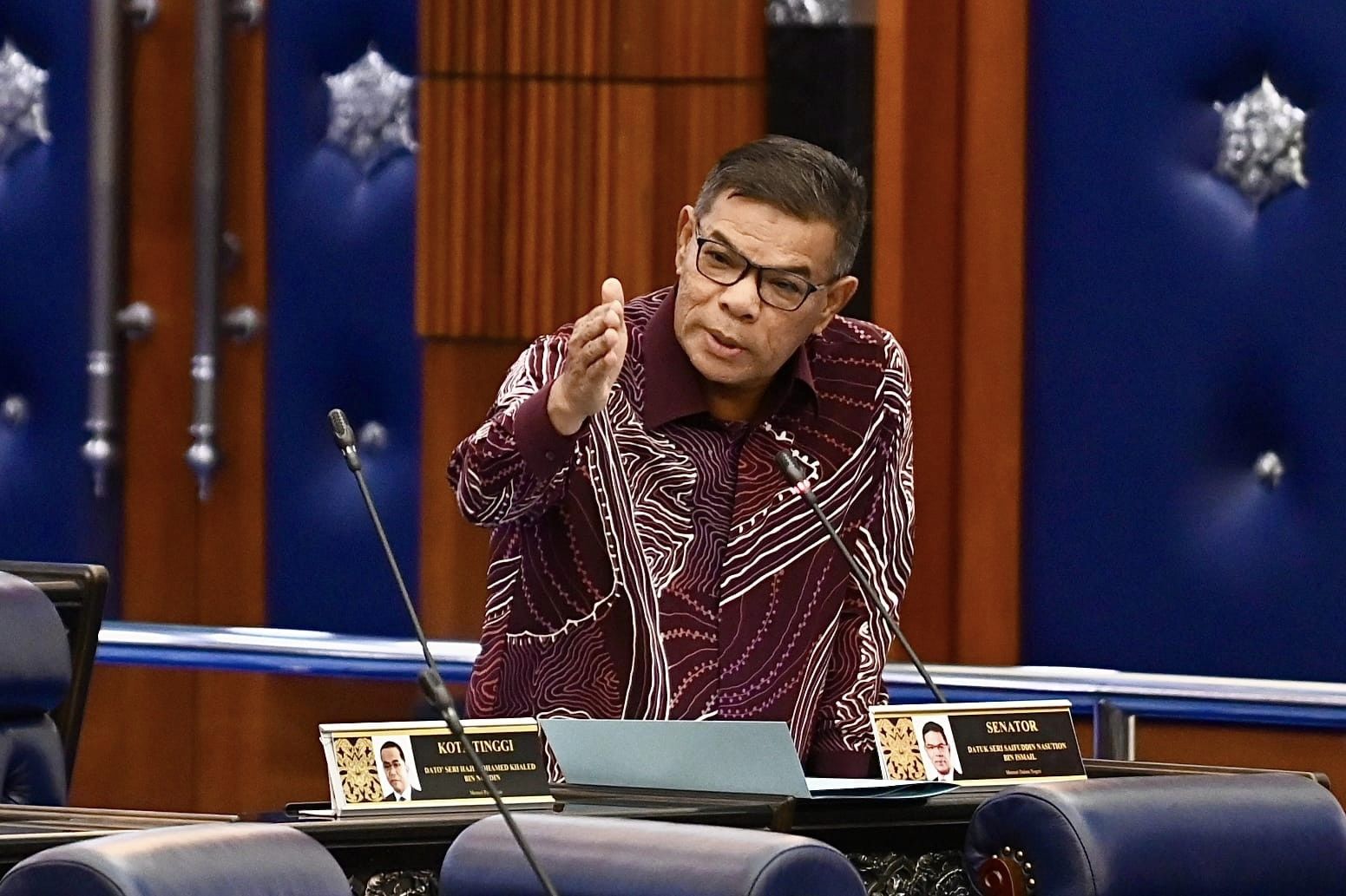
KUALA LUMPUR, July 18 — The Dewan Rakyat today passed the Drug Dependants (Treatment and Rehabilitation) (Amendment) Bill 2024 by voice vote, following meetings by both the Health and Security Parliament Special Select Committees (PSSCs).
Home Minister Saifuddin Nasution Ismail said that the committees had agreed for the Lower House to pass the bill, which was left unchanged, as soon as possible, with a focus on updating and improving its implementation.
“The outcomes from both the Health and Security PSSC meetings were that the Security PSSC concluded that all members agreed that this bill should be passed immediately and that the implementation methods should be improved.
“Meanwhile, the Health PSSC agreed in principle and supported the amendments to this Act with some recommendations,” Saifuddin said in his winding-up speech.
The bill was initially tabled for a second reading in the Dewan Rakyat on July 3 but faced an overdose of criticisms from MPs on both sides of the divide, who primarily questioned the National Anti-Drug Agency’s (AADK) ability to diagnose and treat drug addiction and the “punitive” nature of the bill, which aims to decriminalise drug use.
The bill was referred to the Health and Security PSSCs for further discussion on July 9. Both committees held a meeting on July 16, involving the Home Affairs Ministry, lawmakers, subject matter experts, academics, and civil society representatives.
Drug Dependants Bill Versus DDA: Two Laws, Two Outcomes?
During Saifuddin’s winding-up speech, Syed Saddiq Syed Abdul Rahman (Muda-Muar) raised concerns about the practical implications of the amended laws. He illustrated a hypothetical scenario where two individuals – one who had consumed a drug and another found with a small amount for personal use – were apprehended during a social event.
Syed Saddiq highlighted that the friend detected for drug consumption would likely be sent to rehabilitation, while the other, caught with drugs in possession but not yet consumed, would face legal prosecution.
“If it’s for personal consumption and use, not for distribution or sale, I hope it falls under the reformed Act that the minister mentioned. My worry is that some may end up in prison while others are directed to rehabilitation centres, and this will result in unfair laws, despite good intentions,” Syed Saddiq said.
Saifuddin acknowledged the dynamic nature of enforcement, stating that possession under Section 12(2) of the Dangerous Drugs Act (DDA) 1952 would still lead to legal action. However, he noted that in cases of drug consumption, factors such as prior drug records or the severity of addiction would be considered.
“The analogy or illustration that Muar is trying to convey – possession under Section 12(2) of the DDA – is still considered an action warranting legal proceedings.
“As for consumption – it’s also subjective – if the consumption has no prior record or if it’s not severe repeated use, these are our target groups.
“What Muar has raised is reasonable. When this Act is implemented, how do we address both scenarios? I take note of that. I consider it practical, not something deemed impossible to happen. It’s reasonable,” Saifuddin said.
AADK Rehab Officers Have “All The Credentials”, Act Doesn’t Sideline Medical Officers
Critics of the bill argue that the amendments grants AADK officers excessive powers to detain and treat drug users, roles they believe should fall under a medical officer’s purview.
Saifuddin defended these powers, saying the issue “should not be exaggerated” (tidak harus diperbesarkan) given AADK’s 40 years of experience.
“They bring with them plenty of experience, they have seen firsthand how clients can recover and be treated. So these rehabilitation officers possess all the credentials,” Saifuddin said. He insisted that medical roles are not sidelined, especially under Sections 6A and 8, crucial for diagnosing conditions like drug-induced psychosis.
“In reality, when a client voluntarily enters AADK, a rehabilitation officer conducts initial assessments for the first two weeks, during which they are placed under observation.
“If during this period there are indications requiring referral to a medical officer, that is what AADK officers will do.
“So the issue of whether medical officers are necessary, the answer is yes. Especially for diagnosing other conditions like drug-induced psychosis among our clients,” Saifuddin said. Currently, 63 medical staff and 24 locums serve across AADK facilities.
Individuals Entering Puspen Not Registered As Criminals
Deputy Speaker Ramli Mohd Nor (BN-Cameron Highlands), a former Royal Malaysia Police officer with over three decades of service, asked Saifuddin whether the bill aims to eliminate the practice of maintaining permanent records for drug users.
He pointed out that Section 15(1) of the DDA treats drug use as a criminal offence, resulting in fingerprints being taken and records being retained.
“In the Drug Dependants Bill, will this information be entered into the Criminal Registry and Wanted Persons list? I understand that once fingerprints are on a criminal record, they remain there indefinitely. Does the Ministry of Home Affairs intend to change this with this bill?”
Saifuddin explained that individuals entering Narcotic Rehabilitation Centers (Puspen) are either voluntary or court-ordered (perintah mahkamah), not as court punishment (hukuman mahkamah).
“In 2015, the Attorney-General’s Chambers (AGC) issued guidelines stating that these are court orders, not criminal convictions,” Saifuddin said. “Therefore, in the Registration of Criminals and Undesirable Persons Act 1969, they cannot be recorded as having criminal records,” Saifuddin said.


