

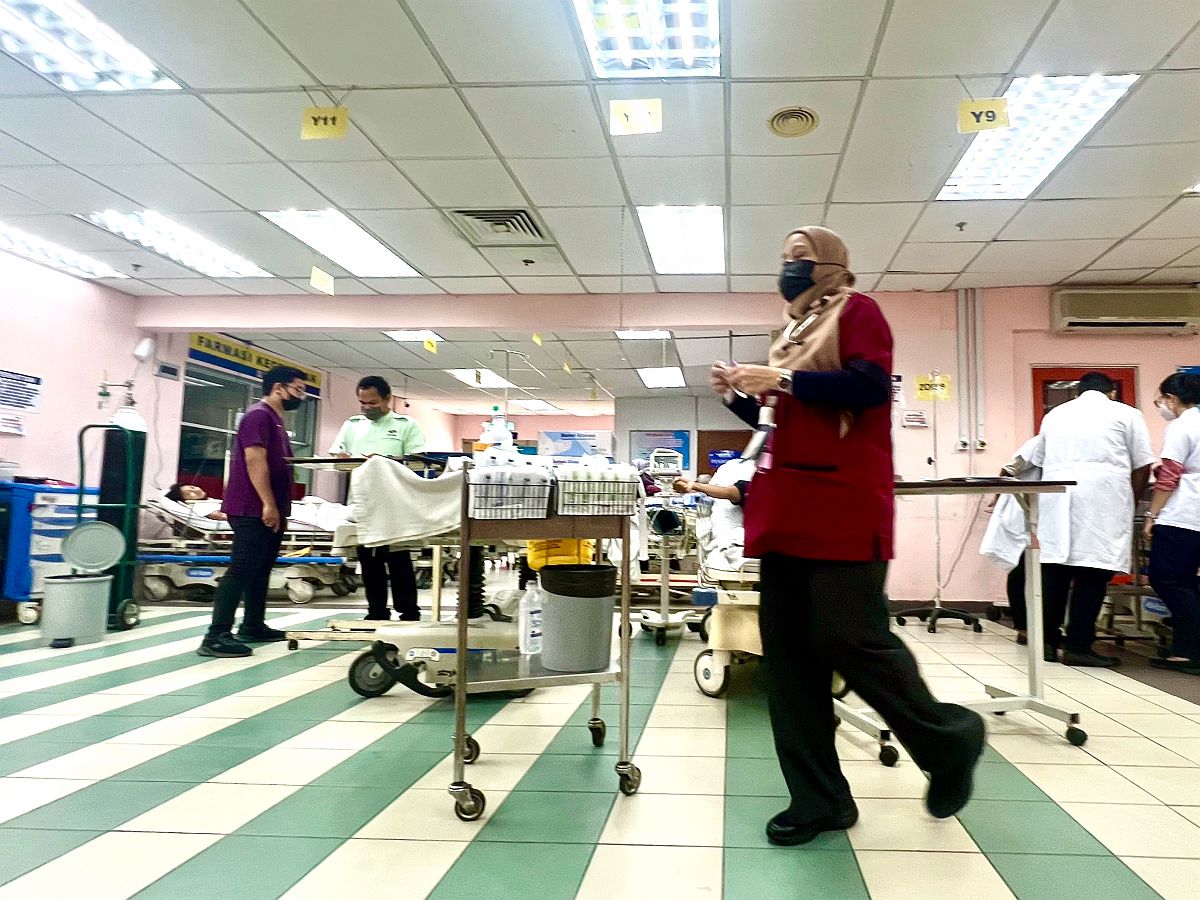
Although many doctors hail the allocation of 9,000 permanent positions under Budget 2027 as a sweet victory in a decade-long struggle, the Madani government has never described this measure as an “abolition” of the contract doctor system.
In both written and verbal statements to the media, Health Minister Dzulkefly Ahmad only ever used the word “dinoktahkan”, the same word used by Prime Minister Anwar Ibrahim when tabling the federal budget in Parliament, rather than “pemansuhan”.
The former is more grandiloquent language, especially when applied to the contract doctor “issue” (another vague word), compared to an abolition of the entire contract doctor “system”.
The substance of the policy measure itself — offering 9,000 permanent positions to contract doctors, including those who complete housemanship — also indicates that permanency is merely being offered at an earlier stage of a doctor’s career, i.e. after housemanship instead of after two years’ compulsory service as a medical officer.
If the Madani government really intends to abolish the contract doctor system, then it should revert to pre-2016 and automatically appoint all medical graduates entering housemanship in 2027 as permanent civil servants on Day One of their training.
This way, 2026 will mark the last of Malaysia’s contract doctor cohorts.
But if permanent positions will only be offered after two-year housemanship, then the contract cycle continues in 2027 and every subsequent year with each new cohort.
How then can we say that the contract doctor system has been abolished?

If the government already plans to offer permanent positions to fresh medical officers next year, why not just bump up these permanent appointments to the start rather than the end of housemanship?
Even if about 100 or so house officers resign annually during their training, it won’t really change anything because their vacancies can be filled, just like other vacancies triggered by regular resignations by any doctor at any stage in their career.
Before Prime Minister Najib Razak’s administration introduced the contract system for the December 2016 housemen batch, there was still a placement process for trainee doctors after completing their training.
Fresh medical officers were posted to whichever state, depending on their application, and they generally reported for duty at their new placement, even if some might have appealed.
Widely reported no-shows for permanent posts this year, especially in Sabah and Sarawak, might still repeat in 2027, even if offers of permanency are made right after completion of housemanship.
This is because the contract system gives doctors a choice. Fresh medical officers can choose whether or not to accept permanent jobs in the civil service by reporting for duty at their new placement or reject their job offers in a non-confrontational way by simply not showing up.
But if they were already permanent staff, they wouldn’t really have a “choice” per se because postings are a workplace instruction in an existing job. If they refuse to comply with such directives, then they must formally resign from service.
This is much harder to do than simply not showing up at a new placement and continuing the short remainder of one’s contract in their existing workplace.
Total elimination of the contract system will also simplify HR processes for both administrators and doctors, such as covering transfer costs or issuing permanent appointment letters.
Contract-to-permanent transitions – whether after completing housemanship or compulsory service – unnecessarily complicates things and gives doctors more reasons to reject permanent positions.
Even though Malaysia already has a legal requirement for two years’ compulsory service after housemanship in order to continue practising medicine, the government should minimise opportunities for doctors to leave.
Administrators in Putrajaya might be reluctant to automatically appoint house officers as permanent employees upon entering service because they continue to treat permanent positions as the sole carrot – or stick, rather – to force doctors to undertake rural postings.
Making Borneo placements attractive isn’t rocket science. Many doctors have given plenty of suggestions, such as substantially increasing hardship allowances, fixing service duration to perhaps two years, improving staff quarters, as well as flexibility and financial coverage of return flights to their hometowns in the peninsula.
National Cancer Society of Malaysia (NCSM) medical director Dr M. Murallitharan has even suggested providing Starlink at Ministry of Health (MOH) staff quarters in rural areas with poor internet access.
If funding is a problem, the federal government can finance these measures on a copay basis with the Sabah or Sarawak state governments, or whichever other state government like Kelantan.
One can argue that posting fresh medical officers before age 25 to the interiors will likely yield higher acceptance rates of permanent appointment offers at that stage, as compared to making such placements for senior doctors who might have already gotten married and built a family, besides other life commitments.
But this remains an untested assumption.
Not only is the new generation different from their older counterparts, Malaysia’s public health care system is now in a very different place than what it was more than a decade ago. Stories of severe understaffing, 33-hour on-calls, and poor remuneration can put anyone off, never mind which generation they’re from.
Some Gen Z doctors prefer work-life balance, while others want to be able to pursue specialisation. But in Malaysia, it reportedly takes 13 to 15 years to become a subspecialist due to inexplicable red tape, unlike eight years in countries like Australia.
Administrative delays in specialist recognition seem to have worsened with the new Supervised Work Experience (SWE) pathway after the Medical (Amendment) Act 2024.
The number of medical graduates entering housemanship hovered at about 3,200 annually from 2022 to 2025, with likely similar numbers this year and next.
Hence, the MOH should allocate 3,200 permanent positions for medical graduates entering housemanship in 2027 as first priority, in order to truly “end” the contract doctor system. Not a single doctor should be hired on a contract basis beginning next year.
The remaining 5,800 permanent posts should be allocated based on seniority, i.e. the oldest cohorts first before the youngest. As a gesture of goodwill, the government should also provide some form of compensation to senior medical officers who were denied early promotions because their contract years weren’t counted as service.
It’s unclear how many contract doctors, both housemen and medical officers, are in the MOH today, excluding incoming 2027 trainees. If the figure doesn’t significantly exceed 5,800, all of them, including 2026 housemen batches, should be able to be absorbed into permanent by 2028 at the latest, taking into account no-shows or resignations that would leave some extra space if needed.
While it’s commendable for Madani to allocate 9,000 permanent positions for contract doctors next year – twice as many as the typical annual intake of 4,500 – my worry is that if no-show rates of 35 to 40 per cent persist in 2027, this means double the number of doctors who will eventually leave the health service.
If no-show rates are minimal, like less than 5 per cent, then offering 9,000 permanent positions will be a huge success. But if no-show percentages remain in high double digits, the scale of attrition is multiplied because of the huge size of the 2027 intake. Just 10 per cent of 9,000 are already 900 doctors.
Politicians and top civil servants in MOH should keep in mind that Budget 2027 failed to introduce retention packages for doctors, nurses, or other health care workers, while inhumane working conditions in many public health care facilities remain unaddressed.
Madani has an opportunity to abolish the contract doctor system by ensuring that 2026 marks the recruitment of the last contract houseman and that 2027 will mark the beginning of the first permanent house officer in a decade.
Having said that, I don’t think that permanency in civil service is the best retention method for doctors, since the government has already abolished pensions. Ensuring smooth career pathways, allowing doctors to work where they want to work, improving remuneration, and providing healthy workplace environments will go a lot further in retaining a doctor in public service.

Boo Su-Lyn is the co-founder and editor-in-chief of CodeBlue.
- This is the personal opinion of the writer or publication and does not necessarily represent the views of CodeBlue.


