

PUTRAJAYA, August 6 — Long before a virus becomes a public health emergency, the first clues may appear in a shelter cat with an unusual infection, malformed lambs on a farm, or microscopic changes in the lungs or liver that are visible only under the microscope.
For Prof Vanessa Herder, a veterinary pathologist at Erasmus Medical Centre in the Netherlands, those clues can reveal how diseases spread between species, why some infections are more severe than others, and how future outbreaks can be prevented.
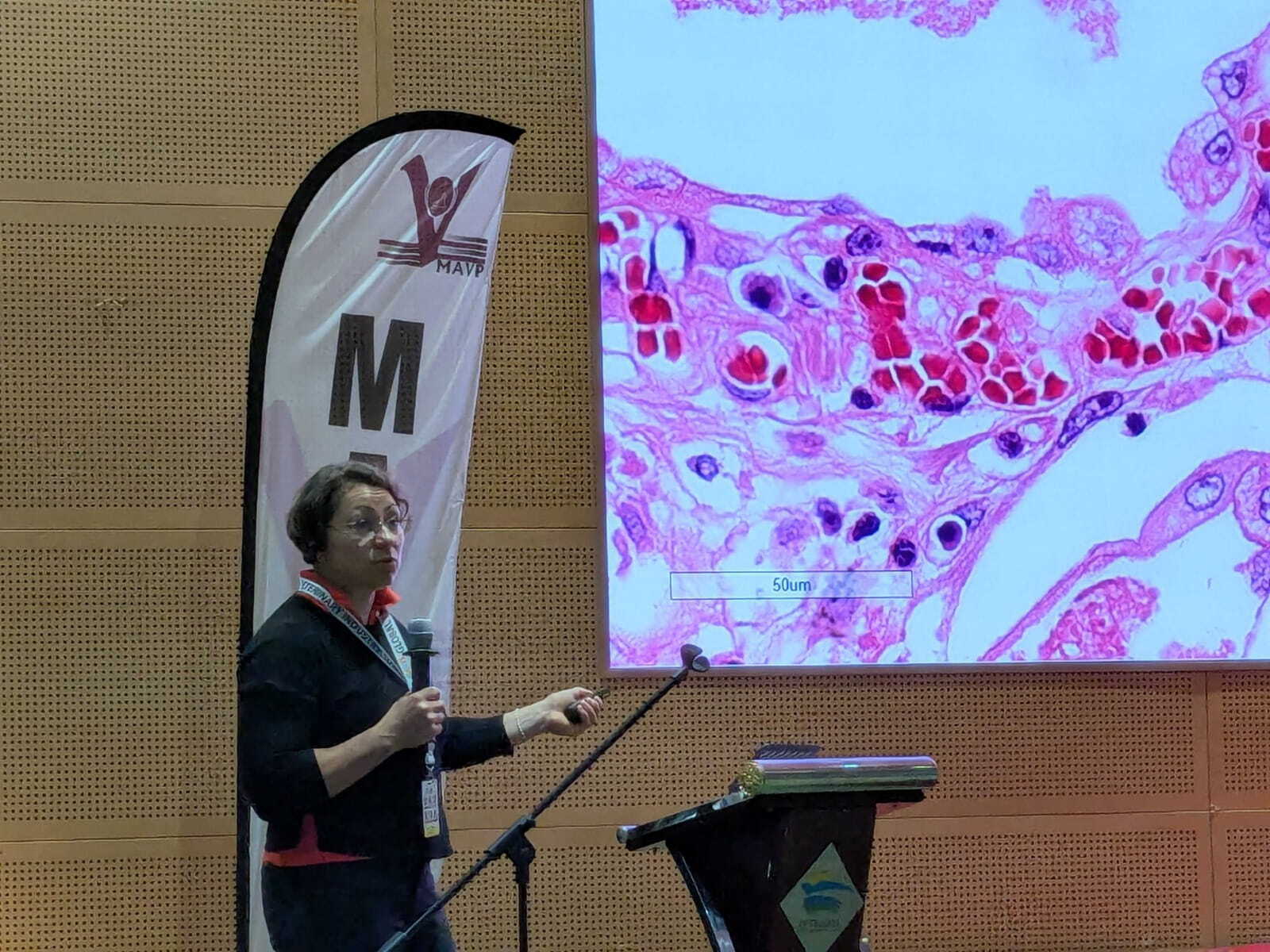
“Disease is not an event. It’s a process,” Herder said during her presentation at the Global Animal Production and Veterinary Industry Summit (Gavis) 2026 on July 23. “Viruses evolve, hosts adapt, ecosystems change, technology advances, but one thing remains constant. Diseases leave a footprint.”
Those footprints, she said, are what pathologists learn to read. “We listen with our eyes.”
Herder sees veterinary pathology as a discipline that sits between animal and human health, where diseases are studied not in isolation, but across species. It is the central idea behind One Health, which views the health of people, animals, and the environment as inseparable.
Unlike human doctors and pathologists, who work within a single species, veterinary pathologists routinely compare diseases across multiple animals, looking for biological patterns that may also apply to human disease.
“We always make the joke that the human doctor is only a specialist in primates. I’ve seen so many species. The human is just another species,” Herder said. “The patterns of immune response in the mammalian body are very, very similar.”
Poxvirus: From Cat To Human
Pathology is often associated with diagnosing disease after death. But for Herder, it is about understanding how disease unfolds, from the earliest changes inside cells to the consequences for individual patients, animal populations, and public health.
One case began not with a human patient, but with a dead shelter cat.
Doctors were treating a person who developed an unusual skin disease after being scratched by a shelter cat, but they did not know what had caused the infection. After the cat died, Herder’s team performed a post-mortem examination.
Under the microscope, Herder’s team identified the characteristic tissue changes of a poxvirus infection. The examination provided the missing clue, allowing doctors to trace the likely route of transmission from rodents to the outdoor shelter cat and then to the patient.
“It’s important to be aware of the cycle of infection – rodent, cat, then the human,” Herder said.
Identifying the virus enabled doctors to make the correct diagnosis and begin appropriate treatment, and the patient recovered. For Herder, the case showed how veterinary pathology can uncover transmission pathways that would otherwise remain invisible.
Schmallenberg Virus: Finding What Was Missing
Herder illustrated the same principle through another investigation, this time involving a previously unknown disease affecting livestock across Germany.
Farmers had begun reporting sheep, goats, and cattle giving birth to malformed offspring with arthrogryposis (twisted limbs), torticollis (curved necks), and severe neurological abnormalities. At the time, no one knew what was causing the condition.
Her laboratory was asked to investigate.
“A giant truck of samples arrived,” Herder recalled. For days, her team examined malformed fetuses, brains, and spinal cords, documenting lesions in search of a pattern.
The breakthrough came while studying cross-sections of the spinal cord. Rather than focusing on what she could see, Herder realised the answer lay in what was missing.
“Where are the other neurons?” she remembered asking herself. The grey matter, where the motor neurons that control movement are located, had largely disappeared.
That single observation explained the deformities affecting the newborn animals.
The virus, later identified as Schmallenberg virus, infected foetuses during pregnancy and selectively targeted developing motor neurons. Herder and her colleagues subsequently published one of the first detailed descriptions of the disease’s pathological features in affected sheep, goats, and cattle.
Without those neurons, lambs and calves were born with twisted limbs, curved necks and other severe congenital abnormalities.
“It’s important not only to see the lesions,” Herder said. “You also have to put them together and understand the pathogenesis.”
In other words, identifying abnormal tissue changes was only the first step. The greater challenge was understanding how those changes fit together to explain the disease process.
Bluetongue Virus And Covid-19: Why Some Infections Turn Deadly
The same question has guided much of Herder’s research for more than a decade. Why do some viral infections remain mild while others become life-threatening?
Studying bluetongue virus in sheep and SARS-CoV-2 in humans, Herder found the answer may lie in the body’s earliest immune response.
An insect-borne virus that infects ruminants such as sheep and cattle, bluetongue virus can cause illness ranging from mild infection to severe disease and death.
Despite affecting different species, Herder found that bluetongue virus and Covid-19 followed remarkably similar biological patterns.
Animals and humans with milder disease mounted a strong antiviral response soon after infection. By contrast, those that became severely ill showed a delayed immune response.
“If you are severely sick, you are lagging behind your antiviral immune response,” Herder said. “The more upregulation I have early, the better it is for the disease.”
The same biological pattern appeared across species despite involving different viruses. “What I’m saying is that viral diseases have a pattern and the early antiviral immune response is key in fighting the disease and having a mild outcome,” Herder said.
Herder and colleagues later showed, in sheep experimentally infected with bluetongue virus, that the timing of this early antiviral response was one of the key determinants of disease severity.
When the Covid-19 pandemic began, Herder had to temporarily suspend her research on bluetongue virus to study SARS-CoV-2 because her laboratory already had the necessary high-containment facilities.
Examining lung tissue from patients who died of Covid-19, her team found the same immune response pattern in humans.
Her findings also extended to comparisons between the Delta and Omicron variants of SARS-CoV-2. Pathology studies in hamsters showed Delta caused much more extensive lung damage than Omicron, mirroring the more severe disease seen in humans.
Compared with Delta, Omicron infection was associated with lower levels of virus in the lungs, less extensive lung damage, and a stronger antiviral immune response early in infection, helping explain why it generally caused milder disease.
“The question I’m asking in research is the same. It’s just a different species, just a different virus,” Herder said.
Artificial Intelligence: Seeing What Machines Cannot
While artificial intelligence (AI) is becoming increasingly important in pathology, Herder warned that new technologies cannot substitute for a deep understanding of disease biology.
“I always make a bit of a provocative joke that if AI would have diagnosed coronavirus, it would be another influenza virus, because AI didn’t have an example of coronavirus,” Herder said.
Novel diseases, she said, require scientists to recognise what has never been seen before rather than relying solely on pattern recognition. “The basics are important.”
As pathology becomes increasingly digital, Herder believes those fundamentals should be shared more openly. She called for digitised pathology slides to be made more publicly available so researchers around the world can examine the evidence underpinning published studies, making scientific findings more transparent and easier to reproduce.
Asked by CodeBlue whether many of the advances she described depended on sophisticated facilities at Erasmus Medical Centre, Herder said the principles of pathology remained the same, whether examining tissue from humans or animals.
Technology and funding could expand the range of investigations, she said, but diagnosis still begins with careful observation.
Sometimes veterinarians have virtually unlimited resources because owners of valuable racehorses or falcons are willing to pay for every available test. At other times, scientists work within tight financial constraints.
“But it’s not only about the budget,” Herder said. “It’s also about creativity, how you address the disease.”
Then, pointing to her head, she smiled. “It’s here.”


