


KUALA LUMPUR, July 6 — Private hospitals say they’re powerless against top insurance companies, complaining about insurers’ demands for excessive discounts at up to 40 per cent with de-empanelment threats.
Association of Private Hospitals of Malaysia (APHM) honorary treasurer Erica Lam noted in a Public Accounts Committee (PAC) inquiry that Malaysia’s insurance industry was controlled by AIA, Prudential, Great Eastern, or Allianz – all of which are foreign companies – unlike Malaysian-owned private hospital groups.
“And the big three insurance are actually making the decision for the whole insurance industry because their market share is so big. So, so big.
“All of us are [at] their mercy right, essentially,” said Lam in the June 17, 2025, proceedings, according to Hansard published in the PAC’s 1,999-page report on health insurance premiums and private hospital charges that was tabled in the Dewan Rakyat recently.
When Bayan Baru MP Sim Tze Tzin asked if APHM was planning to set up its own insurance company to “fight them”, Lam replied that it was very difficult to break into the industry.
APHM board member Dr Tan Hui Ling said the biggest “so-called cost-cutting” exercise by private hospitals was acquiescing to insurance companies’ demands for discounts.
“We have insurance asking for 25 percent discount, 40 percent discount even. But it’s impossible for us to give 40 percent discount. Giving 40 percent discount means I am subsidising your client. It doesn’t make sense in a private sector. Even a charity hospital cannot run with 40 percent discount,” Dr Tan told the PAC on June 17, 2025, according to Hansard.
Lam noted that IHH Malaysia’s cost-saving was about two to three per cent, exceeded by the hospital operator’s five per cent discount to insurance companies. “How can? That’s what this is now, in real life.”
Dr Tan explained that insurers’ demands for discounts applied to all their clients, at the threat of removing cashless facilities from private hospitals, which she said has happened before to two hospitals.
“Now they use these two to go to the bigger groups and negotiate. ‘If you don’t give me more discount, this is what will happen to you’. Look at the small fries, we are the small fry okay. Small hospitals, small fry. ‘We can just delist you like that’. And that’s how the insurers deal with us.”
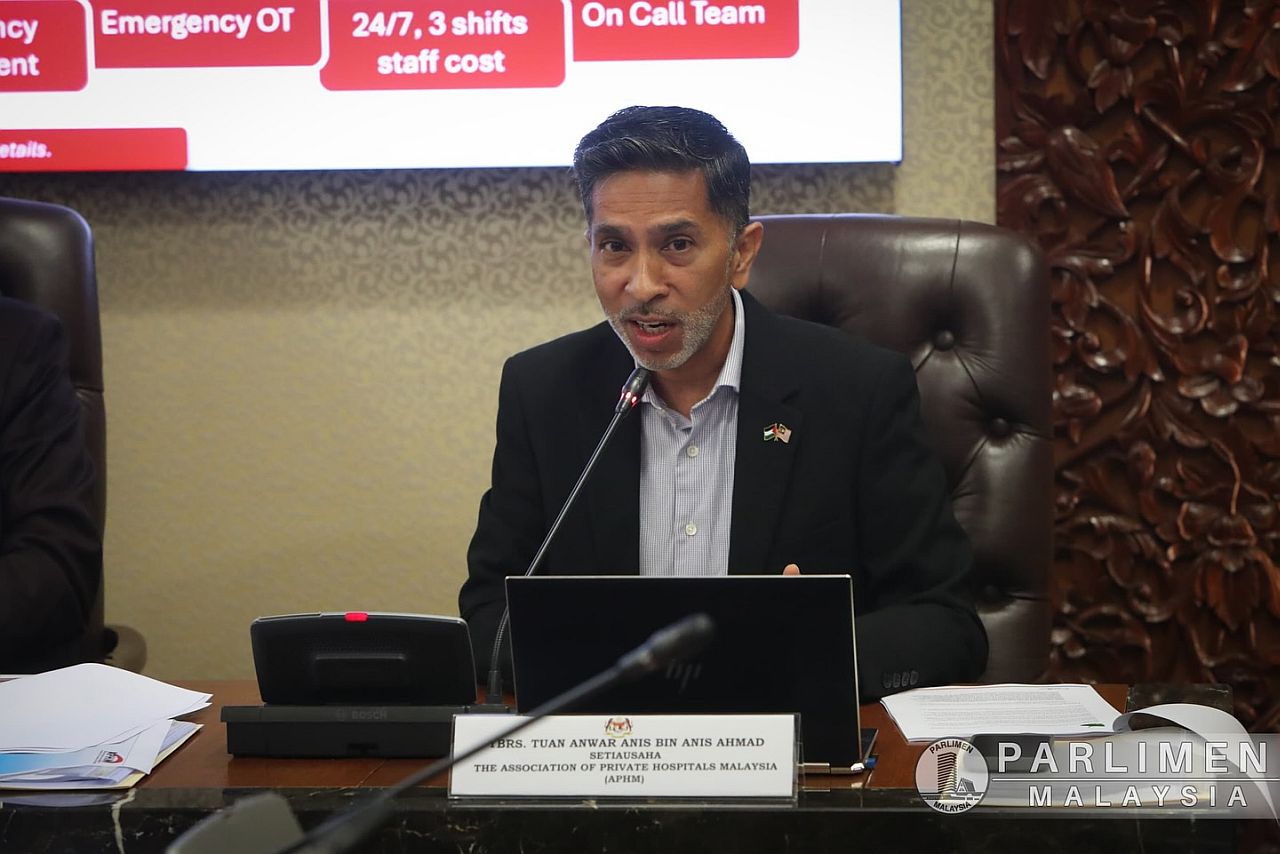
In the same June 17, 2025 proceedings, APHM honorary secretary Anwar Anis said hospitals had already been giving insurers discounts at up to 10 per cent for many years. However, due to Bank Negara Malaysia’s moratorium on health insurance premium increases from December 2024 to end 2026, insurance companies were now requesting for discounts at 20, 25, or 30 per cent.
Public listed hospital companies’ profit margins ranged between nine and 11 per cent, he said.
“We can give this discount for a short period. But, if you ask to do this for a long term, it will certainly threaten our existence,” Anwar told the PAC, according to Hansard.
“So, two issues. One is asking for excessive discounts and two, removing hospitals who don’t give discounts from the panel. This limits patient’s choice and this is not going to be sustainable for us.”
Anwar also pointed out that many private hospitals were owned by government-linked companies (GLCs) like the Employees’ Provident Fund (EPF), Tabung Haji, or Retirement Fund Inc. (KWAP). “So, again those impacts will be felt down the line if it’s not already felt already.”
KPJ Healthcare Bhd president and managing director Chin Keat Chyuan took a more optimistic view that the fates of insurance companies and private hospitals were intertwined.
“Now today, the question is if we don’t have private insurance, can we survive? The answer – we can, but we will suffer for a while. But insurance company also will be suffering because they are using medical health insurance as a door opening to sell their other products,” Chin told the PAC proceedings on June 17, 2025, according to Hansard.
“If we decided today where they depanel us from everywhere, do you think policyholders will still want to subscribe to insurance? No.”
Chin questioned where patients would go if insurance companies de-empanelled all private health care providers, complaining that some insurers were “being so difficult” with cashless facilities.
“We can’t live without them, maybe. Suffer a bit. Can they live entirely independent on us? I also doubt.”
He said he was more worried about government hospitals drastically improving facilities and services to the level of their private counterparts.
“If it’s free, no long queues, very good service from the government, I think I cannot survive, if you ask me seriously,” said Chin. “That to me is the biggest, biggest threat, but of course it’s good for the Malaysian lah. That means all Malaysians will get the best health care at the free of the cost.”
Why Hospitals Cross-Subsidise, Mark Up Consumables, Unbundle Charges

Private hospital representatives insisted that the hospital industry wasn’t very profitable, despite a nine to 11 per cent profit margin, due to extremely high costs of medical equipment, technology, staffing, doctors’ medical indemnity insurance, compliance, and utilities.
They explained that much of these costs, which aren’t charged to patients directly in their bills, are recovered by marking up consumables, medical supplies, and medicines. AHPM even claimed that private hospitals actually subsidise medical equipment and nursing services for patients.
In the March 10, 2025 proceedings, Anwar explained that although building a hospital cost about RM1 million to RM1.5 million per bed upfront, the cost of maintenance was three to five times higher, but this isn’t charged to patients.
Hospital rooms can’t use a split-unit air-conditioner because fresh air must come into the room, as per regulations, hence chillers are provided. Medical gases must also be provided in hospital rooms even if patients don’t need it at the time. So hospitals must maintain a medical gas plant at least two to three times a year.
“And those are, again, cost related just for the room itself.”
Then there is an advanced nurse call system to provide better patient care, besides technology like AI, all of which goes into the room cost.
“So, is RM200 or RM300 a day sufficient to cover that? Certainly not. So, where do we recover this cost from? Which is what we talk about cross-subsidisation,” said Anwar. “Unfortunately, we then have to charge this shortfall of three to five times in [other] items in the bill where we can recover the cost.”
Anwar said if hospital bundled charges under room and board at RM400 or RM800 per night, for example, patients would incur copayments or excess fees because insurance typically caps room and board coverage at RM200 or RM300.
“So, because of how the insurance policy has been and there’s been no change to that product structure itself, we have developed like over the last 15 to 20 years into a need to recover those costs in other item in bill,” he said.
“Unfortunately, that’s how it appears that perhaps masks or gloves are — what is available in RM2 outside, it’s at RM4, RM5, RM6 in the hospital. It is because we cannot recover these costs like room charges and all those are other items which is not in the bill.”
Secondly, Anwar claimed that hospitals actually undercharge patients for medical equipment, such as an intra-aortic balloon pump (IABP) that is used when patients get poor cardiac output.
An IABP costs around RM300,000 for purchase. But having just one isn’t sufficient for hospitals that provide complex procedures because even if it’s only used five times a year, there may be occasions when either another patient needs it at the same time or the machine is under maintenance, as Anwar cited Murphy’s law.
Hence hospitals need at least two IABPs to provide safe care, he said, totalling RM600,000 in purchase costs.
“So, the frequency of use in the hospital is an average of only 10 times in a year. But in the bill, what we charge per use is about RM1,500 when it’s used,” said Anwar.
But with two IABP units costing RM600,000 for purchase, plus maintenance costs at typically 10 to 15 per cent of the upfront cost of the equipment (i.e. factor of 1.25), charging patients for use of the equipment – at cost – should actually be RM15,000 per use (based on 10 cases per year for five years). Hence, hospitals are providing RM13,500 subsidy by only charging patients RM1,500.
“So, we have to again recover this from other parts of the bill. It is not that we want to but that is how the structure of the bill is, currently in Malaysia,” said Anwar.
Thirdly, Anwar raised manpower costs, especially nursing costs amid a shortage of nurses in Malaysia and attrition to other countries. Like medical equipment, private hospitals also undercharge patients for nursing services, he claimed.
The Private Healthcare Facilities and Services Act 1998 (Act 586) mandates one-to-one nursing ratios in intensive care units (ICUs), i.e. one nurse to one bed. So three shifts for that one bed or patient means three nurses are required.
An ICU staff’s monthly basic salary is about RM6,000, excluding bonuses and statutory contributions, said Anwar in March 2025, adding that this would probably go up to RM6,500 in the next six months.
With three nursing shifts in an ICU operating 24/7, nursing manpower costs RM18,000 per bed. However, with private hospitals typically charging patients RM300 per day for nursing in the ICU, that only totals RM9,000 in monthly revenue to the hospital – assuming 100 per cent bed occupancy.
“So, the cost is RM18,000. But our charges to the patient is RM9,000. That is a deficit of RM9,000. But like I said, 100 percent occupancy is not possible in any hospital. Typically, when we talk about at 70 to 80 percent is already considered very high occupancy,” said Anwar. “So, if you take 70 percent as typical occupancy. Then, our revenue is only RM6,300 and the deficit are even bigger.”
Hence, private hospitals recover the cost by marking up consumables, medical supplies, and drugs “perhaps a little bit more”.
Fourthly, Anwar cited the cost of utilities at RM600,000 to RM700,000 a month for a large hospital, or even close to RM1 million monthly for hospitals with 400 to 500 beds, just on electricity alone.
Private hospitals have also been investing more in cybersecurity over the past five years amid cyberattacks, he added. These costs are, again, not reflected in a patient’s bill.
Chin said in the same March 2025 proceedings that KPJ spent a few hundred million ringgit on an electronic medical record system to enhance efficiency and the patient experience.
Finally, Anwar cited costs of providing an emergency department that is mandated for private hospitals by law. An A&E department, alongside treatment rooms and an emergency operating theatre, operates 24/7 with three shifts, even though not all private hospitals’ emergency units are busy.
“So, this like we said, are redundancies and preparedness costs, which is also not reflected in the bill.”
Chin said hospitals’ pharmaceutical and medical costs went up after the Covid-19 pandemic because affluent patients wanted better health care, such as robotic technology for total knee replacement (TKR).
“Same TKR last time used to be less than RM40,000; today, might be costing RM45,000 because of the technology advancement. Who asks for it? Patients demand for it,” he told the PAC on June 17, 2025.
Hence, even though private hospital charges have increased significantly in a few years, profit margins remain in the “same low single digit”.
APHM’s Dr Tan said private hospitals tried to implement cost-saving measures for medical equipment and pharmaceuticals, but not manpower because they would lose health care professionals without salary increments.
Previously, private hospitals hardly considered procuring medical equipment from China, but “I can tell you now China vendors are our favourite”, she said. However, many products from China, Taiwan, and Japan are not approved by Malaysia’s Medical Device Authority (MDA), unlike more expensive European products that are all MDA approved. Hence, private hospitals are sourcing for “cheaper products and hopefully as good quality”.
Dr Tan said private hospitals could switch from innovators to generic versions for certain pharmaceuticals, but not others.
“Because generics, theoretically they work the same but they don’t honestly. Efficiency, side effects are different. I mean, I myself use— even as simple, Panadol or paracetamol. Paracetamol is generic. The drug name paracetamol for different brands gives me different side effect. I get gastric discomfort for the generic brand. What more or a lot of other cardio, heart drug et cetera,” she told the PAC on June 17, 2025.
Medical indemnity costs have also spiked. Chin said before he joined KPJ, his doctors used to pay for RM500,000 medical indemnity coverage. Today, KPJ’s mandatory minimum coverage is RM3 million. Many of its obstetricians & gynaecologists and paediatricians are even paying for medical indemnity coverage exceeding RM10 million.
“Now imagine if you were to buy anything more than RM10 million, how much premium you are paying? So, I think all this direct or indirectly is adding to the medical inflation,” said Chin, noting that a court awarded a patient in 2024 over RM9 million in a medical negligence suit against a government hospital. This case involved a boy who suffered brain damage at birth.
Patients Bear Huge Copayment If Hospital Charges Bundled Under Room And Board

APHM board member Stanley Lam explained that if hospitals bundled charges under room and board, exceeding the typical insurance coverage of RM200 or RM300, patients’ copayments, which are a percentage of the total hospital bill, would be very significant.
Lam pointed out that, for example, a single-bed room costs just RM100 more than a double-bedded room, hence a patient staying in a single-bed room for three nights, even though his policy only covers a double-bedded room, should technically only incur an additional cost of RM300.
But because the patient is charged a copayment for exceeding his room and board entitlement, a 20 per cent copayment of an RM10,000 hospital bill means that the patient must pay RM2,000, instead of the RM300 room difference.
“So, the implication to the patient, it is very big. That’s why if let’s say we want to restructure the bill, it’s not just the hospital side, but the insurance side also must accept and design their products appropriately,” Lam told the PAC on March 10, 2025, according to Hansard.
Anwar also pointed out that insurers wouldn’t be happy if private hospitals doubled ICU nursing charges to RM600, for example.
“When we talk about nursing just now, and like we said we are not saying it is wrong, but the insurer will come every year to do an audit to say, ‘Why is your hospital charging ICU nursing at RM600 when everybody else is charging RM300? You cannot charge RM600. If you continue to charge, we may have to remove you from the panel’.”
Doctors Reduce Fees For Self-Pay Patients

APHM’s Anwar said the share of pay-and-claim patients in private hospitals was very small at perhaps two to three per cent, as the vast majority were guarantee letter (GL) patients.
He explained that insurance patients actually get a discount on “most light items”, unlike cash-paying patients, citing a registration fee of RM10 to RM15 for cash patients for example, compared to insurance patients who aren’t charged registration fees because insurers refuse to pay for it.
On why insurance patients sometimes get bigger hospital bills than cash patients, Anwar cited dengue for example, where an insurance patient is admitted based on clinical guidelines. A cash patient paying out of pocket, on the other hand, also requires admission based on their blood test results, but can’t afford it.
“And doctors, out of their goodwill, may say, ‘Okay, never mind. You don’t get admitted. Tomorrow, you come back and we will monitor again’. So, that could be one difference,” Anwar told the PAC on March 10, 2025.
A self-pay patient may also decline to undergo an advanced blood test that confirms dengue, enabling immediate treatment, but is unaffordable to them at RM300. Their doctor then offers a cheaper regular blood test, but with slightly delayed results.
“So, that difference now starts to drive — it is not because the same item in the hospital is RM300 to the insurance patient and RM200 to the self-paying patient. It is not because of that. It is because of humanitarian grounds,” said Anwar.
Finally, doctors may voluntarily reduce their fees, charging self-pay patients only RM100 and insurance patients RM200, even though the schedule of fees allows doctors to charge RM230.
Anwar also told the June 17, 2025, proceedings that doctors sometimes even waive their fees “out of frustration” for insurance patients due to repeated questions and deferments from insurers, just to get GL approval and for the doctor and hospital to get paid.
“So, at the bottom level, we urge the PAC and the government to really address the detrimental impact on patient care and health care cost, which is the result of this excessive discount demands and the depanelment threats that hospitals are facing.”
PAC member Sim asked why, in one case, a patient was told, before admission, about an estimated RM25,000 bill for anterior cruciate ligament (ACL) treatment if they paid cash, but the estimate was revised to RM40,000 after they said they had insurance. In the end, the patient was charged about RM36,000 to RM38,000.
APHM’s Anwar, who first clarified that he wasn’t an orthopaedic doctor, said ACL treatment could either utilise one’s own ligaments or external ligaments, driving a significant difference in cost. Harvesting one’s own ligament leaves a scar on the leg and recovery is “a bit” longer, compared to using an external ligament with a shorter length of stay, no scar, and no risk of infection to the patient.
A self-pay patient who chooses the former treatment option, without minding a scar and longer recovery time, may pay RM25,000, compared to RM40,000 for the latter option chosen by an insurance patient.
“So, when the insurance patient comes, who will be paying insurance for the last 20 years, and he comes to the doctor and he tells the doctor, ‘If this is now the standard of care, will you provide me with a good implant? Where you don’t harvest my own implant, if that is now the standard of care? That is what I want’,” Anwar told the PAC on March 10, 2025.
“Why would the insurance patient say, ‘No doctor, never mind. Cut take my implant and reduce my cost to the insurance’? They would not ask for that. They would ask for what is now the standard of care.
“But if a patient who cannot afford, do we say, ‘No, sorry. We still want to charge you RM30,000. I don’t care whether you are self-paying patient. If you cannot afford RM40,000, go to KKM (Ministry of Health)’. But that’s not what we do. We want to be able to provide options to the patients.”
APHM president Dr Kuljit Singh told parliamentarians that medicine isn’t straightforward or clear-cut because “every human being is designed differently, the diseases present in different way”.
This is the third article in CodeBlue’s series on the PAC’s 1,999-page report. Read our two other articles: Insurers Question ‘Excessive’ Private Health Screenings, Procedures, Hospitalisations and Governor: Bank Negara Mandated To Protect Insurance Industry.


