

I have been serving in the Ministry of Health since 2010. Watching the system rot slowly before my eyes, yet being unable to rectify it, is perhaps the most painful part. It feels like cancer engulfing the body from within.
We used to have an abundance of house officers and medical officers in Malaysia, until the contract system introduced in 2016 destroyed the ecosystem. That system was created by policymakers who seemed to have no true sense of nationalism at all.
If we are serious about loyalty, devotion, and nation-building, then why were permanent posts not offered in the first place? Why the urgent need to feed egos by building the tallest towers and the biggest roundabouts? Why the obsession with Guinness records when the same “atasan” promote alcohol sobriety for political purposes?
I believe the majority of Malaysians genuinely want to develop this country. However, because of increasingly poor management, flawed policies, and the constant racial and religious narratives created by politicians, many have become disillusioned and chosen to leave Malaysia.
The reports about doctor shortages in Sabah, Sarawak, and more recently Perak are therefore not surprising. In fact, they were predicted more than 10 years ago.
Coming back to nationalism, I volunteered to work in Sibu even before entering the neurosurgical master’s programme. Immediately after my six-month gazettement in Kuching, I came to Sibu fully aware that the conditions would be harsh: inadequate staffing, insufficient armamentarium and material, no master’s students or registrars, countless on-calls, and a town lacking much in development and entertainment.
Nevertheless, I persevered and poured my heart into developing the neurosurgical fraternity in the central zone of Sarawak. I requested the Sarawak state health department (JKNS) to transfer my post to Sibu so that the neurosurgery unit could be upgraded into a full department.
Most people would not have done so, fearing that they might never be transferred back to Kuching again, the comfort zone, the place where milk and honey flow. Yet, creating a department is vital for any new discipline in a hospital because only then, can it have a stronger voice in matters involving consumables and assets.
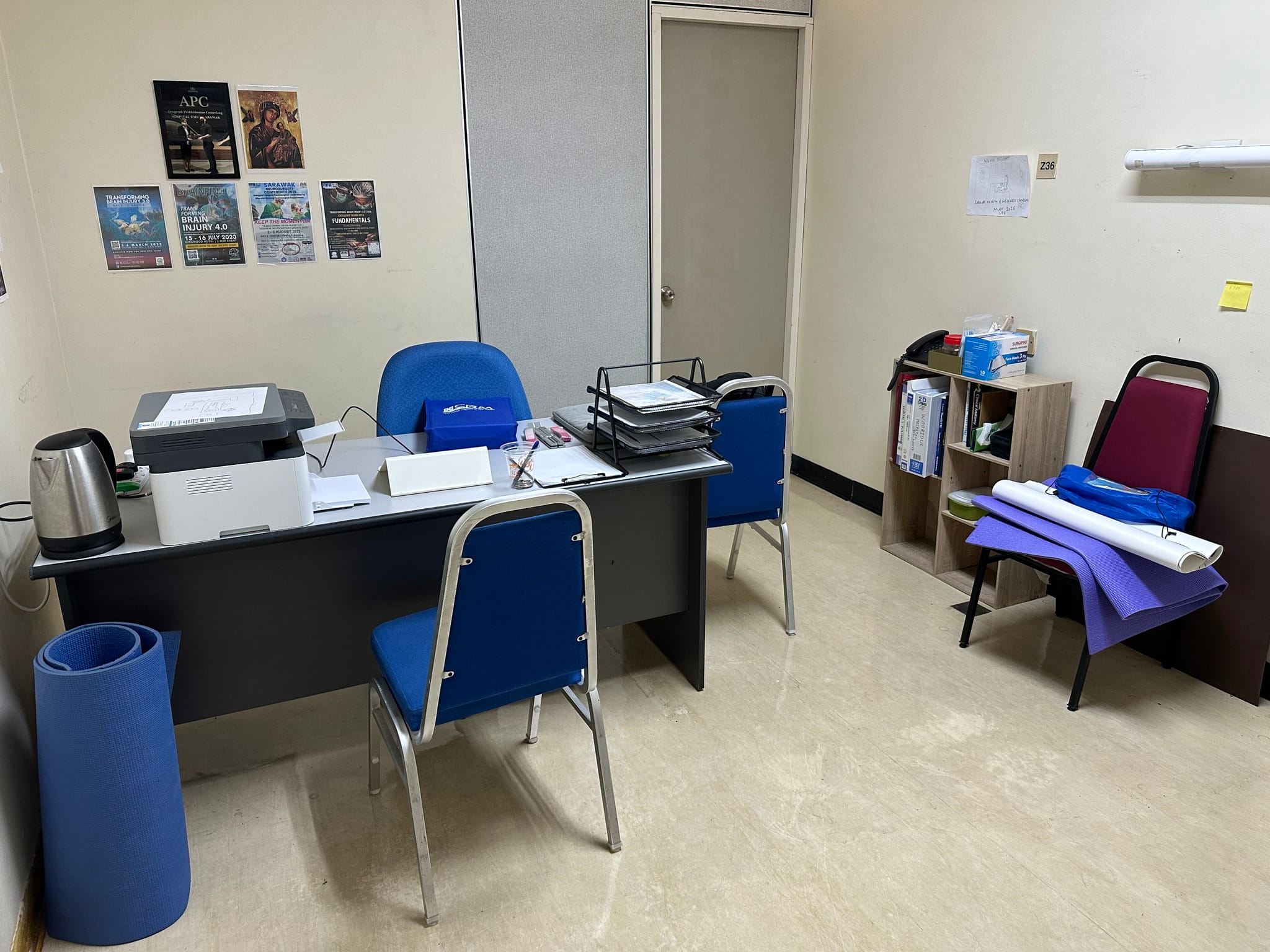
I had to beg for almost two years just to obtain an office for the Head of Department of Neurosurgery. It was finally given to me in late 2021, furnished with one table, three chairs, a laptop, and a printer.
Over the next five years, no additional furniture was provided, not even a bookshelf or filing cabinet. If the “atasan” were truly nationalistic, would they not equip their workers, especially heads of department, with the basic necessities to function properly?
Here in Sibu, I once went through three months of back-to-back on-calls while still doing ward rounds, performing elective surgeries, running clinics, and conducting visiting clinics. At one point, I developed an inguinal hernia, yet I was back at work on postoperative day one doing rounds and clinic, and on postoperative day two I clipped a brain aneurysm after my hernia repair.
Thanks to Mr Jesse Ting for the excellent repair at Rejang Medical Centre.
In terms of manpower, we used to have house officers posted to neurosurgery. That was the best time for them to gain exposure to the specialty, and also the best time for us to identify and recruit future medical officers (MOs) into neurosurgery.
As for MOs, I wrote countless appeal letters to retain my already well-trained and genuinely interested officers, only for them to be sent elsewhere after their so-called “floating” periods.
It has been extremely frustrating that this situation continues even now, when contract doctors who finally receive permanent posts are still shifted away, resulting in the loss of experienced MOs and forcing us to train new ones from zero yet again.
This skill mismatch and vicious cycle must stop if policymakers truly have nationalism in mind instead of kowtowing to political influence or favouritism.
I stayed in the dilapidated hospital quarters for five years so that I could remain close to the hospital. During those five years, there were no meaningful upgrades to the quarters. How can anyone expect doctors to come and work in Sibu Hospital when the accommodation provided is so miserable?
I had to spend a large amount of my own money to refurbish the place just to make it fit for human living. This is yet another major problem in Malaysia, not only the inability to build, but also the inability to maintain infrastructure.
Despite all the toil and trouble, despite working in an understaffed and overburdened frontline hospital compared to the so-called “kayangan” hospitals, there was no incentive and no promotion. Most of the neurosurgeons from my batch are already in the private sector.
Working in “kayangan” hospitals gives one ample time to do locum work, since on-calls may only be five to six times per month, making it easier to taste the honey before eventually stepping into the dark side. Again, all of this is controlled by the “atasan” and the Public Service Department (JPA), with more than a hint of favouritism.
Favouritism runs deep, not only in manpower allocation and promotions, but also in the distribution of assets, consumables, and infrastructure. If we are truly talking about nationalism, why not rectify all this before the public health care system collapses completely?
Back in Sibu, this week I carried out the usual twice-weekly clinics and elective OT list, including a visiting clinic to Kapit Hospital. Three elective surgeries were performed, including one vestibular schwannoma excision that went smoothly in four hours despite a delayed start because we had to share the navigation system with the ear, nose and throat (ENT) department.
I willingly let ENT use it first in the spirit of bertolak ansur. The Kapit outreach clinic also reached a new milestone, seeing 30 patients. Despite the full clinic, I took the opportunity to deliver continuous medical education (CME) sessions to the doctors, nurses, and medical assistants there.
After that, we went on to promote our international neurosurgical conference, TBI 6.0. On the journey back, we also shared the good news with the polyclinics in Kapit and Song, as well as Kanowit Hospital.
The week ended with a Raya lunch organised by the Maxillofacial Department of Sibu Hospital. We were treated to a sumptuous meal and warm hospitality, especially by Dr Khodijah, and it reflected the very spirit of semangat bekerjasama and true nationalism.
In conclusion, if policymakers themselves do not possess nationalism, then they cannot expect health care workers to remain loyal to the system.
To retain health care workers, the leaders must first show genuine love for the nation through fair policies, proper planning, and sincere support for those who continue serving on the frontlines.
The author is a specialist in Sibu Hospital. This article is a reproduction of the author’s original Facebook post, republished with permission. CodeBlue is providing the author anonymity because civil servants are prohibited from writing to the press.
- This is the personal opinion of the writer or publication and does not necessarily represent the views of CodeBlue.


