

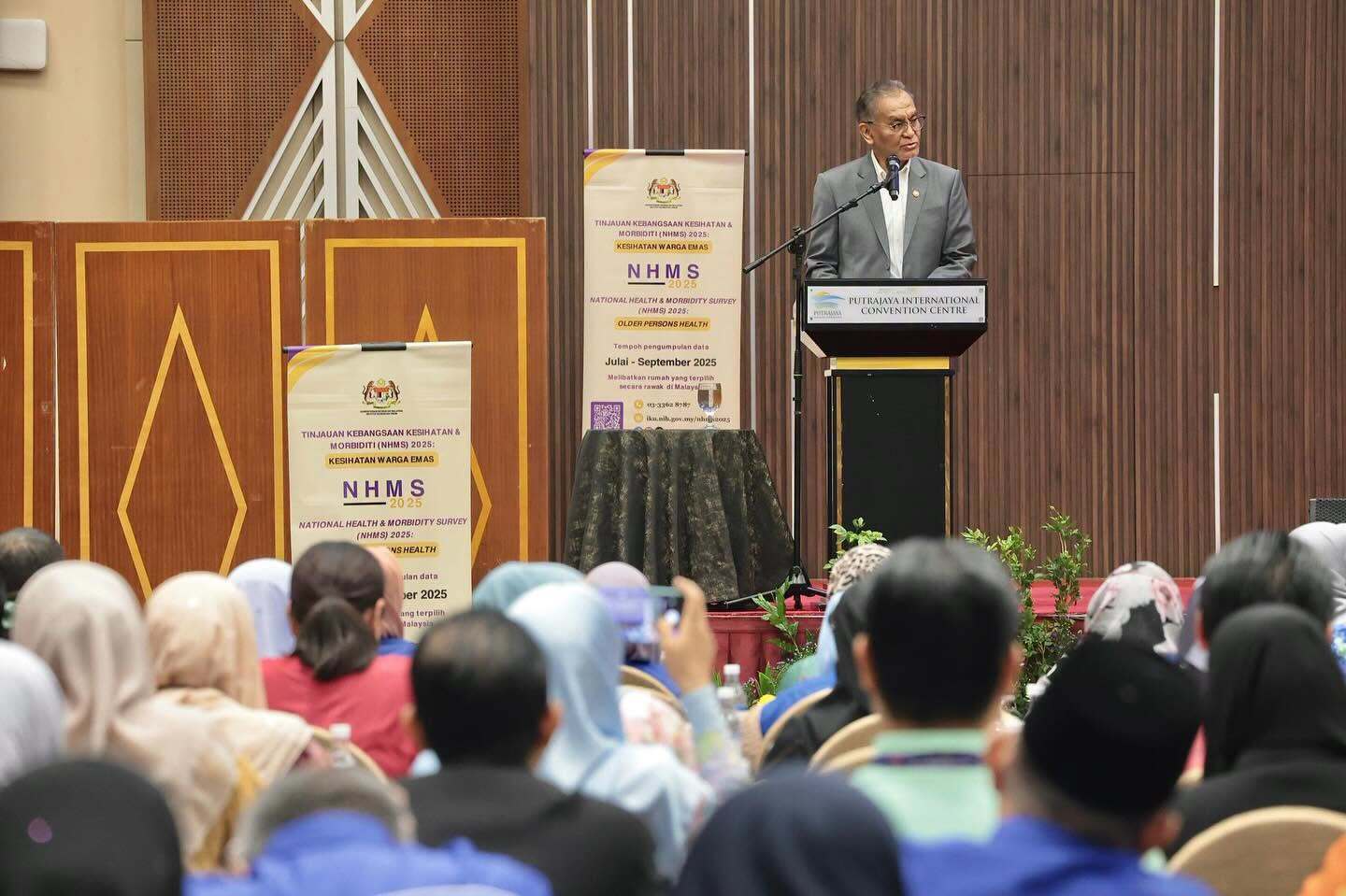

A report on the National Health and Morbidity Survey 2025 (NHMS 2025) released last week has delivered a stark and uncomfortable truth. Only 14.7 per cent of Malaysians aged 60 and above are ageing well.
This means more than 85 per cent of older Malaysians are living with disease, disability, cognitive decline, or social vulnerability — often all at once.
For readers of this column, this is not surprising. What is new is that we now have national data confirming it — decisively.
From NHMS 2018 to 2025: Improvement Without Transformation
This is only the second time Malaysia has conducted a dedicated national assessment of older persons, following NHMS 2018. There are some improvements. Depression has declined from 11.2 per cent to 8 per cent, and functional dependence in daily living has improved.
These gains matter, but are incremental and overshadowed by deeper concerns.
In seven years between the two surveys, dementia has risen to around 10 per cent, nearly 1 in 5 older persons now live alone while chronic diseases remain widespread and poorly controlled.
Even more worrying, a large proportion of older Malaysians are now pre-frail or frail, with conditions like sarcopenia affecting nearly half. This is not just ageing. This is accelerated decline at population scale.
We Are Treating The Wrong Problem
Across previous Grey Wave articles, one central argument has been consistent – Malaysia treats ageing as a health care issue, when it is fundamentally a systems issue.
The NHMS 2025 reinforces this. It did not just measure disease, but also examined cognitive function, mental health, functional independence and social support.
What emerges is a clear and troubling pattern. Older Malaysians are not failing because of a single illness, but they are failing because multiple systems are failing them simultaneously.
Malaysia’s health care is fragmented. Its social care is underdeveloped, while community support is inconsistent and families are overwhelmed.
Hospitals Cannot Carry This Burden
One of the most persistent policy instincts is to respond to ageing by expanding hospital services. The NHMS 2025 demonstrates that this approach is fundamentally flawed.
The bulk of the burden arises from: poorly controlled non-communicable diseases (NCDs), frailty and sarcopenia, cognitive decline, and social isolation.
These are not problems hospitals can solve. By the time an older person presents to hospital, the trajectory is often already set towards dependency, repeated admissions, and eventual institutionalisation.
This is why Health Minister Dzulkefly Ahmad has rightly emphasised that interventions must begin before age 60 — from age 50 or even 40. The real question is whether our system is designed to do that. At present, it is not quite.
The Missing Layer: Long-Term Care
Malaysia’s most glaring gap remains unchanged, one repeatedly highlighted in this column. Instead of having a coherent long-term care system, we continue to rely heavily on families.
This model once worked when, families were large, women were more likely to stay home, life expectancy was shorter and care-giving demands were less complex.
But NHMS 2025 signals that this model is collapsing. More elderly are living alone, care needs are more complex and requiring longer duration. Families are now absorbing what is essentially a national care deficit – often at significant emotional, physical, and economic cost.
What Other Countries Did Differently
If Malaysia’s trajectory feels familiar, it is because others have faced it before, and responded decisively.
Singapore offers a useful example. Rather than allowing care to evolve in a fragmented manner, the government built a coordinated ecosystem:
- The Agency for Integrated Care (AIC) acts as a central coordinator linking hospitals, community services, and long-term care.
Active Ageing Centres (AACs) operate within communities, to provide social engagement, preventive health programmes, and early detection of decline. - The Silver Support Scheme provides targeted financial assistance for vulnerable elderly..
- Community Care Apartments integrate housing with on-site care and social support.
- CareShield Life provides long-term care insurance for severe disability.
- National frameworks such as the Action Plan for Successful Ageing embed ageing across policy sectors.
These are not standalone initiatives. They are part of a deliberately designed system — integrating health, social care, housing and financing. As a result, ageing is managed before it becomes a crisis.
Malaysia: Still Designing At The Margins
Malaysia has taken some steps, namely; the Elderly Healthcare Services Action Plan 2023–2030, National Dementia Action Plan, and the proposed Senior Citizens Bill.
These are commendable, but they remain policy fragments, not a fully integrated system. Even the proposed Senior Citizens Bill, while necessary, risks becoming symbolic unless it is backed by service delivery reform, financing mechanisms and community infrastructure.
Legislation alone does not deliver care, but systems do.
Three Shifts Malaysia Must Make Now
NHMS 2025 is not just data. It is a policy mandate. If we are serious about ageing well, three shifts are necessary:
From health care to life-course prevention: Screening for frailty, cognitive decline, and functional loss must begin in midlife — not at retirement.
From family reliance to system support: Families must be supported — not substituted — through home-based care services, day-care and respite programmes and caregiver training and financial support
From fragmentation to integration: Malaysia needs its own version of an integrated care system — linking hospitals, primary care, social services, and community networks. Without this, we will continue treating symptoms — not solving causes.
The Window Is Closing, But Not Closed
One of the most important — and underappreciated — findings of NHMS 2025 is that a large proportion of older Malaysians are pre-frail. But this is not yet an irreversible decline. It is a window of opportunity.
With the right interventions — exercise, nutrition, social engagement, chronic disease control — many can return to functional independence. But this requires action now, not later.
The Grey Wave Is No Longer Coming, It Is Here
Malaysia currently has over four million people aged 60 and above, and will become an aged nation within the next decade. The Grey Wave is not approaching. It has already arrived.
NHMS 2025 has done its job — it has shown us the reality. The question now is whether we will respond with incremental adjustments or structural transformation.
Because if 85 per cent of our elderly are not ageing well today, then without change, tomorrow’s crisis will not just be bigger. It will be unmanageable.
Dr Zarihah Zain is a public health physician who retired from the Ministry of Health in 2012 and is now a part-time lecturer in community medicine and medical ethics. Dr Zainal Ariffin Omar is a retired Pahang state health director and past president of the Malaysian Public Health Physicians Association.
- This is the personal opinion of the writer or publication and does not necessarily represent the views of CodeBlue.


