

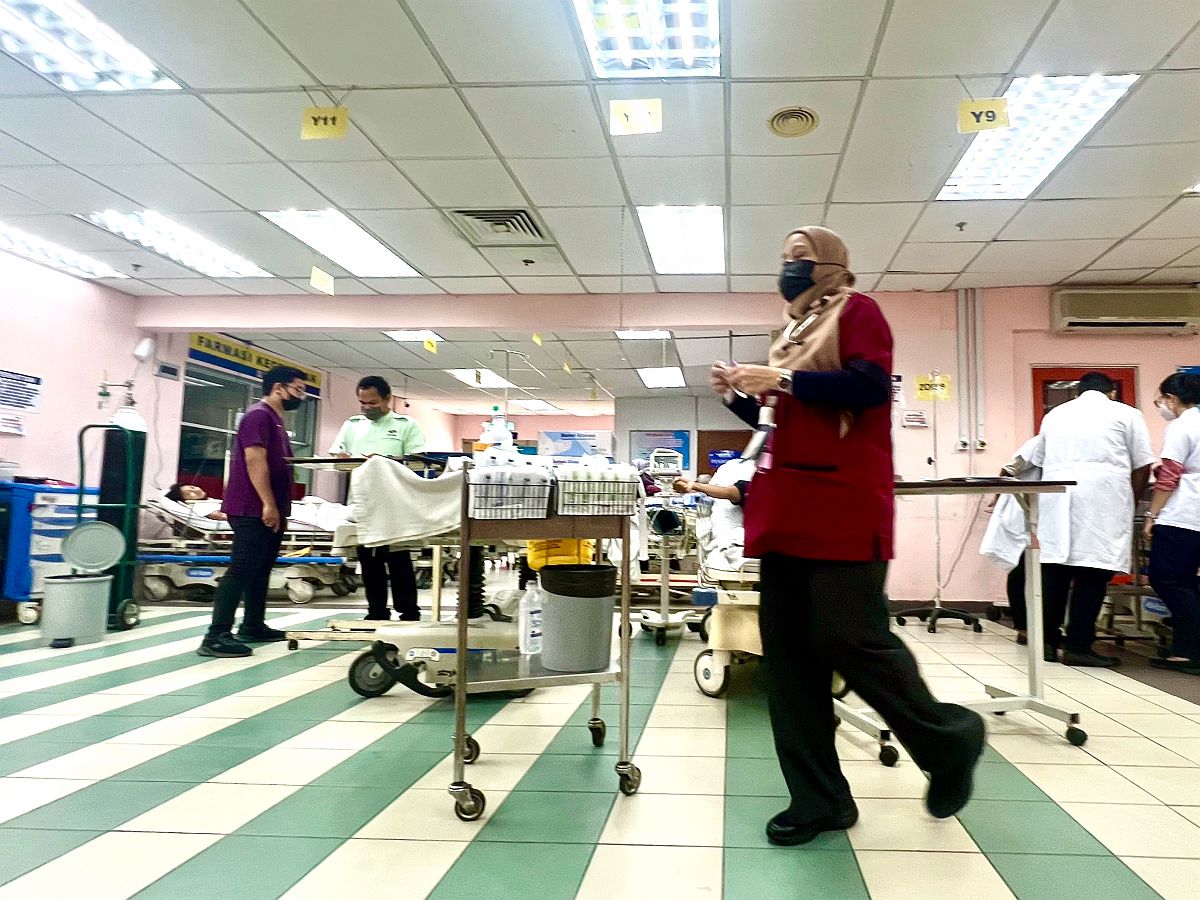
The Ministry of Health (MOH) on March 17, 2026 announced that the medical graduate intake for housemanship has halved since 2019.
This is not just a statistic. It is a signal that a vital system is quietly losing its future workforce.
In January 2026, only 529 graduates turned up for 5,000 housemanship training slots. At first glance, it may look like a simple mismatch. In reality, the system is no longer asymptomatic, and the pathology is now clearly manifesting now.
For decades, we worried about oversupply. Today, we are staring at the opposite problem: a shrinking pipeline of young doctors willing to enter and remain in public service.
If this trajectory continues, we must ask an uncomfortable question: are we heading back to the 1960s and 1970s, when we had to import doctors from India, Pakistan, Egypt, and Myanmar just to keep the system running?
The Consequence: A System Without Renewal
Health care is not just about infrastructure. It is about people and more importantly, continuity of people.
Without sufficient house officers, there is no new blood and no replenishment, and the natural progression of workforce collapses.
Medical officers (MOs) will be forced to absorb house officer duties, young specialists will be pulled back into MO-level work, and senior specialists and consultants will continue to carry the burden of complex care with diminishing support below them.
This is not just inefficiency. This is structural fatigue, and over time, fatigue becomes failure.
The Broken Pipeline
We must ask honestly this question: how many doctors do we actually need to produce each year?
And of those who graduate, how many will stay after housemanship? And of those who stay, how many will remain through their MO tenures?
How many will endure long enough to become specialists, and beyond that, subspecialists? Under the current contract system, many leave early due to uncertainty, lack of career progression, and poor recognition.
Those who stay often do so at significant personal and professional cost. The system, as it stands, is not rewarding enough to retain talent.
In effect, we are not just losing doctors. We are losing futures, future healing hands and potential clinical experts who will never make it there.
When Policy Fails, The Market Responds
When public health care becomes less attractive, more young doctors drift toward private general practice or aesthetic medicine.
Clinics will appear like mushrooms after the rain, not always out of passion, but out of survival.
Consultation fees may be lowered to compete, working hours extend to sustain income, and some doctors may begin to sell or promote supplements, or venture into aesthetic procedures without adequate backup or governance.
And when the system pushes hard enough, even good doctors are forced into difficult compromises.
The MOH Knows, But What Next?
The MOH itself has acknowledged that this is a serious issue. They have highlighted a sharp yearly decline in recruitment and a high resignation rate among doctors, from young doctors up to highly trained. They have also acknowledged that the reasons offered by statistic are multifactorial.
But this is not new. This problem became chronic from the very first year the contract system was introduced into public health care in 2016.
Year after year, the warning signs have been visible, including declining intake, poor retention, and waning morale.
And yet, despite recognising the severity and long-term implications, the response has been slow, fragmented, and insufficient.
After years of data, trends, and lived experience from the ground, one must ask: what exactly is the plan?
Because at this point, continuing with a “No Action, Talk Only” attitude is no longer acceptable. The system is already showing strain, and the cracks are no longer theoretical.
There is gradual service strain in district hospitals, increasing pressure in primary care settings, manpower gaps that are patched, not solved. These are early signs of systemic weakening.
And yet, there has been no clear, aggressive, or decisive reform that matches the scale of the problem.
There is no bold restructuring of the contract pathway, no convincing long-term retention strategy, and no visible urgency proportionate to the risk.
Incrementalism in the face of a structural crisis is not neutrality. It is complicity in the decline.
The Deeper Concern: Quality Of Care
This is not just about numbers. It is about experience, clinical acumen, and depth of training. When fewer doctors stay long enough.
Clinical maturity is lost, mentorship chains weaken, and the system risks producing a workforce that is fragmented, fatigued, and less supported.
If this continues, we must ask ourselves: what kind of medical service are we building for the future?
When the day comes that we or our loved ones become patients, will we be able to trust, rely on, and feel safe within this system?
By then, rebuilding will take far longer than it took to break.
The time to act is not when the system collapses. The time to act is now, while there is still something left to save.
The author is a clinician in public service.
- This is the personal opinion of the writer or publication and does not necessarily represent the views of CodeBlue.


