

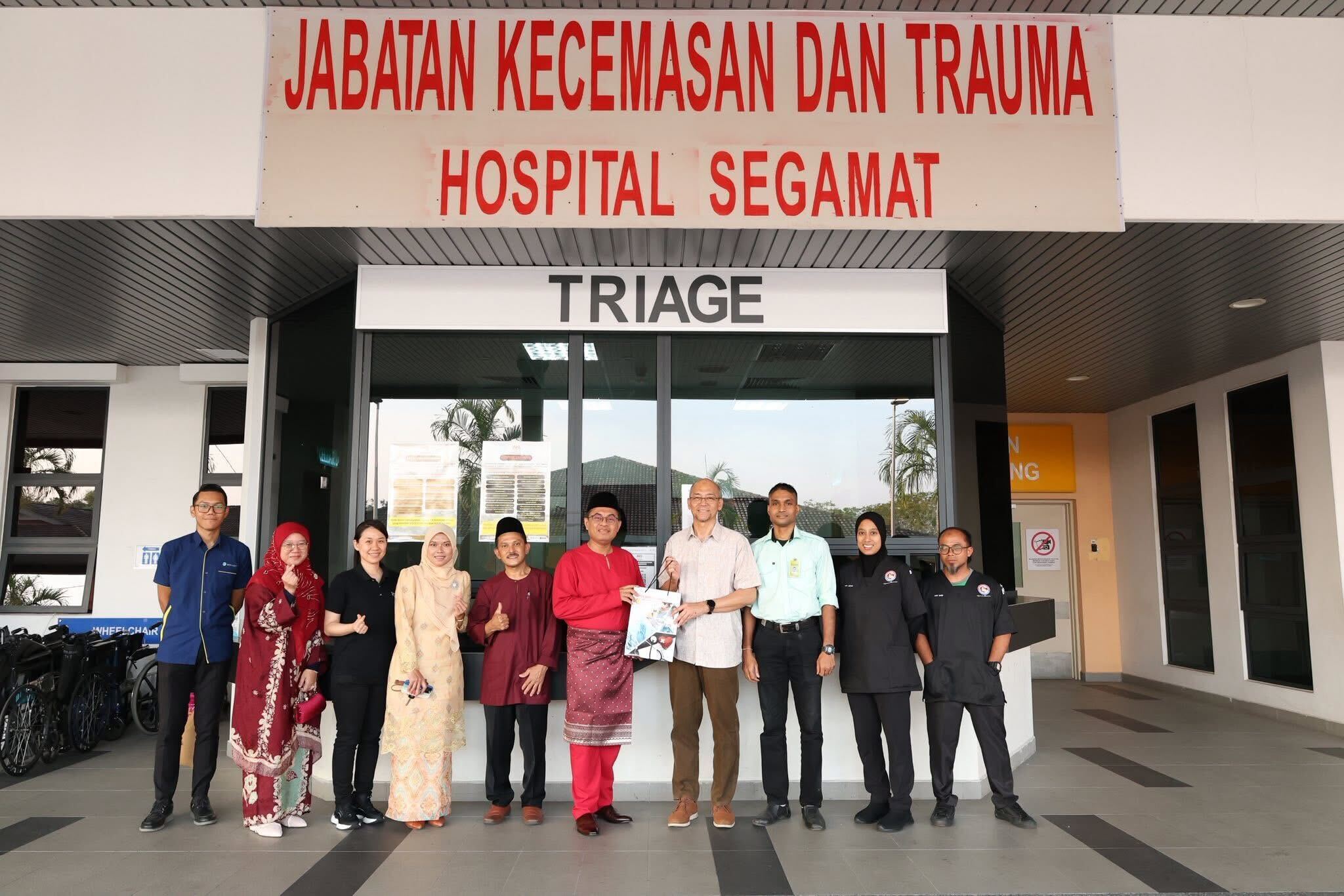
The Emergency and Trauma Department of Segamat Hospital would like to draw the attention of the Johor state health department to the issue of the uneven distribution of medical officers (MO) between health facilities in the Segamat district, particularly between health clinics under the District Health Office and the clinical departments at Segamat Hospital.
Based on current information, several major health clinics in the Segamat district have significantly higher numbers of medical officers compared to clinical departments in the hospital.
For example, Segamat Health Clinic has approximately 25 to 30 MOs, whereas Labis Health Clinic has approximately 20 MOs.
In contrast, clinical departments at Segamat Hospital have, on average, only about 8 to 10 MOs per department, who must also cover on-call duties between eight and 15 times per month to ensure continuity of hospital services.
This situation has a very significant impact on the operations of the Emergency and Trauma Department at Segamat Hospital, which operates 24 hours a day as the main entry point for emergency patients in the Segamat district and surrounding areas.
At present, the department has only 13 MOs. In less than two weeks, this number will decrease to 11 due to the resignation of two officers. Workforce constraints have forced the Emergency Department to operate on a three-shift model; however, in most situations only one MO is assigned per zone.
This results in highly challenging doctor-to-patient ratios, such as:
- Green Zone: approximately one MO to 25 patients.
- Yellow Zone: approximately one MO to 15 patients.
- Red Zone: approximately one MO to five critical patients.
An alternative is to implement double shifts or extend working hours by reducing the three-shift system to two shifts. Recently, we have been required to work double shifts at least once a week.
If the number of medical officers continues to decline, we will need to work double or extended shifts more frequently. Working continuously for 12 to 14 hours, often alone and almost daily in the Emergency Department, is extremely burdensome, as we are frontline medical officers who receive a constant and unpredictable flow of patients, most of whom require immediate assessment and treatment.
Although emergency medicine specialists also step in to assist in patient management across treatment zones to mitigate this shortage, these measures remain insufficient, as they also have to carry out on-call duties, clinical administration, training supervision, and management of critical cases.
This situation not only places significant pressure on the medical officers on duty, but also has the potential to compromise patient safety, increase waiting times for treatment, and affect the sustainability of emergency service operations if the manpower shortage persists.
In light of this, we respectfully request that the Johor state health department reassess the distribution of medical officers among health facilities in the Segamat district, taking into account the operational needs of a hospital that provides round-the-clock emergency care and the increasing workload.
The Emergency Department of Segamat Hospital sincerely hopes that this imbalance will be given due attention so that district hospitals such as Segamat Hospital do not continue to operate under prolonged human resource constraints.
CodeBlue has requested comments from Segamat Hospital and the Johor state health department.
The author is a medical officer at Segamat Hospital. CodeBlue is providing the author anonymity because civil servants are prohibited from writing to the press.
- This is the personal opinion of the writer or publication and does not necessarily represent the views of CodeBlue.


