

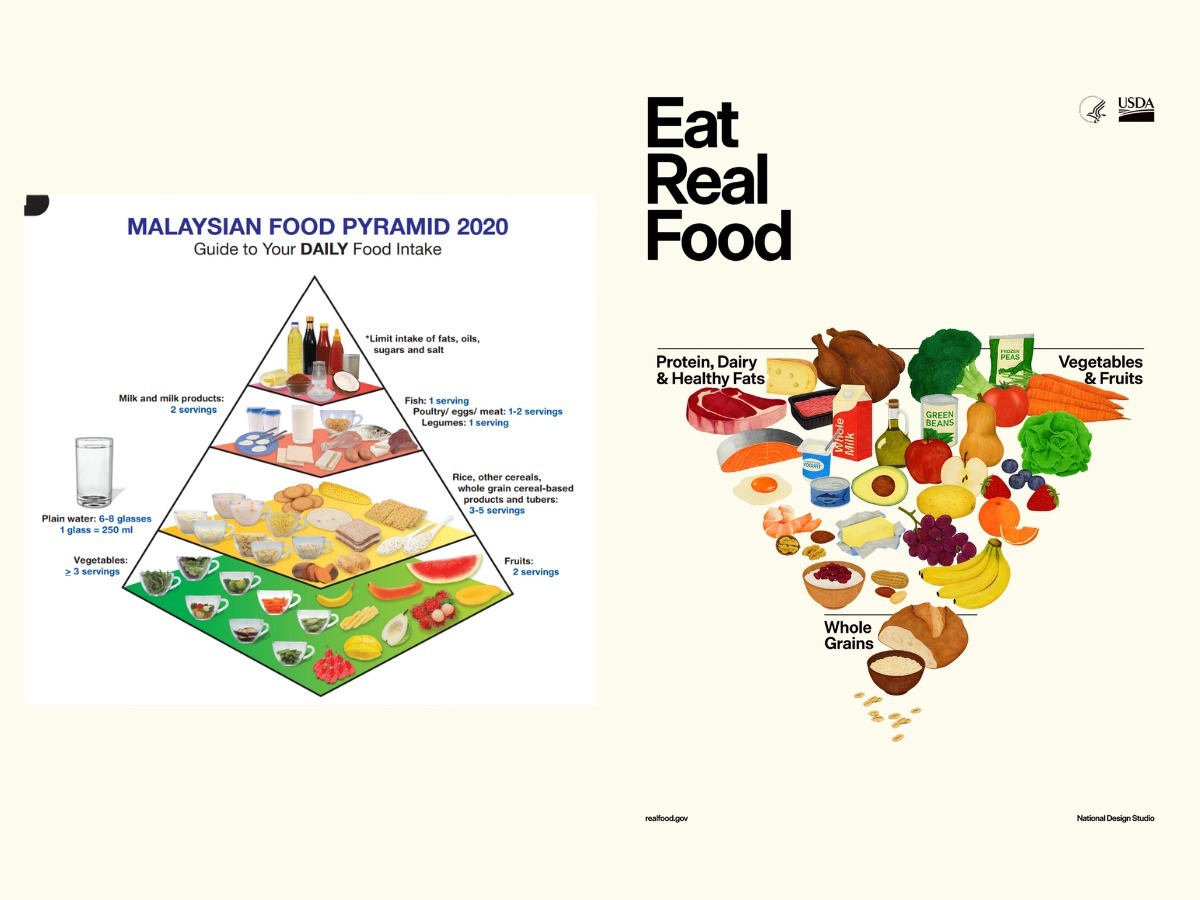
KUALA LUMPUR, Jan 20 — Malaysians should follow Malaysia’s dietary framework instead of adopting the United States’ new inverted food pyramid, as local nutrition experts argue that Malaysia’s food pyramid is evidence-based and better suited to local diets, costs, and food supply conditions.
The updated US 2025-2030 dietary guidelines by US Department of Health and Human Services Secretary Robert F. Kennedy Jr and US Department of Agriculture Secretary Brooke Rollins come with an inverted food pyramid graphic that puts “real food” like protein, dairy, healthy fats, vegetables, and fruits at the top, with whole grains like oats and rice at the bottom.
The new guidelines, which also cast American farmers and ranchers as central to a revamped food system, urge Americans to steer clear of refined carbohydrates and highly processed foods.
US officials say the guidance can help prevent chronic disease or slow its progression, with an emphasis on higher-protein meals, and cutting added sugar and highly processed foods. Like America, Malaysia is also facing a non-communicable disease (NCD) crisis that eats up a large chunk of health care spending.
But Malaysian nutritionists told CodeBlue that food guides cannot be imported wholesale. Dietary advice is shaped by a country’s eating habits, disease trends, food prices, and what households can realistically buy and cook.
Tee: US Food Pyramid Overemphasises Animal Proteins

Senior nutritionist and IMU University adjunct professor Dr Tee E Siong said debates over whether a pyramid should be upright or inverted misses the point, as both formats follow the same logic.
“Firstly, the principle of the pyramid, whether it is the conventional upright format or inverted pyramid, is the same. It is a visual guide for consumers to choose food items/groups for their daily diets,” Dr Tee told CodeBlue in an email response.
“Those foods placed at the broader parts of the pyramid are to be consumed more, and as we move down (or up) the pyramid, the food items are to be consumed in lesser amounts. The food items at the smallest part (the tip of the pyramid), is to be consumed the least.”
Still, Dr Tee said Malaysia should not follow the US template, which he described as too protein-heavy, particularly in how it visually elevates animal foods.
“In the US dietary guidelines, the food groups at the broadest part (top of the inverted pyramid) are protein-rich animal foods, including chicken, dairy foods, animal meat, salmon fish, egg, etc. I do not think Malaysians should follow this recommendation,” Dr Tee said.
“I would suggest keeping the approach of the current Malaysian pyramid wherein protein-rich animal foods are at the mid part of the pyramid, to be consumed moderately.”
Eating more animal foods, he said, leads to higher cholesterol levels and more animal-based saturated fats that are unhealthy. Red meat and processed meats are reportedly linked to higher risk of cardiovascular disease and certain cancers.
The new US dietary guidance seems to contradict itself, Dr Tee noted, by emphasising the importance of high fibre content in whole-grain food, but placing whole grains at the tip of the pyramid.
Dr Tee said Malaysia’s existing guidance already aligns with the US emphasis on fruits and vegetables.
“We can see that in the US pyramid, vegetables and fruits are also at the largest part,” Dr Tee said. “This is in line with the current Malaysian pyramid, wherein vegetables and fruits are placed at the base of the pyramid, to be consumed the most.”
Dr Tee also pointed out that Malaysia’s bigger dietary problem was not packaged ultra-processed foods, but the sheer scale of eating out.
“There is another segment of the food environment that I am afraid we have not given sufficient attention, i.e. the meals consumed away from home,” he said. “Large segments of the population eat at least one to two meals away from home, in a huge variety of eating places (hawker centres, kopitiam, cafes, restaurants) and food delivery services.”
“We shouldn’t miss out on the main sources of energy and nutrient intake of the masses – the away-from-home meals,” he added.
Dr Tee said Malaysia’s diabetes messaging can also become too narrowly focused on sugary bottled drinks, while downplaying the role of refined carbohydrates like white rice and portion sizes, as well as made-to-order sugary drinks in eateries. Refined carbs, he stressed, still raise sugar intake.
“Excess carbohydrates will be converted to fat and stored and increase risk to overweight and obesity, which are key factors for increasing risk to diabetes, aside from other NCDs. So the note to reduce carbs in the plate is relevant.”
NSM Defends Rice’s Place In Malaysian Food Pyramid, But Warns Against Overeating

The Nutrition Society of Malaysia (NSM) Council similarly pushed back against the idea of importing the new US model that may not be “culturally appropriate or practical”.
NSM noted that the US inverted food pyramid was a response to escalating diet-related NCDs, particularly obesity, diabetes, and cardiometabolic disorders. These are the same chronic diseases affecting Malaysians.
“Their approach is based on their country’s food environment and eating habits, which are considerably different from those in Malaysia. Malaysian diets are culturally diverse and traditionally carbohydrate-centred (e.g., rice, noodles, tubers), which are served with dishes featuring various protein sources and vegetables,” NSM told CodeBlue in a statement.
NSM said Malaysia’s dietary guidelines are based on scientific evidence that is considered alongside the country’s local food environment and eating habits.
“In Malaysia, it is important that we follow our own local dietary recommendations rather than directly adopting food pyramids from other countries,” said NSM.
“Placing rice above protein in our food pyramid is scientifically consistent with our national nutrient recommendations and reflects local eating patterns, food availability, and cultural context.
“However, that said, the key message is not to overeat rice, but to choose appropriate serving sizes and combine it with adequate protein, vegetables and healthy fats to achieve a balanced diet.”
NSM noted that Malaysia’s dietary guidelines recommend that at least half of our cereal and cereal-based foods come from whole grains, such as brown rice, oats, barley, and corn.
“In practical terms, Malaysians can continue to eat white rice, but are encouraged to moderate portions and, where possible, gradually include more whole-grain choices as part of a balanced meal.”
While NSM described Suku-Suku Separuh as “simple, practical, and public-friendly”, it said the main problem with the Ministry of Health’s (MOH) healthy plate model was insufficient differentiation of carbohydrate quality, like the lack of a clear distinction between whole grains and refined carbs.
Nor does Suku-Suku Separuh explicitly address processed foods, added sugars, or sugar-sweetened beverages that are the key drivers of current NCD trends.
“Given changing food environments and eating behaviours, there is scope to strengthen messaging on food quality rather than just food groups,” said NSM.
MOH: Malaysian Food Pyramid Based On Science, Culture, Food Availability

The MOH’s nutrition division said Malaysia is aware of international discussions on alternative dietary frameworks, including the US inverted pyramid, but does not plan to adopt it.
“National dietary guidance in Malaysia is developed based on robust local scientific evidence, population nutritional status, prevailing dietary patterns, disease burden, cultural and socioeconomic considerations, and food availability,” MOH’s nutrition division told CodeBlue.
“Accordingly, MOH does not currently consider the adoption of an inverted food pyramid model.”
The MOH said its latest 2020 food pyramid was an update to its 2010 pyramid by replacing carbohydrate-based foods with vegetables and fruits at the base, reducing carb intake to 50 to 65 per cent, increasing protein intake to 10 to 20 per cent, and raising healthy fat intake to 5 per cent.
Vegetables and fruits should be consumed in the largest amounts, with recommended intakes of at least three servings of vegetables and two servings of fruits per day.
“The Ministry of Health does not advocate for the exclusion of any major macronutrient group. Instead, the national dietary approach emphasises balance, moderation, portion control, and food quality.
“Ongoing refinements to nutrition messaging are guided by scientific evidence, population health data, and overall dietary patterns, rather than short-term dietary trends,” said the nutrition division.
MOH said Suku-Suku Separuh remains central to Malaysia’s public nutrition messaging. Citing a large local study by Tan et. al, 2023, the ministry said this indicated that familiarity with the concept was linked to improved fruit and vegetable intake.
“While the Suku-Suku Separuh concept remains relevant, MOH will further enhance messaging related to food quality, degree of processing, and healthier food choices within each food group,” it said.
KPKM Pitches ‘Farm-To-Plate’ Campaign

The Ministry of Agriculture and Food Security (KPKM) framed the food pyramid debate through production capacity and food system resilience. KPKM said Malaysia’s supply-side strategy is already built around the Malaysian Dietary Guidelines (MDG) 2020.
“MDG serves as a strategic framework, particularly the Suku-Suku-Separuh plate, which has a moderate portion of carbohydrates and proteins, that aligns seamlessly with Malaysia’s production strengths in staples like rice and poultry,” KPKM told CodeBlue in a statement.
“Our domestic production strategies are specifically optimised to support this existing, evidence-based national framework, ensuring that a healthy diet remains both sustainable and affordable for all Malaysians.”
Malaysia is nearly self-sufficient in poultry, with a 90.2 per cent self-sufficiency ratio for chicken, but not rice (56.2 per cent), beef (14.7 per cent), or pork (69.6 per cent).
KPKM said its strategy is guided by the National Agrofood Policy 2021-2030 and the upcoming National Food Security Policy 2030, which focus on strengthening self-sufficiency for key food categories like crops, fisheries, and poultry.
But KPKM also called for closer collaboration with the MOH on a joint public campaign through a “Farm-to-Plate” advocacy model, arguing that this synergy aligns the demand-side goals of Suku-Suku Separuh with the supply-side realities of national food security.
“A unified campaign is essential to shift consumer preference toward local seasonal fruits and vegetables, emphasising their nutritional advantages over imported alternatives,” KPKM said.
“This approach simultaneously improves public health and drives necessary demand for domestic produce, vital for supporting smallholder farmer livelihoods.”
KPKM added that a Farm-to-Plate campaign would also boost national food security by shifting consumer preferences toward climate-resilient and affordable local produce.
“While MOH focuses on the reduction of non-communicable diseases, KPKM may leverage this health-conscious demand to justify further investments in agriculture modernisation across the value chain.
“Positioning healthy eating as a strategic pillar of national food security empowers the nation to curtail food import dependency, ultimately fostering a sustainable food ecosystem that is accessible to all.”
Gopeng MP: Fix Implementation, Not The Pyramid

Gopeng MP Tan Kar Hing said Malaysia’s nutrition framework is broadly on track, but implementation is uneven.
“Malaysia’s current national food pyramid and the healthy foods framework are already on the right track,” Tan said. “The real challenge has never been policy design, but execution, consistency, and public awareness.”
The PKR lawmaker said Malaysia should respond to local lifestyle realities rather than mirror overseas messaging.
“Therefore, the focus of our messaging should not be about replicating overseas campaigns, but about responding to Malaysia’s modern lifestyle realities,” Tan told CodeBlue.
He also called for nutrition promotion to be driven across ministries, not left to the MOH alone.
“It should be advanced as a joint policy effort involving MOH, KPKM, and also the Ministry of Education, with clear and complementary roles.”


