

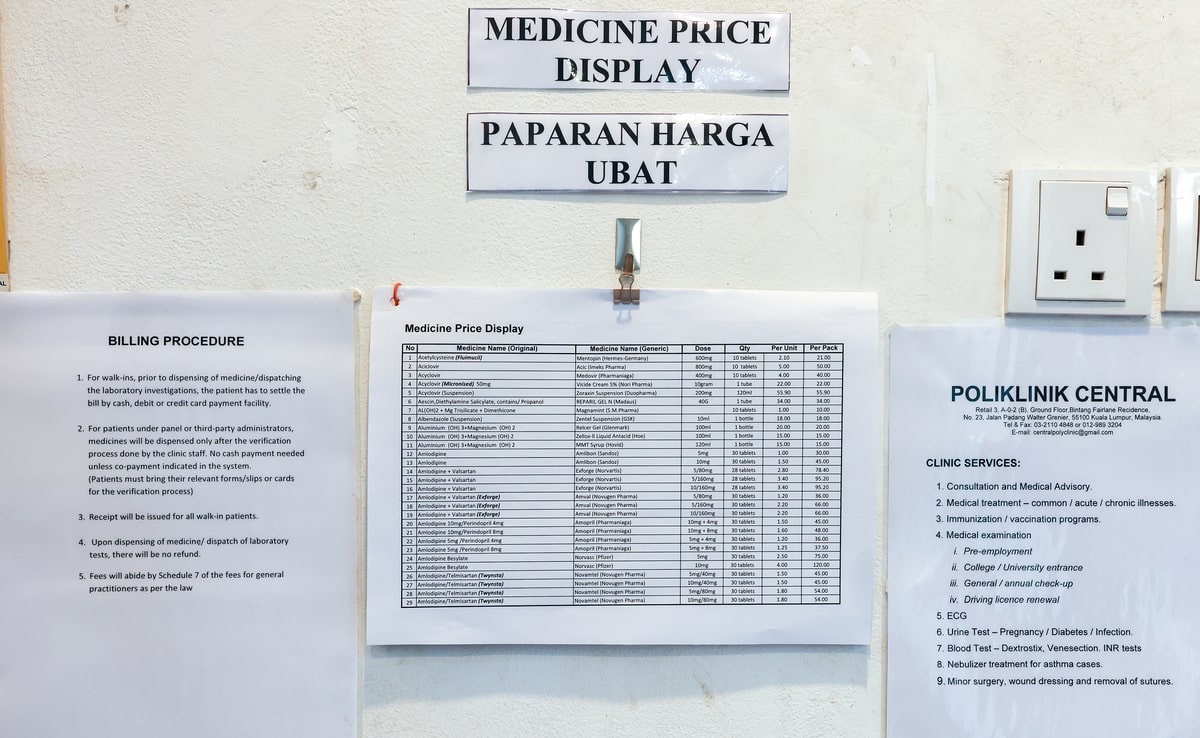
KUALA LUMPUR, August 4 — The government has reversed its promise to extend the grace period for drug price display enforcement until the outcome of a judicial review filed by medical and dental groups.
In a joint statement by the Ministry of Health (MOH) and the Domestic Trade and Cost of Living Ministry (KPDN) yesterday, both ministries said the grace period of educational enforcement would be continued from August 1 only until September 30, during which reminder letters may be issued for non-compliance.
“From October 1, 2025, compounds can be issued for repeat offences. Full enforcement will begin on January 1, 2026,” said the MOH and KPDN.
During the first three months of educational enforcement since the drug price display order came into force on May 1, authorities inspected 842 facilities comprising private medical clinics, dental clinics, and hospitals, as well as community pharmacies, showing a 57 per cent compliance rate of satisfactory implementation.
Both ministries took note of a judicial review application filed in the High Court here on July 24 by seven associations representing medical and dental practitioners, together with a Sabah-based general practitioner (GP), against the Price Control and Anti-Profiteering (Price Marking for Drug) Order 2025 [P.U.(A) 141/2025].
“However, at the time of issuing this statement, there has yet to be a court order instructing a stay of the implementation or enforcement of the P.U.(A) 141/2025 Order. Therefore, the P.U.(A) 141/2025 Order remains valid and in force,” they said.
The price display order under the Price Control and Anti-Profiteering Act 2011 (Act 723), which is in KPDN’s jurisdiction, requires community pharmacies and private health care facilities, including GP clinics, specialist clinics, dental clinics, and hospitals, to display retail medicine prices.
“MOH and KPDN remain committed to implementing this initiative in an inclusive, phased, and prudent manner to ensure that its benefits can be enjoyed by consumers and contribute to increased transparency, accountability, and trust in the country’s health care system.”
Last Wednesday, Health Minister Dzulkefly Ahmad promised an extension of “educational enforcement” of the drug price display mandate “until the court decides on the judicial review.”
Besides the judicial review application by the eight applicants against the drug price display order under Act 723, the Private Medical Practitioners Association of Selangor and Kuala Lumpur (PMPASKL) and Medipulse Healthcare Sdn Bhd, which operates the Klinik Medipulse group of clinics, filed a separate judicial review bid against the mandate on July 29.
Both lawsuits seek to quash the medicine price display mandate, besides requesting the court to stay enforcement against private health care facilities. Case management for the suit by the eight applicants is set for August 22.
The July 24 suit by eight applicants contended that the drug price display order interfered with the right of doctors and dentists to prescribe poisons to their patients under the Poisons Act 1952 for the purpose of medical or dental treatment.
The July 29 suit by PMPASKL and Medipulse claimed that the drug price display order cannot interfere with legislations specific to health care, which they characterised as a “health care regulatory regime” comprising five laws.
Prime Minister Anwar Ibrahim’s administration has yet to raise private GPs’ consultation fees that have stagnated at a rate of RM10 to RM35 for more than three decades since 1992, despite a promise to do so before imposing the MOH’s price transparency policy. Doctors’ groups demand a revised quantum of RM50 to RM80.


