

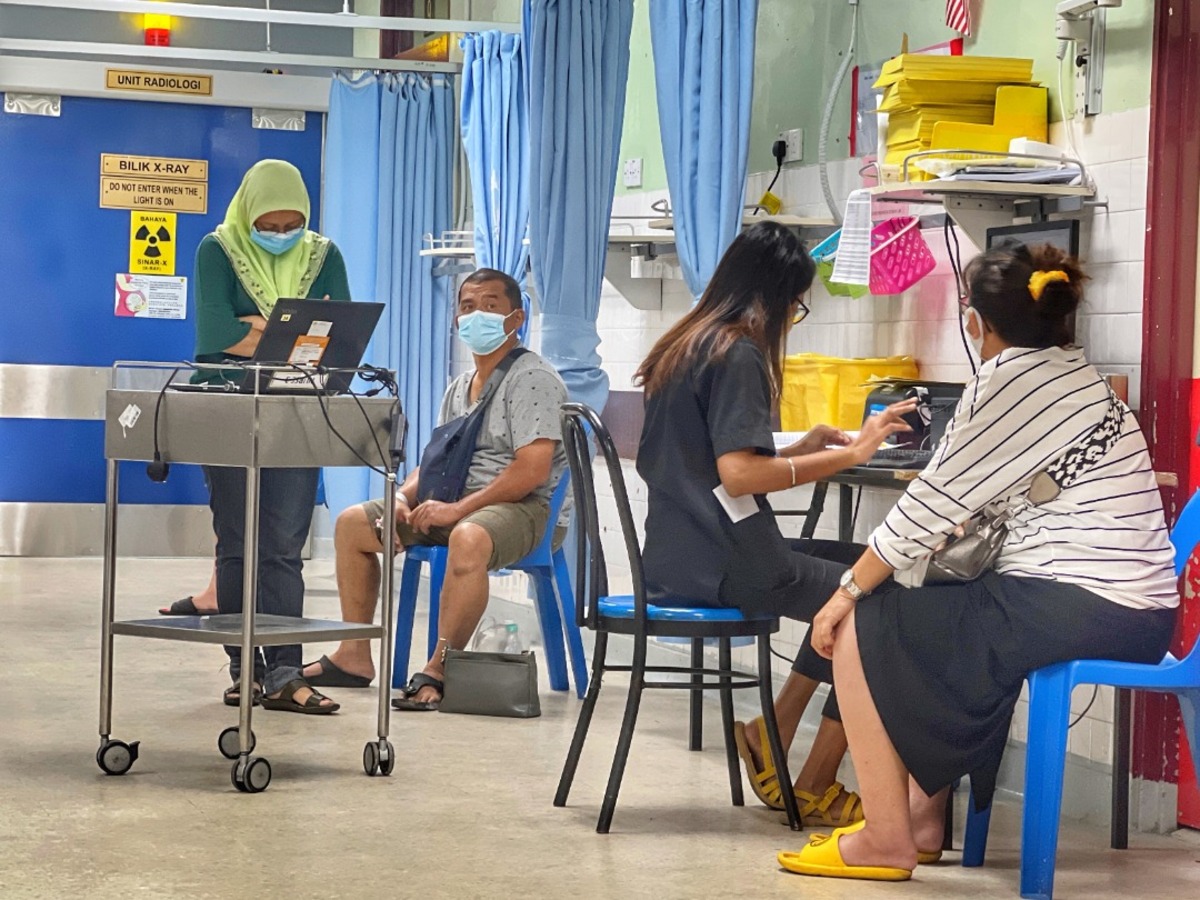
KUALA LUMPUR, April 21 — In a CodeBlue survey, 62 per cent of medical officers (MOs) say they would rather quit government service than serve away from their home state.
CodeBlue’s poll of 938 contract and permanent MOs in the public sector across Malaysia also showed that 61 per cent ranked state as the most important factor for them in deciding where to serve, exceeding department to pursue specialisation (29 per cent) and type of facility (10 per cent).
The top three preferred states to serve were Selangor, Perak, and Kuala Lumpur, matching the most common home towns of respondents. Another 11 per cent preferred placements anywhere in the Klang Valley.
Subsequent preferred states to serve were Johor, Kelantan, Penang, and Kedah (5 per cent each for all), similar to the list of home towns (albeit in different order).
Only 3 per cent said they were willing to be posted to any state in the peninsula, while an even smaller minority (2 per cent) didn’t mind where they served.
For many peninsular states – Selangor, Kuala Lumpur, Penang, Kelantan, Johor, Kedah, Negeri Sembilan, Terengganu, and Melaka – natives exceeded preferred placements in the respective states. (The sole respondent born in Labuan, a permanent MO who is currently working in Pahang, said he didn’t mind serving anywhere; no one chose Labuan specifically as a preferred placement).
The reverse held for Putrajaya, Sabah, and Perlis, where preferred placements exceeded those born there. Preferred placement and home town percentages matched for Perak, Sarawak, and Pahang.

Perak Case Study: Not All Perak-Borns Want To Serve Perak And Vice Versa
In CodeBlue’s survey, MOs do not necessarily prefer to serve in the state where they were born. Looking at Perak as an example, 60 per cent (89 respondents) of 148 Perak-born respondents prefer to serve their home town.
The remaining 40 per cent, who did not choose Perak specifically as their preferred placement, selected Kuala Lumpur, Selangor, “anywhere in the Klang Valley”, “any state in the peninsula”, certain peninsular states, Sarawak, as well as a couple not minding where they served. Most of these respondents said they wanted to serve in a state where their family currently lives.
Crucially, over half of the 59 Perak-born respondents, who do not prefer Perak specifically for placement, said they would quit if they were forced to choose between serving away from their home state and resigning from government service.
Likewise, not all 146 MOs who said they prefer to serve in Perak were born there, with 39 per cent coming from outside the state. Most of the 57 non-Perak natives who want to work in Perak said they wanted to serve where their family resides.
Looking at our case study of Perak, there appears to be contradictions in respondents’ attitudes, where some say they would rather quit than serve outside their home state but, at the same time, they also chose preferred placements outside the state where they were born.
CodeBlue has two interpretations for this apparent discrepancy. For the question on choosing between quitting and serving away from their “home state”, the phrase “home state” can be perceived as their family’s location, not just where they were born. Another possibility is that even though this is an independent survey, some respondents behaved the same as they would when actually applying for placements in the ePlacement system, i.e. choosing the next best thing (like Klang Valley) instead of their home state.
(Below is a slide show of two graphics on the Perak case study. Tap left or right on the arrows. You can also tap parts of whatever chart for labels to pop up if they’re not immediately visible).
Family Trumps Career
Among 901 respondents who answered why state is an important factor for them in deciding placements, the vast majority at 86 per cent want to serve where their family currently lives. Only 30 per cent cited better career development opportunities.
Dozens of doctors raised family concerns, whether it was to get married and raise a family, or to take care of their young children or elderly parents.
A contract MO in her 30s, who is currently working at a public health clinic in Johor, wrote that she is pregnant in her third trimester and living away from her husband and family in the Kang Valley. The doctor, who prefers to serve in Selangor, said she has been driving up and down to visit her family regularly.
“Who is going to be responsible for my safety and even my partner? Financials affected. We rented two houses: one in KL and one in Johor. Travelling cost. Emotional status affected,” she said.
A 30-something female permanent MO, who is working at a Ministry of Health (MOH) hospital in her preferred state and hometown of Terengganu, wrote: “I need to be near my family, so that my parents can look after my child. My parents and I don’t trust outside caretakers/ Taska. At least my family is around when I am on-call.”
An unmarried contract MO, who is currently working at a government hospital in her hometown of Perak, wrote: “I am the elder daughter, father is ill; I need to take care of my old parents.” However, she also said she was willing to serve in any state in the peninsula.
The top two factors that would motivate MOs to serve in Sabah, Sarawak, or rural or interior areas were higher pay or incentives (65 per cent) and fixed service duration, for example two years, with guaranteed transfer to their state of choice after that (64 per cent).
More than half (57 per cent) wanted relocation costs to be covered by the government. Contract officers relocating for permanent positions must cover their own transfers because the MOH’s Human Resource Division (BSM) considers them to be new staff joining the service, despite having worked for years under contract previously.
Only 6 per cent said they would absolutely reject placements in Sabah, Sarawak, or rural or interior areas, or that nothing would motivate them to serve there.
Despite fierce criticism from government doctors about placements, the majority of respondents in CodeBlue’s survey said they’re currently serving in their preferred state (63 per cent), type of facility (74 per cent), and hospital department (70 per cent).
This is reinforced by the similarity between the most common current workplaces (Perak, Selangor, and Kuala Lumpur) and respondents’ top three preferred states to serve (Selangor, Perak, and Kuala Lumpur).
On which facility MOs would like to serve in, 54 per cent picked tertiary hospital, followed by Klinik Kesihatan (34 per cent) and district hospital (9 per cent). Other preferred facilities include district health offices, state health departments, university hospitals, or MOH’s headquarters in Putrajaya.
(Below is a slide show of graphics on CodeBlue’s survey. Tap left or right on the arrows. You can also tap parts of whatever chart for labels to pop up if they’re not immediately visible).
Over Half Oppose First-Come, First-Served Placements
Following the ePlacement debacle, 57 per cent were against continuing medical officer placements on a first-come, first-served basis. Only 27 per cent supported this policy, while 16 per cent were unsure.
Health Minister Dzulkefly Ahmad said last month that the new ePlacement system won’t continue to be first-come, first-served, but utilise other algorithms to be “fairer”. However, MOH has yet to specify what this new “merit-based” system will look like.
More than 2,200 contract medical officers were affected by the nullification of the February 27 ePlacement results for permanent placements, due to a system glitch. The new ePlacement session for this cohort is expected to be held early next month.
On CodeBlue’s suggestion to replace fixed intakes of centralised placements by BSM with year-round recruitment from individual hospitals, akin to a job marketplace, 47 per cent supported the idea. Some 31 per cent were unsure, while 22 per cent rejected the proposal.
Demographics: Mostly Senior MOs, Two-Thirds Women, Aged 20s To 30s, Based In MOH Hospitals
Slightly more than half of respondents (52 per cent) are contract medical officers. The vast majority are senior doctors with at least three years in government service: 3-5 years (56 per cent), over seven years (18 per cent), and 6-7 years (14 per cent). Only 12 per cent have served for less than three years in the public health care sector.
About 74 per cent of respondents are currently working in an MOH hospital, followed by Klinik Kesihatan (21 per cent), and university hospitals (4 per cent). Other places of work (1 per cent) include district health offices or state health departments.
Nearly two-thirds of respondents are women at 65 per cent. The vast majority of total respondents are in their 30s (69 per cent) and 20s (29 per cent).
More than half of respondents (52 per cent) are married with either at least one child (32 per cent) or no children (20 per cent). About 47 per cent of respondents are single.
A quarter of respondents are currently working in the Klang Valley (Selangor, Kuala Lumpur, and Putrajaya). Some 15 per cent are serving Borneo (10 per cent Sarawak and 5 per cent Sabah). The survey had respondents located across every state and territory in Malaysia.
Five Takeaways: Family, Borneo Isn’t A Lost Cause, Follow Doctors’ Preferences
Below are the main findings from CodeBlue’s survey:
- MOs would rather quit than serve away from their home state or family (note: most respondents are senior doctors).
- Family is more important to MOs than career progression.
- Generally, MOs prefer to serve in their home town or where their family resides. Only a small minority are willing to serve anywhere in the peninsula or country.
- MOs can be persuaded to choose placements in Sabah, Sarawak, or rural areas with better pay and fixed service duration, as only a small minority absolutely refuses to serve in those places.
- The majority of MOs oppose a first-come, first-served basis for placements.
Overall sentiments about placements can be summed up by this medical officer’s statement: “Just let us choose what we like.”
Survey Methodology
CodeBlue’s survey was conducted online on SurveyMonkey in English and Bahasa Malaysia for nine days from April 8 to 17, 2025, guaranteeing anonymity as respondents did not have to sign in with an email address to take the poll.
Anonymity is crucial for polls among civil servants. In response to an optional question for respondents to leave their contact details, an MO wrote: “Sorry, tied up by government pekeliling rule. But I’ve been following CodeBlue since my contract period. You guys are our only voice, and it’s getting louder. Thanks to you, I’m still serving in the government sector. Keep up the good work.”
CodeBlue did not publish the link to the survey to prevent the general public from taking the poll, but distributed the link via WhatsApp to the editorial team’s personal contacts in the public health care sector and asked them to forward it to their networks.
CodeBlue also provided the survey link upon request to those who emailed CodeBlue after verification that they work in the government health service, such as checking the Malaysian Medical Council (MMC) registry.
Overall, the survey collected 942 responses, but we removed 4 respondents who did not match our target audience criteria – i.e. those who are working in the private sector or who have already resigned from public service. A total of 938 responses were used for analysis.
One of the weaknesses with our survey is potential self-selection bias, due to reliance on social networks among respondents who may share similar opinions. However, we believe that our survey is a good representation of overall sentiments among medical officers in the health service, due to the large sample size and representation from every state in a difficult-to-get group.
Following CodeBlue’s poll, we recommend that the MOH conduct focus group discussions to further untangle MOs’ attitudes towards placements. Our survey shows that human attitudes and behaviours are complex; as such, human resources cannot simply be reduced to numbers on a spreadsheet.


