


As health administrators, we are not normally at the frontline of things. But the Covid pandemic wreaked havoc not just on the clinical front but also behind the scenes.
Administrators dealt with disrupted supply chains and the uncertainty of having enough staff due to quarantines or lockdowns.
They had to address the fear of staff working in Covid-afflicted areas when they were not vaccinated, or think about how to protect the foreign workers working alongside us. The level of misinformation was high as the virus evolved faster than our understanding of it.
In 2021, I was not only the CEO of a private health care provider, but also a member of the Compliance and Monitoring Team (CMT) in the Greater Klang Valley Special Task Force on Covid-19 (GKVSTF), which was a joint task force convened and headed by the Ministry of Health (MOH) and the Malaysian Armed Forces to tackle the surging number of Covid cases in the Greater Klang Valley.
As a CMT member, together with members of the Armed Forces medical division and MOH, my job was to go to the ground and assess the situation at all Covid centres, and then give a report directly to the task force, along with recommendations for improvement by 8.30pm daily.
The Delta wave started in May 2021 and we were given two months to come up with ways to cope with the surging cases (and deaths) while waiting for the vaccination campaign to catch up.
People today question the necessity of the Covid vaccine, but perhaps we forget just how easy it was to die of Covid before we achieved herd immunity.
One of the biggest pivots that we had to make was realising that quarantines were not working anymore. As the pandemic spread, contact tracing became less effective.
Quarantine bands could be bought online and there were not enough officers to enforce quarantine orders.
Quarantine centres were filled with relatively well Covid patients (who occasionally posted dance videos to pass their time) while hospitals struggled with patients who ranged from mild coughing cases to being intubated. Health care workers were required to oversee all of them. And there weren’t enough health care workers to begin with.
A decision was made to roll out home quarantine orders and have people self-assess at home. Patients would only require admission if they deteriorated beyond Category 2.
Internally there were lots of questions. Would people know when to seek help? What if patients all died at home because they were unsupervised? How would we allocate resources if patients were all dispersed? Would ambulances be able to cope?
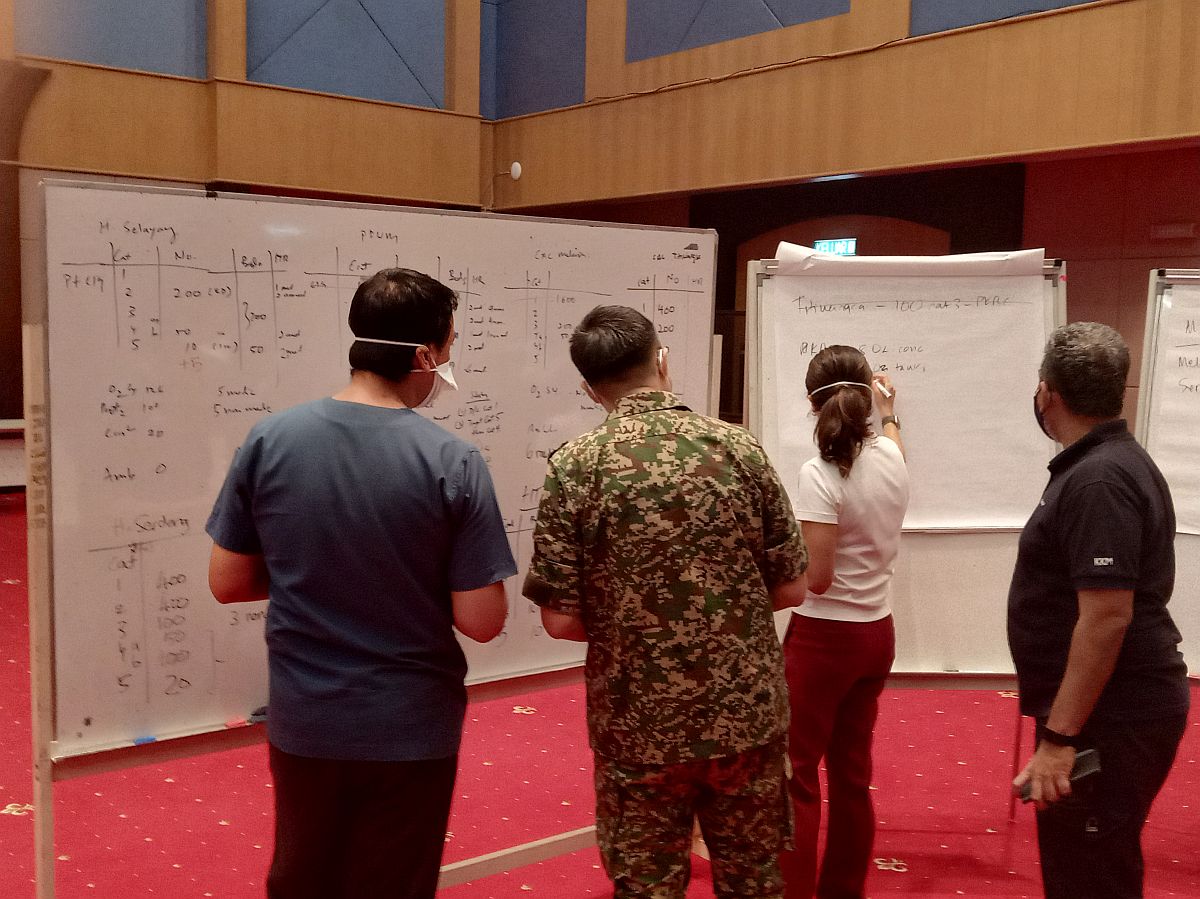
How could we get all the stakeholders involved to understand the impact and prepare for outcomes? To answer these questions, we borrowed a strategy from the Armed Forces. We held a war game. Except in this war game, the goal was to minimise the number of deaths.

We gathered all the stakeholders and cloistered them for one day at the Employees’ Provider Fund (EPF) training centre in Bangi. There were members from MOH, the Armed Forces, university hospitals, engineering teams, logistics teams, private hospitals, general practitioners (GPs), and many others.
We were given scenarios and resources to simulate our responses. As a member of the CMT team, I was given the unenviable task of being the Commander of the war games, coordinating with the various teams and formulating strategies.
Over and over, we would go through scenarios and when the timer stopped, we all looked at the tally to see how many “deaths” had occurred based on the strategies we had.
We were all acutely aware that the decisions we made would have a real-life impact on Malaysians. In the end, we were convinced that home monitoring was the only way we could cope with the surge that was happening, especially when the Omicron variant appeared in late 2021.
We were able to roll out home monitoring because of strong public-private partnerships. MySejahtera was used as a home assessment tool. with data being sent to a central monitoring system that would flag patients that required follow-up.
Call centres were established with the help of companies like TIME.com who provided internet access and mobile devices for a team of medical officers from both public and private sectors to contact these patients.
The ambulance response was further strengthened with additional call centre members from the private sector to help ensure that emergency calls could be attended to.
As vaccination rates increased and the public became educated about the signs and symptoms of Covid, we saw the cases finally start to abate.
Since the Covid outbreak in Malaysia, I have really come to appreciate my colleagues across the health care sector, not just in the MOH, but also the Armed Forces, university hospitals, and even other private companies who came to help (thank you, Mr DIY, for the oxygen tanks).
Covid brought us all together and we realised that the issues we faced were similar, forcing us to view each other from different perspectives.
And I would like to think that at that moment, they also realised that those of us in the private health care sector also genuinely cared about the health of Malaysians.
Private hospitals can and did step up to treat Covid patients and elective patients decanted from public hospitals to reduce waiting times. They offered their resources and support, setting up vaccination centres for the public.
In that moment, we were not the enemy. The virus was.
In the aftermath of Covid, I’ve come to realise how fragile and fragmented our primary health ecosystem is.
There are only roughly 1,000 klinik kesihatan (public health clinics) in the country. At the height of Covid, these clinics were tasked with screening, triaging, and managing Covid patients from all over the country, and they barely coped.
Private GPs, who comprise roughly 90 per cent of primary health providers in Malaysia, were only roped in after during the vaccination campaign via ProtectHealth. And they still mostly remain outside our universal health system.
And yet, primary and preventive care is the one thing that will save us from the next pandemic – be it an infectious disease or a non-communicable disease.
Strengthening our primary care system should be made a priority. The task of monitoring and managing these patients should be done outside hospitals. This would save costs too.
Whether it is a diabetic patient or someone with HIV, we should ensure that all Malaysians have universal access to a regular primary care doctor who understands their history.
Trust is a very important commodity. Given the rampant disinformation that spreads online, having a trusted relationship with a primary care provider is important to provide accurate and appropriate health information to patients.
To maintain trust, we must ensure that the quality of primary care remains high, with more Family Medicine Specialists alongside GPs.
Integrating our primary care network across public and private sectors is also important to give us access to data and enable us to predict and prepare.
Just as the number of cases reported in MySejahtera once gave us clues on what was happening in the community, an integrated digital health system amongst primary care providers is necessary to provide us data that could signal future public health outbreaks.
I welcome Health Minister Dzulkefly Ahmad’s announcement that the MOH is committed to digitising our klinik kesihatan. I hope we go one step further and have health financing to incentivise, develop, expand, and integrate our primary care system across both public and private sectors in order to reach all Malaysians.
We did it once. We should do it again – and make it permanent.
Nadiah Wan is former Group CEO of TMC Life Sciences Bhd and former CEO of Thomson Hospital Kota Damansara (THKD). She served as a member of the Compliance & Monitoring Team (CMT) in the Greater Klang Valley Special Task Force on Covid-19 (GKVSTF) during the Covid-19 pandemic.
This article is part of a special CodeBlue series marking the fifth anniversary of the World Health Organization declaring Covid-19 as a global pandemic on March 11, 2020.
- This is the personal opinion of the writer or publication and does not necessarily represent the views of CodeBlue.


