

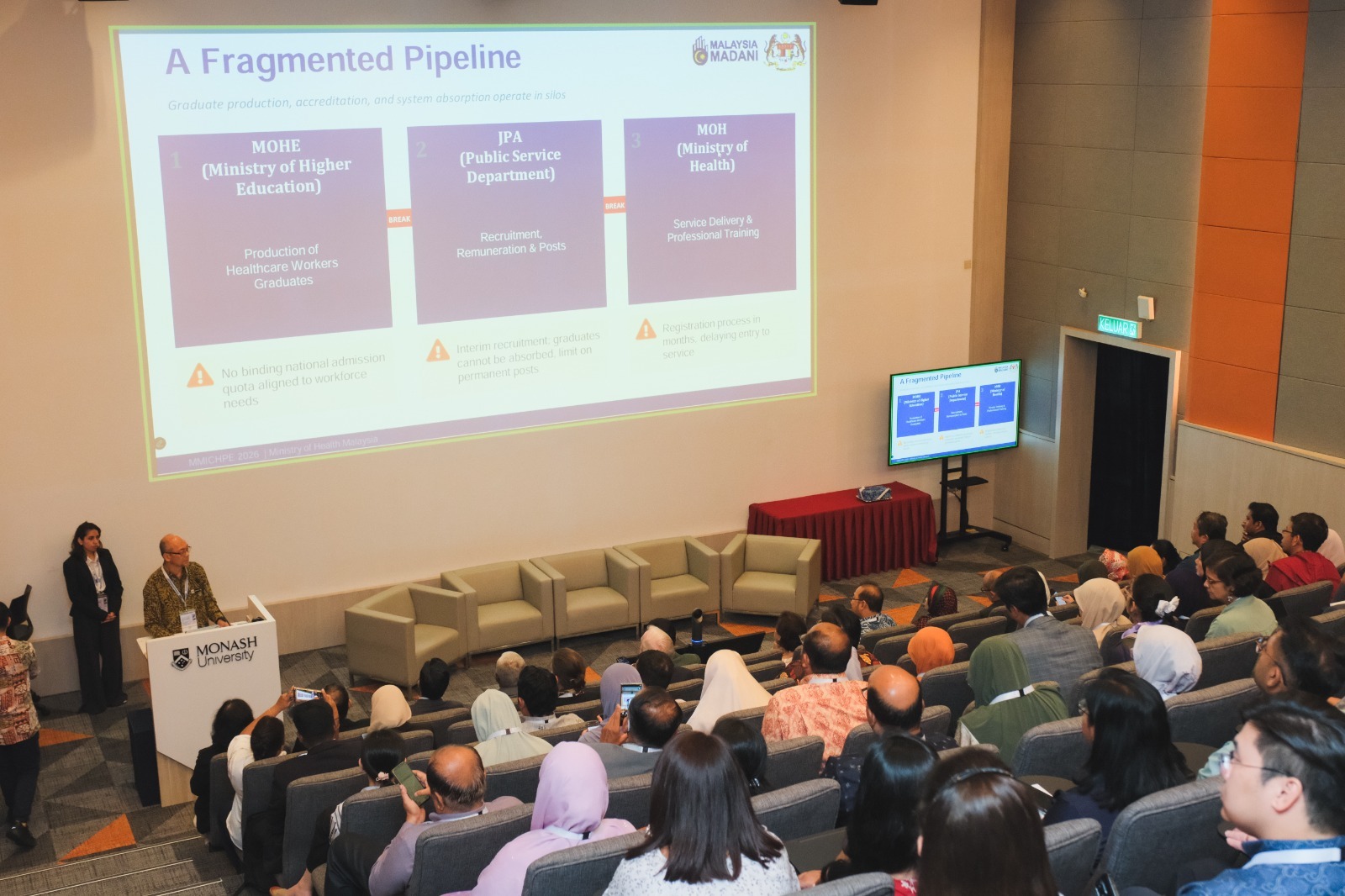
SUBANG JAYA, April 23 — Malaysia’s pipeline for producing and deploying doctors is fragmented across multiple ministries and agencies with differing priorities, contributing to delays in graduates entering service and persistent workforce gaps.
Health director-general Dr Mahathar Abd Wahab said different stages of the medical workforce pipeline – from student intake and training to recruitment and deployment – are governed by separate entities that are not always aligned.
“We currently have disconnected segments, rather than a seamless pipeline,” Dr Mahathar said in his plenary address at the Monash Malaysia-MAEMHS (Malaysian Association of Education in Medical and Health Sciences) International Conference on Health Professions Education 2026 here last April 9.
“As a result, graduates experience delays in entering service, health care facilities continue to face shortages, and patients experience gaps in care delivery.”
Slides presented during his plenary showed that responsibility for the pipeline is divided among the Ministry of Higher Education (MOHE), the Public Service Department (JPA), and the Ministry of Health (MOH) – a structure that contributes to misalignment between graduate output, hiring capacity, and service delivery needs.
“What Malaysia needs is a coordinated, end-to-end workforce planning approach,” Dr Mahathar said.
The lack of alignment across these institutions has led to structural inefficiencies, he said. Medical student intake is not directly tied to workforce needs, permanent posts are limited, and administrative processes – including professional registration – can take months, leaving graduates waiting even as vacancies persist.
According to his slide that listed problems in MOHE, JPA, and MOH, under MOHE that’s responsible for the production of health care worker graduates, there is “no binding national admission quota aligned to workforce needs”. Under JPA, which is responsible for recruitment, remuneration, and posts, the issue is “interim recruitment; graduates cannot be absorbed, limit on permanent posts”. MOH, which is in charge of service delivery and professional training, faces the problem of “registration process in months, delaying entry to service”.
“Graduate production, accreditation, and system absorption operate in silos,” according to Dr Mahathar’s slide.
Dr Mahathar said the issue is not simply one of workforce supply. Citing World Bank data in his presentation, he said Malaysia has 74,517 registered doctors and 121,361 registered nurses, with a doctor-to-population ratio of 2.3 per 1,000 people as of 2023 – below the OECD average of 3.9 per 1,000, but above the Asean average of 1.1 per 1,000.
Malaysia also has 6.34 skilled health workers per 1,000 people, above the World Health Organization (WHO) benchmark of 4.45 doctors, nurses, and midwives per 1,000.
“While our overall skilled health workforce ratio exceeds the WHO benchmark, numbers alone do not tell the full story. It’s a very crude value,” Dr Mahathar said.
“What truly matters is whether this workforce is properly distributed, equipped with the right competencies, and able to enter service without delay and be retained where they are most needed. This is therefore not just an issue of quantity, but one of distribution, competencies, and, of course, system design.”
He added that many graduates are not fully prepared for the realities of the current health care system, where ageing populations, rising non-communicable diseases (NCDs), and a shift towards community-based care require broader competencies.
Dr Mahathar’s slide presentation indicated that training remains largely hospital-based and specialty-oriented, with “knowledge-heavy and competency-light” assessments, limited exposure to rural and community settings, and little emphasis on interprofessional learning and practical training.
Dr Mahathar said training reforms should move away from time-based models towards competency-based approaches that better reflect service needs.
“Rather than simply completing a fixed duration of training, training programmes must emphasise practical competence, communication, teamwork, digital literacy, and preparedness for emerging technologies such as artificial intelligence,” he said.
“Curriculum reform must therefore be viewed not merely as an academic exercise, but as a strategic workforce reform, because what we teach is subsequently produced and ultimately determines how our system performs.”
Dr Mahathar, who is president of the Malaysian Medical Council (MMC), also pointed to regulatory delays in the transition from graduation to practice, describing the need to reduce what he termed as “regulatory drag”.
His slides outlining the current doctor pathway showed multiple steps from graduation to independent practice, including provisional registration, housemanship, full registration, and compulsory service.
“The transition from graduation to practice must be efficient and streamlined, while maintaining professional standards. These require the digitalisation of processes, clearer timelines, and more transparent regulatory pathways,” he said, adding that this remains a work in progress for the MOH and relevant agencies.
On retention, Dr Mahathar said workforce sustainability depends not only on financial incentives but also on working conditions and career development. He added that retaining staff is the most cost-effective strategy to strengthen the health care system.
“It is essential to ensure fair deployment across regions, provide viable career pathways, create supportive working environments, and maintain manageable workloads,” said the Health DG.
“My take on this is, quote, unquote, treat them as a whole, treat them as humans.”
To shift care from hospitals to the community, Dr Mahathar said Malaysia will need to develop a more structured community health workforce to support prevention, follow-up care, and long-term management of chronic diseases.
During his speech, Dr Mahathar said the MOH is looking at establishing a national health workforce committee as part of efforts to strengthen governance and better align education with employment across the pipeline.
His slides presented at the conference proposed an “independent National HRH Governing Committee”, alongside measures to link workforce planning cycles to service capacity and to develop a unified national health workforce information system.
However, key details – including the committee’s mandate, membership, and decision-making authority – were not defined.
In response to queries from CodeBlue, the Health DG’s office said Dr Mahathar’s proposal remains under consideration and requires further engagement with central agencies and relevant stakeholders.
“As such, the Ministry does not intend to pre-empt any policy decisions that fall under the jurisdiction of the government as a whole,” the Health DG’s office told CodeBlue in a statement.
The ministry added that it remains committed to working with relevant parties to ensure workforce planning is implemented in a phased and coordinated manner.
The proposal comes amid longstanding calls from stakeholders, including the Malaysian Medical Association (MMA), for more centralised oversight of health workforce planning, such as through a Health Service Commission.
It remains unclear whether the proposed committee would carry decision-making authority or function primarily as a coordinating platform, or whether it could resolve the structural fragmentation it is intended to address.

