

KUALA LUMPUR, Nov 18 — Recovering from a stroke can take months, sometimes years, but survivors may regain functions they initially thought they had lost.
With rehabilitation, patients can work towards walking again, communicating more easily and returning to everyday activities.
Some may even regain substantial independence, although the extent of recovery varies from person to person.
“Regaining your life is always possible, but may not be the same,” Dr Kok Chin Yong, consultant physician and neurologist at Sunway Medical Centre Velocity (SMCV), told CodeBlue in an interview.
His message is that surviving a stroke is only the first step. What follows is a sustained effort to help patients recover lost functions, adapt to changes, and rebuild their lives.
While advances in emergency treatment have improved the chances of survival and helped limit brain damage, rehabilitation remains essential in determining how well survivors regain their independence and quality of life.
The Brain’s Capacity To Recover
Stroke damages the brain by interrupting its blood supply. This can happen when a blood clot blocks a vessel, causing an ischaemic stroke, or when a blood vessel ruptures, causing a haemorrhagic stroke.
Although brain cells that were lost during a stroke do not regenerate, the brain can reorganise and adapt. Surviving cells can form new connections, allowing other parts of the brain to take on some of the functions that have been affected.
“It’s not all doom and gloom,” Dr Kok said. “Although we cannot regenerate brain cells, our surviving or healthy brain cells surrounding the dead cells have this unique capability of rewiring and readapting to a new environment or new situations.
“This is what we call neuroplasticity. It is another powerful characteristic of our brain.”
This ability is central to stroke rehabilitation, which aims to help patients regain as much of their lost function as possible.
“If a stroke patient undergoes intensive, adequate and appropriate rehabilitation, including physiotherapy, occupational therapy and speech therapy, they can always regain some functions, if not all,” said Dr Kok.
“More often than not, when they follow a proper rehabilitation programme, we see significant improvements in their ability to regain their functions. So, in short, regaining your life back is possible.
“For those with severe strokes, it is definitely a big change to their lives, but regaining some functions are always possible.”
Through physiotherapy, patients work to regain their strength, balance, and movement. Occupational therapy helps them relearn everyday tasks, while speech therapy addresses difficulties with communication and swallowing.
“The first three to six months after a stroke are particularly important,” Dr Kok said, as the brain may be more responsive to rehabilitation during this period.
However, recovery does not necessarily stop after six months, and patients can continue making progress beyond this time window.
Dr Kok said many Malaysians mistakenly believe that stroke care ends once patients are discharged from hospital, overlooking the importance of continued rehabilitation.
“Many Malaysians do not realise that they have a good opportunity to regain their functions after discharge. They think that once they are discharged, stroke care is done and there is no more care after that. But that’s completely wrong,” he said.
Patients must continue working towards regaining their abilities through rehabilitation, according to Dr Kok. Remaining inactive at home, he warned, could undermine their recovery.
This is particularly significant given that stroke affects many Malaysians who are still in their working years.
Figures from the National Stroke Registry 2017-2024 suggest that approximately 46 per cent of stroke patients are below 60. The mean age of Malaysian stroke patients is 60.6 years, compared with 64.4 years internationally.
For people who experience a stroke while still working and raising families, the consequences can extend beyond their physical health. Difficulty returning to work or carrying out everyday responsibilities can affect household income and place additional pressure on family members.
Drawing on his experience treating patients with haemorrhagic stroke, Dr Gerard Arvind Martin, consultant neurosurgeon at SMCV, said the psychological and emotional burden of stroke is often overlooked, particularly among patients who were their families’ sole breadwinners.
“That’s the psycho-emotional part of the burden of stroke. I’ve met so many patients who, when they are able to communicate, actually talk to me about their families and the children they still have to look after,” he told CodeBlue at the same interview with Dr Kok.
“When it comes to the burden of stroke, this is the main area of concern – regaining the life they had before the stroke.”
For patients who remain conscious and are able to understand the extent of their condition, the realisation that they may not fully recover can be particularly difficult.
Dr Gerard said rehabilitation was therefore not simply about helping patients regain movement. It could also help them recover their independence, participate in family life and return to activities that gave them a sense of purpose.
rTMS Complements Conventional Rehab After Stroke

Alongside conventional rehabilitation, newer approaches are being explored to support the brain’s ability to reorganise after a stroke.
One such treatment is repetitive transcranial magnetic stimulation (rTMS), which uses magnetic pulses delivered through a coil placed near the patient’s scalp to stimulate targeted areas of the brain.
At SMCV, rTMS is offered to eligible patients as an additional approach to support their recovery. Dr Kok explained that activity between the two sides of the brain can become imbalanced following a stroke.
rTMS aims to restore this balance by stimulating brain cells, potentially enhancing neuroplasticity and supporting the recovery of affected functions.
Research has suggested potential benefits in certain areas, particularly hand function, although its effectiveness varies between patients.
Dr Kok said eligible patients with either ischaemic or haemorrhagic stroke could receive the treatment, which is intended to complement rather than replace conventional rehabilitation.
“rTMS is very safe. There is no injection or drugs involved. The patient just has to sit on a chair and the machine is positioned close to their scalp. They will feel a tapping sensation over the scalp,” he explained.
The magnetic pulses induce electrical activity in the brain and stimulate neurons. Treatment involves at least 10 daily sessions, with each session lasting about 30 to 40 minutes.
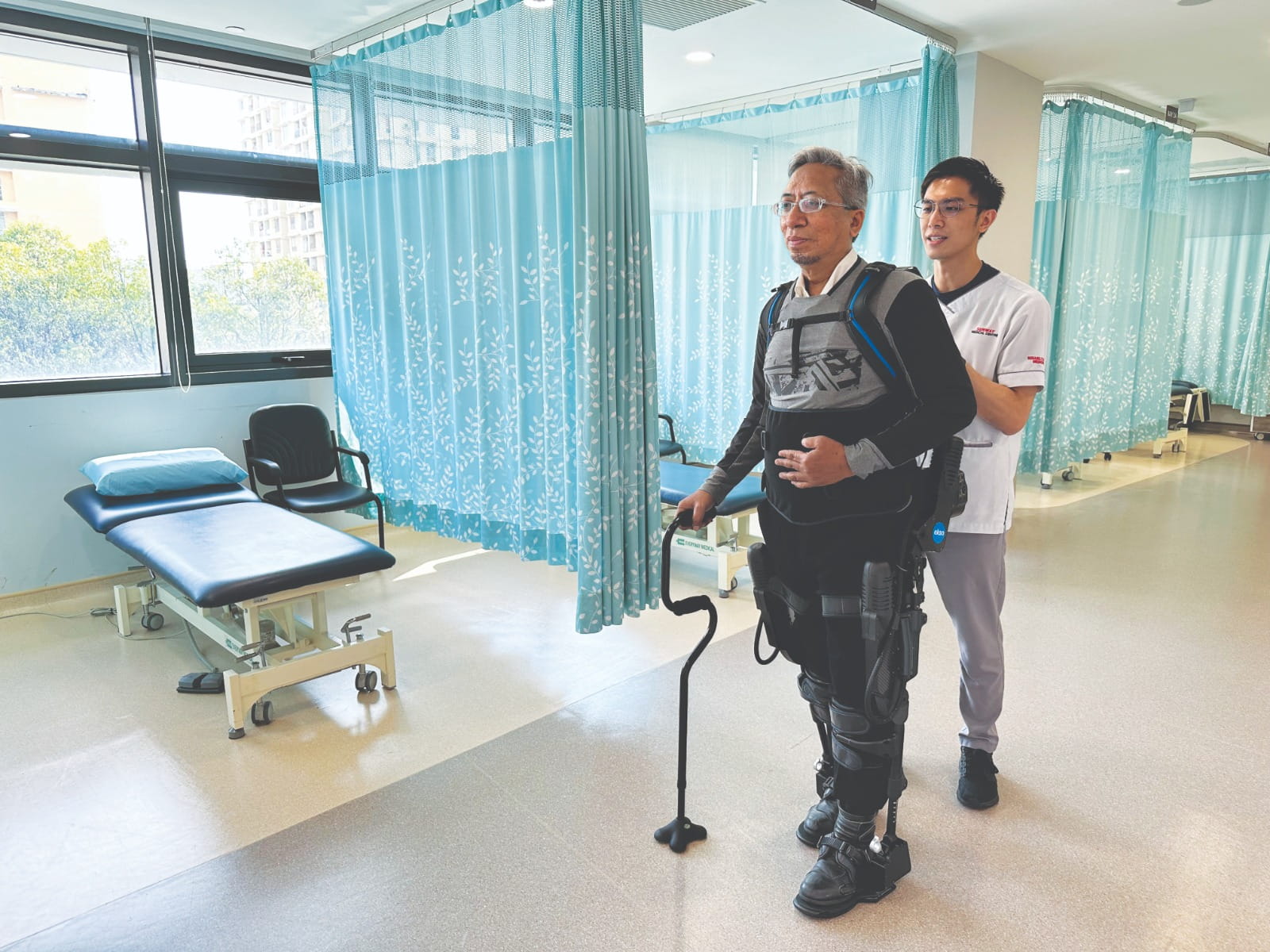
Beyond rTMS, SMCV has also established a dedicated neurorehabilitation area for patients with neurological conditions, equipped with facilities such as hoists and an exoskeleton to support more advanced rehabilitation.
“We have some of the newer equipment, including hoists and an exoskeleton. These are more advanced rehabilitation methods that we use to help speed up the recovery process,” Dr Kok said.
Get Treatment Within 4.5 Hours From Stroke Symptom Onset
Rehabilitation is only one part of stroke care. The treatment patients receive during an initial emergency can also influence how much function they retain and their prospects for recovery.
For eligible patients with ischaemic stroke, thrombolysis uses medication to dissolve blood clots, while mechanical thrombectomy involves guiding a catheter into the brain to physically remove a blockage in a large blood vessel.
Both treatments are time-sensitive. According to figures from the National Stroke Registry, only 36.3 per cent, or about one-third, of patients with ischaemic stroke reached hospital within a four-and-a-half-hour window for thrombolysis from stroke symptom onset. Approximately 1.6 per cent underwent mechanical thrombectomy.
Although the median time between symptom onset and hospital arrival improved from 8.5 hours in 2017 to 6.3 hours in 2024, it remains longer than the target four and a half hours.
Malaysia’s national stroke report identified poor symptom recognition and transportation challenges as some of the factors contributing to delays in seeking emergency care.
The public is often encouraged to use the BE FAST acronym to recognise the warning signs of stroke which includes B: Sudden loss of balance, E: Sudden blurred, doubled or loss of vision, F: One side of the face droops, A: One arm becomes weak, S: Slurred speech, and T: Time to call 999 and get to a hospital immediately.
Dr Kok stressed that the four-and-a-half-hour window should not be treated as time patients can afford to spend waiting. Anyone experiencing possible stroke symptoms should seek emergency medical attention immediately, he said.
“Every minute that passes during an ischaemic stroke results in the death of about two million brain cells. We have approximately 86 billion neurons in our brain, so every minute counts,” he said.
At SMCV, patients presenting with suspected stroke symptoms at the emergency department are immediately placed in the red zone, where a stroke code is activated. This triggers an emergency protocol that prioritises medical assessment and brain imaging.
Dr Kok explained that doctors cannot initially distinguish between an ischaemic and haemorrhagic stroke based on symptoms alone, making an immediate brain scan crucial.
“We cannot differentiate whether a patient has an ischaemic or haemorrhagic stroke just from their symptoms. Hence, we give the highest priority to getting the brain scanned immediately,” he said.
Patients undergo a CT scan or MRI, with radiologists prioritising the images and communicating their findings promptly to the treating team. The results determine which treatment pathway follows.
For ischaemic stroke, eligible patients may receive thrombolysis through an intravenous injection of clot-busting medication, ideally within four-and-a-half hours of symptom onset.
For patients with a large-vessel blockage, mechanical thrombectomy may also be performed to physically remove the clot. While the traditional treatment window for thrombectomy is up to six hours, selected patients arriving later may still qualify following more advanced imaging, such as CT perfusion or MRI perfusion.
However, missing the window for emergency treatments such as thrombolysis and thrombectomy does not mean recovery is no longer possible.
“If you miss the window for thrombolysis and thrombectomy, do not give up. We have many methods of rehabilitation to help you during the recovery phase, particularly in the first three to six months,” Dr Kok said.
For haemorrhagic stroke, where a blood vessel has ruptured and caused bleeding in the brain, the approach is different.
Dr Gerard said treatment decisions depend on several factors, including the patient’s age and clinical condition, as well as the location and extent of the bleeding.
“Not every patient needs surgery. Some haemorrhages can be managed conservatively, while others require surgical intervention, particularly if the patient deteriorates clinically,” he said.
Depending on the circumstances, surgery may involve inserting a catheter to drain accumulated fluid, removing part of the skull to relieve pressure on the brain, or evacuating the blood clot. These procedures may also be combined.
Dr Gerard stressed that the objective is to remove as much of the blood clot as possible without causing further damage to the brain. Doctors must also consider whether surgery is likely to improve the patient’s chances of survival and preserve their quality of life.
Beyond Saving Lives
Surviving a stroke is only the beginning of a long recovery journey. For many patients, progress comes gradually, through rehabilitation, persistence and the support of those around them.
Both Dr Kok and Dr Gerard stressed that recovery is not necessarily about returning to life exactly as it was before the stroke, but about helping survivors regain as much function and independence as possible.
“Not every patient will regain all the functions they had before their stroke, and the extent of recovery varies,” Dr Gerard said. “But rehabilitation can help survivors make the most of their remaining abilities, adapt to changes and regain a degree of independence.”
Dr Kok said stroke care should not end when a patient leaves the hospital. Recovery continues in the months and years that follow, as survivors work towards regaining their independence and families learn to navigate the changes brought about by the stroke.
To raise awareness of stroke symptoms and the importance of timely medical attention, SMCV recently introduced Malaysia’s first educational Stroke Mirror as the centrepiece of its Brain for Life: The Ultimate Mind and Motion Experience.
The interactive experience aims to make stroke education more accessible and engaging by bringing essential health information into the community.
Through this initiative, SMCV hopes to encourage Malaysians to recognise stroke warning signs, take preventive measures and seek prompt medical attention.
Supported by the expertise of its medical professionals, advanced technology, and facilities, SMCV remains committed to empowering individuals and families to make informed decisions about their health.


