

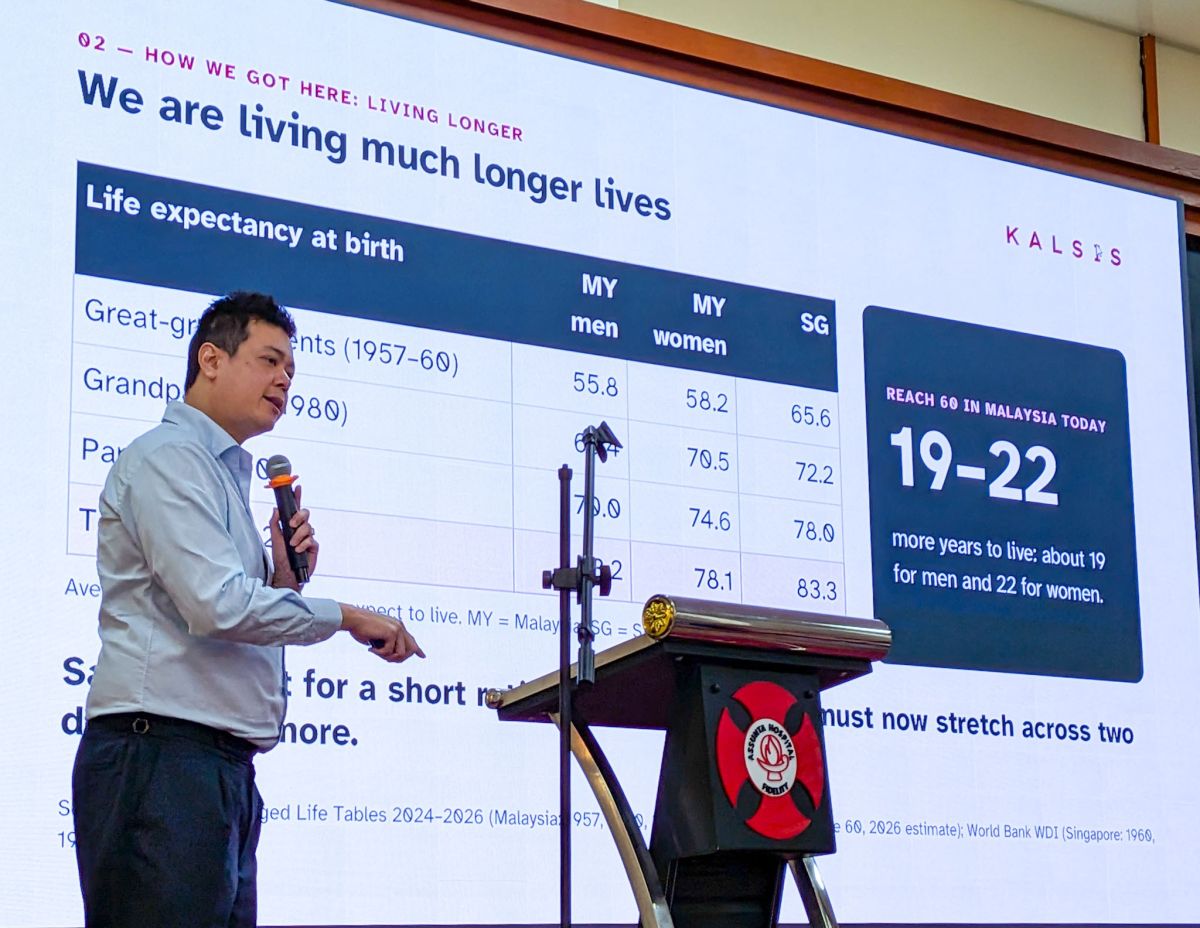
PETALING JAYA, Nov 4 — Seniors should have more ways to finance their retirement and health care needs instead of relying primarily on their adult children, says KALSIS founder and chief executive officer Jonathan Teoh.
With people living longer, medical costs rising, and retirement savings often insufficient, Teoh said families face an increasingly difficult financial burden as older parents may require support for 20 or more years after retirement.
“Adult children comprising the sandwich generation may find it difficult to fund their parents’ living expenses whilst shouldering the cost burden of raising their own families,” Teoh said at a forum last October 31 on ageing with dignity at Assunta Hospital’s Tun Tan Cheng Lock College of Nursing.
Teoh cited findings from the Malaysia Ageing and Retirement Survey by Universiti Malaya’s (UM) Social Wellbeing Research Centre, which found that 55 per cent of older Malaysians depended on their children for financial support, receiving an average of RM526 a month.
Yet, the average monthly contribution covered only about a fifth of a single senior’s estimated living expenses. The Employees Provident Fund (EPF) BelanjawanKu estimates that a single senior needs RM2,690 a month to maintain a reasonable standard of living in the Klang Valley.
Teoh said seniors need a steady source of income to support themselves through retirement, allowing them to remain financially independent and continue living in their own homes for as long as possible.
“What they really want is income for life and to stay at home, to age in place,” he said.
KALSIS seeks to address this gap by allowing eligible seniors aged 70 and over to unlock the value of their freehold and landed homes while retaining the right to live in the property for the rest of their lives.
Under its home-equity financing scheme, participants sell their properties at an agreed market value in exchange for an upfront payment and subsequent payouts.
For a property valued at RM1.5 million, for example, the scheme could provide up to RM150,000 lump-sum payment in the first year, followed by up to RM60,000 annually from the second year for the rest of the participants’ lives. The money can be used for health care expenses or retirement living costs.
The scheme comes as Malaysia prepares to table a proposed Older Persons Bill in Parliament, expected in the first quarter of 2027.
The Bill aims to protect older persons from neglect, abuse and exploitation, according to Asmar Asmadi, senior director of the Ministry of Women, Family and Community Development’s Strategic Policy and Planning Division.
The proposed legislation identifies three categories of harm. Neglect includes failing to provide food, health care, hygiene, daily support, or safe living conditions. Abuse covers physical, sexual, psychological and emotional harm, while exploitation includes manipulating or misusing older persons for another person’s benefit, including through financial or illegal activities.
Existing laws provide some protection for older persons, Asmar said. These include the Domestic Violence Act 1994 and Penal Code, while care facilities are regulated under the Care Centres Act 1993. Other relevant legislation includes the Mental Health Act 2001, Employees Provident Fund Act 1991 and Pensions Act 1980.
However, these laws do not comprehensively address the neglect, abuse, and exploitation of older persons.
Although the Bill is still under review, Asmar said it would include powers to ensure caregivers and family members are held “accountable”.
But Teoh questioned whether placing greater responsibility on adult children would address the underlying problem of inadequate retirement and eldercare financing.
“Don’t look at enforcement as a means to the end,” he said, arguing that legislation should not overlook adult children who may themselves be struggling to support their own households.
Singapore’s Maintenance of Parents Act 1995 (MPA) allows parents aged 60 and above who cannot meet their basic needs to seek financial maintenance from their children.
Teoh, a Singaporean, traced the law to more than a decade of debate, beginning with calls for legislation in 1982. A government committee recommended a law in 1984, but an advisory council subsequently concluded that filial piety could not be legislated.
The proposal was revived in 1994 as a safety net for parents without family support, and the MPA was passed in November 1995, introducing mediation before cases could proceed to a tribunal.
About 2,400 claims reached the tribunal between 1996 and 2021, while around 100 parents a year sought maintenance in 2022.
Teoh highlighted the difficulties of enforcement, including cases where adult children alleged that their parents had abused or neglected them during childhood. Some agreed to pay simply to end the proceedings.
He said the MPA operates alongside broader support systems, including retirement savings, housing monetisation schemes, health care financing and social assistance, underscoring that legislation alone cannot address the financial needs of an ageing population.


