

“A house built on sand cannot stand.”
The proposition sounds irresistible. Create a mandatory health insurance pool, compel every citizen to contribute, and guarantee universal coverage. It has worked in South Korea, Taiwan, and Germany. Why not Malaysia?
The answer is not that the idea lacks merit. It is that the foundations upon which such a scheme must be built do not exist. Malaysia’s health care financing architecture is not a blank slate upon which reformers can draw a new system.
It is a complex, layered structure shaped by decades of political compromise, fiscal constraint, and demographic reality. To propose a mandatory national health insurance (NHI) or social health insurance (SHI) scheme without acknowledging these constraints is not reform; it is fantasy.
The Fiscal Reality: A Nation That Cannot Afford The Premium
Over the past decade, Malaysia’s total health expenditure has hovered between 3.8 per cent and 5.1 per cent of the country’s gross domestic product (GDP), while the public (government) health budget / expenditure alone has generally accounted for roughly 2.0 per cent to 2.9 per cent of GDP, with total health expenditure (public and private combined) peaking at an all-time high of 5.1 per cent during the height of the Covid-19 pandemic in 2021.
The Health Ministry’s 2026 allocation of RM46.52 billion represents nearly 10 per cent of total government spending. Yet even this is under constant threat. Fuel subsidies, driven by global conflicts, have ballooned resulting in health care financing subject to the whims of annual budget negotiations.
To implement a mandatory NHI or SHI scheme, the government would need to dramatically increase contributions. But the fiscal space does not exist. The National Budget deficit remains significant.
Why NHI and SHI Are Not the Answer: A ‘Double War’ On Taxpayers
Mandatory NHI and SHI schemes have been repeatedly proposed but repeatedly rejected.
The reason is not lack of vision. It is political and fiscal reality. The political obstacle is even more formidable. Malaysia operates a Beveridge-style, tax-funded public health system, the same model as the United Kingdom’s National Health Service. The public tier of Malaysia’s health care is funded almost entirely by general taxation via the federal government’s treasury.
Citizens already pay taxes that fund public hospitals and clinics, where user fees remain a nominal RM1 for general outpatient care and RM5 for specialist visits. These rates were established under the Fees (Medical) Order 1982 and have remained unchanged for decades.
To introduce a mandatory NHI or SHI scheme on top of this would require citizens to contribute additional mandatory premiums on top of income tax, sales tax, and other levies, while they already expect near-free care in public facilities. This is not speculation.
The government has explicitly rejected mandatory NHI and SHI on precisely these grounds, describing it as a “double war” on taxpayers.
The historical record is instructive. The “1Care for 1Malaysia (1C1M)” initiative, launched in 2010 to overhaul the health care system, faced insurmountable challenges: inadequate political will, financial constraints, stakeholder opposition, and institutional conflict of interest.
It was ultimately abandoned.
One of the cardinal factors was that the proposed National Health Financing Authority would have stripped financing power from the Ministry of Health, creating bureaucratic resistance that proved fatal to the reform.
The lesson is clear: after 45 years of discussions and 15 policy papers, Malaysia has consistently failed to implement mandatory health insurance. This is not an accident. It is a reflection of deep-seated political and institutional resistance that no amount of policy advocacy can overcome.
The Dual-Tier Trap
Malaysia’s health care system is not a blank slate. It is a deeply entrenched dual-tier system: an overstretched, tax-funded public sector rubbing shoulders with an expensive, profit-driven fee-for-service private sector.
Malaysian public hospitals and government health care facilities handle approximately 65 per cent to 75 per cent of inpatient admissions and roughly 80 per cent to 90 per cent of outpatient visits in the country.
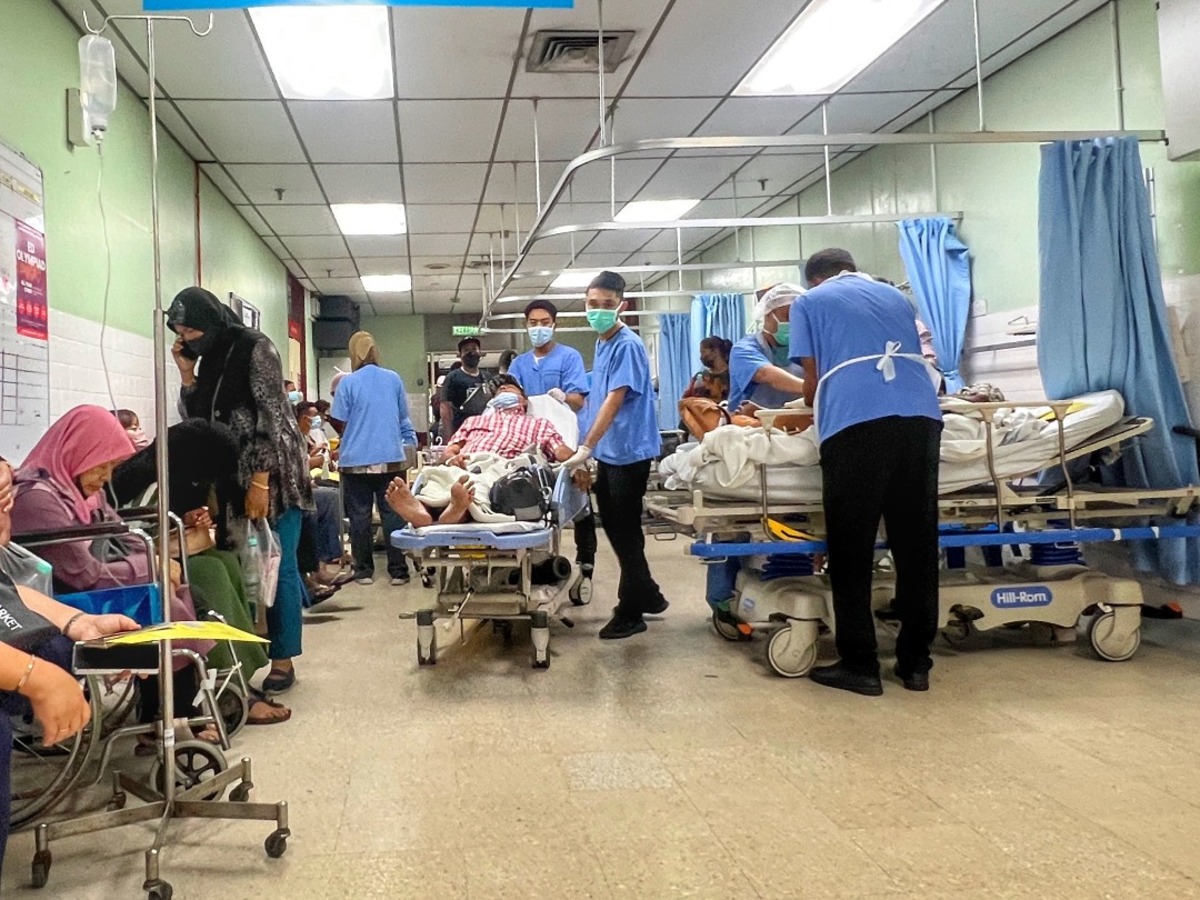
They are now operating at maximum capacity amid a shortage of nearly 11,000 medical specialists and an estimated 18 per cent vacancy rate for nurses. Approximately 80 per cent of public hospitals are at full capacity. Emergency department wait times stretch to nine hours. Elective surgeries are postponed indefinitely.
The private sector, by contrast, serves a smaller population but has driven medical inflation to unsustainable levels. Only 22 per cent of Malaysians currently have medical insurance. Private insurance covers just 39 per cent of total private health care spending.
The majority of private health care is funded through out-of-pocket payments, which constitute a staggering 76 per cent of private health care financing.
The Public Accounts Committee has confirmed that the primary driver of medical inflation is not doctors’ professional fees – which have been regulated since 2013 – but rising non-professional charges imposed by private hospitals.
These include medicines, medical supplies, equipment, diagnostic tests, and laboratory services. Charges for medicines and medical supplies are often marked up significantly, in some cases by as much as 300 per cent.
The private health care sector remains heavily dependent on imports, which account for 94 per cent of medicines used. This import dependency, combined with opaque billing practices and unregulated charges, has created a system where costs spiral upward while accountability remains elusive.
An NHI or SHI scheme would need to integrate these two worlds, a task of staggering complexity. How would reimbursement rates be set? How would private hospitals be regulated? How would the government prevent the private sector from simply absorbing NHI funds without improving outcomes?
These are not theoretical questions; they are the practical obstacles that have derailed reform efforts for decades.
The MediAsas Precedent: A Cautionary Tale
The government’s recent experience with MediAsas, a voluntary, government-designed health insurance product, offers a sobering lesson.
MediAsas was supposed to be a lifeline for the uninsured, including those with stable, controlled pre-existing conditions. But the fine print told a different story.
If we cannot design a voluntary insurance product that delivers on its promises, what confidence can we have that the government can design and administer a mandatory NHI or SHI scheme covering the entire population?
The MediAsas debacle is not an argument for NHI; it is a warning against overreach.
The Demographic Reality: An Ageing Population That Cannot Be Insured
Malaysia is ageing faster than anticipated. By 2030, 15 per cent of the population will be aged 60 and above. By 2040, health care costs for older Malaysians will exceed RM21 billion annually, more than 1 per cent of GDP.
Under a mandatory NHI or SHI scheme, the young would subsidise the old, and the healthy would support the sick. This is the theory. The practice is far messier.
Malaysia does not have the fiscal capacity to absorb such deficits. The 2.7 million individual taxpayers – roughly 15 per cent of the workforce – funding health care for a population of 33 million is already an unsustainable arithmetic. Adding a mandatory insurance scheme would not solve this problem; it would compound it.
The Path Not Taken
A bird in the hand is worth two in the bush. Malaysia already has a tax-funded public health care system that, for all its flaws, provides affordable care to the vast majority of its citizens. The answer is not to abandon this system for an untested, unaffordable, and politically untenable NHI or SHI scheme.
The path forward lies in strengthening what we have, and not reinventing the wheel: increasing public health expenditure to 5 per cent of GDP, improving efficiency and reducing waste.
The remedy is a hybrid model that preserves and optimizes the current dual-tier system, combining tax funding, social insurance, and a public safety net option, a system that preserves the dual-tier foundation while diversifying funding sources.
NHI and SHI are seductive dreams. But in Malaysia, they remain just that – dreams. The political, fiscal, and structural realities are simply too formidable. The question is not whether they are desirable; the question is whether they are possible. And the honest answer, for now, is no.
Dr Rajeentheran Suntheralingam is a senior consultant urologist and urological surgeon at Damansara Specialist Hospital.
- This is the personal opinion of the writer or publication and does not necessarily represent the views of CodeBlue.


