

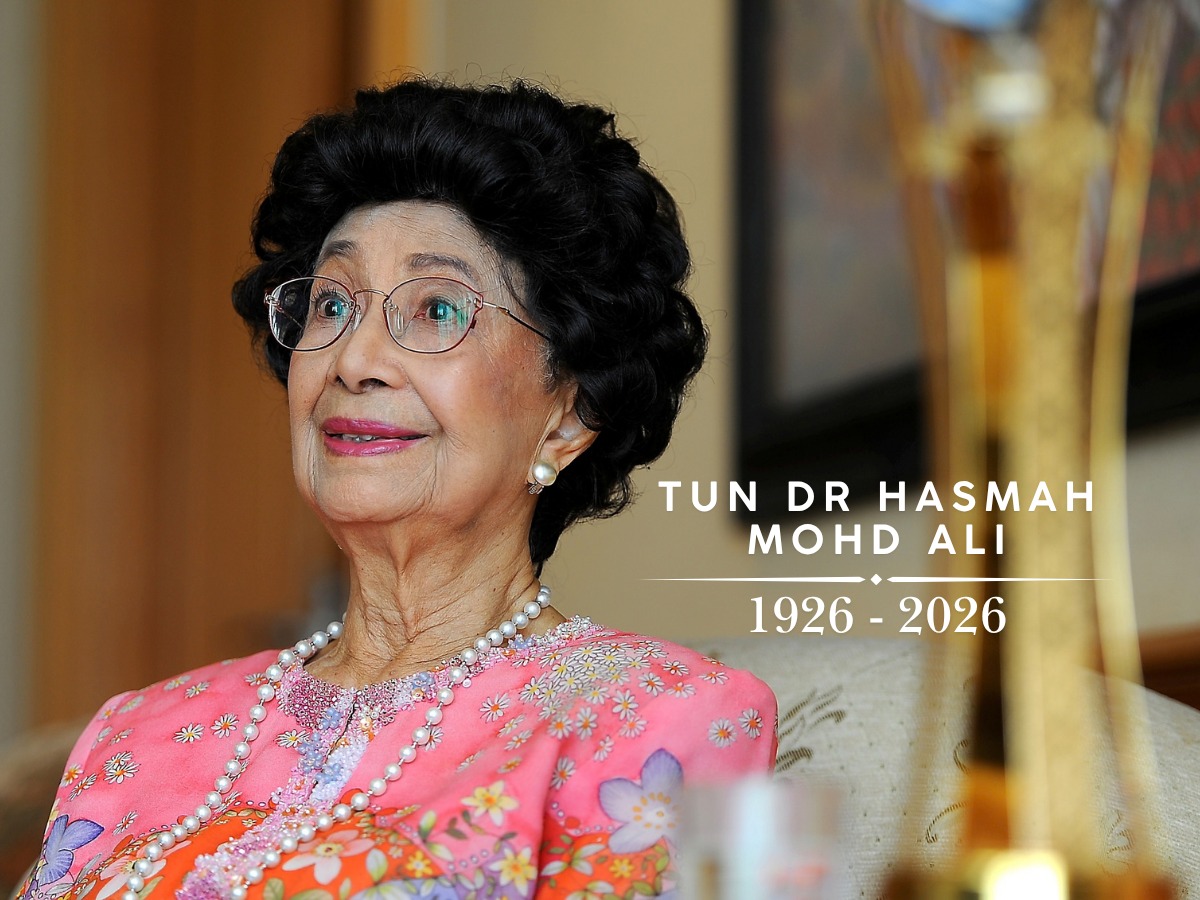
I have never met Dr Hasmah Mohd Ali in person. And yet, when I woke up to the news that she had passed away, I was surprised to realise I was sad.
Perhaps it is because, for as long as I can remember my Malaysian upbringing, she was there.
She was beside Dr Mahathir Mohamad in the newspapers and on television. She was there in photographs from moments I was too young to remember, and others that happened before I was even born.
I grew up with the strange familiarity we sometimes have with public figures who have occupied the background of our lives for so long that we cannot remember first learning their names. Dr Hasmah was simply there.
I don’t think I even knew, when I was very young, that she was a doctor. At some point, of course, I learnt: Dr. Only two letters.
They meant a great deal in my household. My father held the title in enormous regard. He would tell me that being a doctor was a precious thing to be.
So I knew that she was one. But knowing that somebody is a doctor is not quite the same as understanding what it took for her to become one.
I understand that a little better now. I became a doctor too, years later, when the social scenery had changed somewhat.
It is only now, looking back at her life after her passing, that I realise how little attention I had paid to the two letters that had sat quietly before her name all those years.
Long before she became a prominent national figure, she had already entered a profession in which women like her were still rare.
She chose the path of public health, dedicating herself to maternal and child health and working closely with rural communities. She became the first woman to hold several senior medical positions in Kedah.
These are facts I can read now. I wish I had thought more about them while she was alive.
Perhaps that is one of the peculiarities of growing up. The people who seem permanent rarely demand close examination.
We assume there will always be another photograph, another appearance, another moment in which they will be standing exactly where we expect them to be.
There is an old photograph of her driving a red Proton Saga across the Penang Bridge. I wasn’t even born yet; the year was 1985. But the first car I ever knew was my father’s Saga.
Years later, looking through photographs of Malaysia’s history, I would see her behind the wheel of one and feel a moment of borrowed pride.
There she was again, in a momentous period of Malaysian history. Always somewhere in the picture.
She once recounted that she had been Hasmah Mohd Ali until “Siti” was added administratively to her name in the late 1970s. She had not asked for it, but kept it. To my generation, she became known simply as Dr Siti Hasmah.
And perhaps that is how I will remember her most. She had accompanied Malaysia through an extraordinary stretch of its life with a kind of quiet constancy. She was always Dr Hasmah, although I understand the weight of those two letters differently now.
There are grander ways to describe a life that lasted a century. I don’t think I need them.
I was one Malaysian child among many who grew up knowing her face. I am now a Malaysian woman doctor, far from home, finally looking properly at the doctor whose face had been familiar to me all along.
I never knew her. So I cannot mourn her as someone who did. But I can notice that someone familiar is missing. And I can finally pay proper attention to those two letters.
Thank you, Dr Hasmah.
The author is a psychiatrist.
- This is the personal opinion of the writer or publication and does not necessarily represent the views of CodeBlue.


