

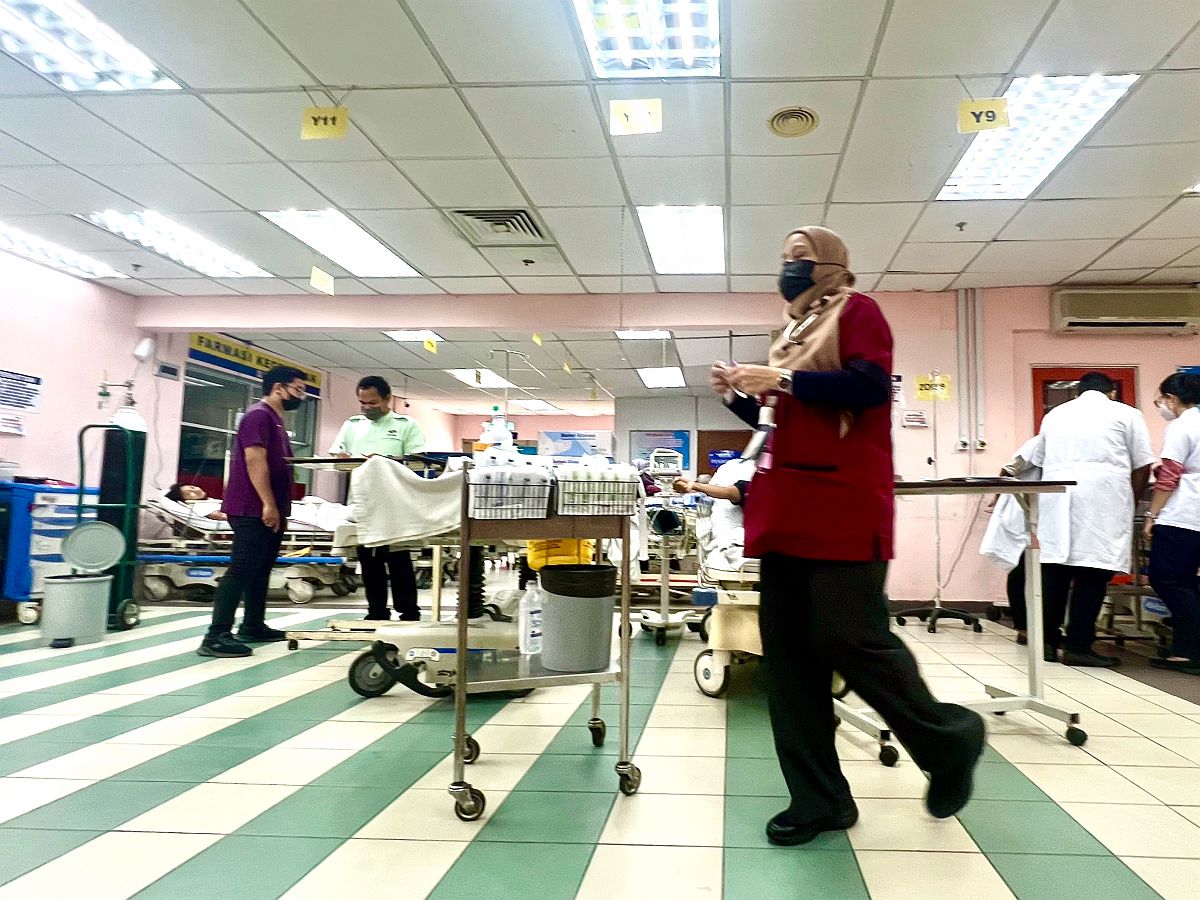
KUALA LUMPUR, August 3 — About 54 per cent of housemanship slots in 48 Housemanship training hospitals (HLS) nationwide were filled after the first three recruitment rounds this year, or 6,580 out of 12,198 training places, according to the Ministry of Health (MOH).
Health Minister Dzulkefly Ahmad said in a written Dewan Negara reply on July 28 that the remaining capacity at 45 MOH hospitals and three university teaching hospitals was sufficient to accommodate eligible medical graduates for the remaining three intake rounds this year.
“As of May 2026, the national occupancy rate at 48 training hospitals nationwide after three recruitment rounds was 54 per cent, with 6,580 slots filled out of a total capacity of 12,198 slots,” Dzulkefly said in a written Dewan Negara reply on July 30.
“This shows that the current housemanship training capacity at 45 MOH facilities and three university teaching hospitals is still sufficient to accommodate eligible medical graduates for the remaining three intake rounds this year.”
The minister was responding to Senator Robert Lau Hui Yew, who asked about the factors contributing to the limited number of housemanship placements in public hospitals and the gap between the number of medical graduates entering the workforce and available housemanship slots.
Dzulkefly said the number of house officers that can be placed at a hospital at any one time is not determined solely by the number of vacant posts.
“Instead, training capacity must comply with the graduate training standards set by the Malaysian Medical Council (MMC) to ensure that the quality of clinical training and patient safety are always preserved,” Dzulkefly said.
He said the MMC’s Malaysian Standards for Housemanship Training determine a hospital’s training capacity based on several factors, including the number of operational beds, the availability of medical, surgical, obstetrics and gynaecology disciplines, the number of resident specialists, the adequacy and diversity of clinical cases, and sufficient administrative staff to manage the training programme.
Each house officer must also be assigned a clinical supervisor for every clinical posting, with supervisors required to be specialists formally appointed by the hospital committee.
Consequently, the number of house officers that can be trained at any one time depends on the supervisory capacity within each department.
“The determination of training capacity must therefore be implemented in a controlled manner to ensure that every graduate medical officer receives sufficient clinical exposure, supervision and competency assessment, without compromising training quality and patient safety,” Dzulkefly said.
The health minister also said the number of medical graduates completing their studies each year does not necessarily correspond to the number immediately available to begin housemanship.
After graduation, medical graduates must first obtain provisional registration with the MMC before applying for appointment through the Public Services Commission.
While some graduates submit their applications immediately after receiving their senate letters, others choose to delay their applications or are not yet ready to begin housemanship for various reasons, he said.
Dzulkefly also disclosed that MOH recruited 15,227 house officers between 2022 and June 2026.
The annual intake comprised 3,245 house officers in 2022, 3,265 in 2023, 3,288 in 2024, 3,279 in 2025, and 2,150 between January and June this year.


