

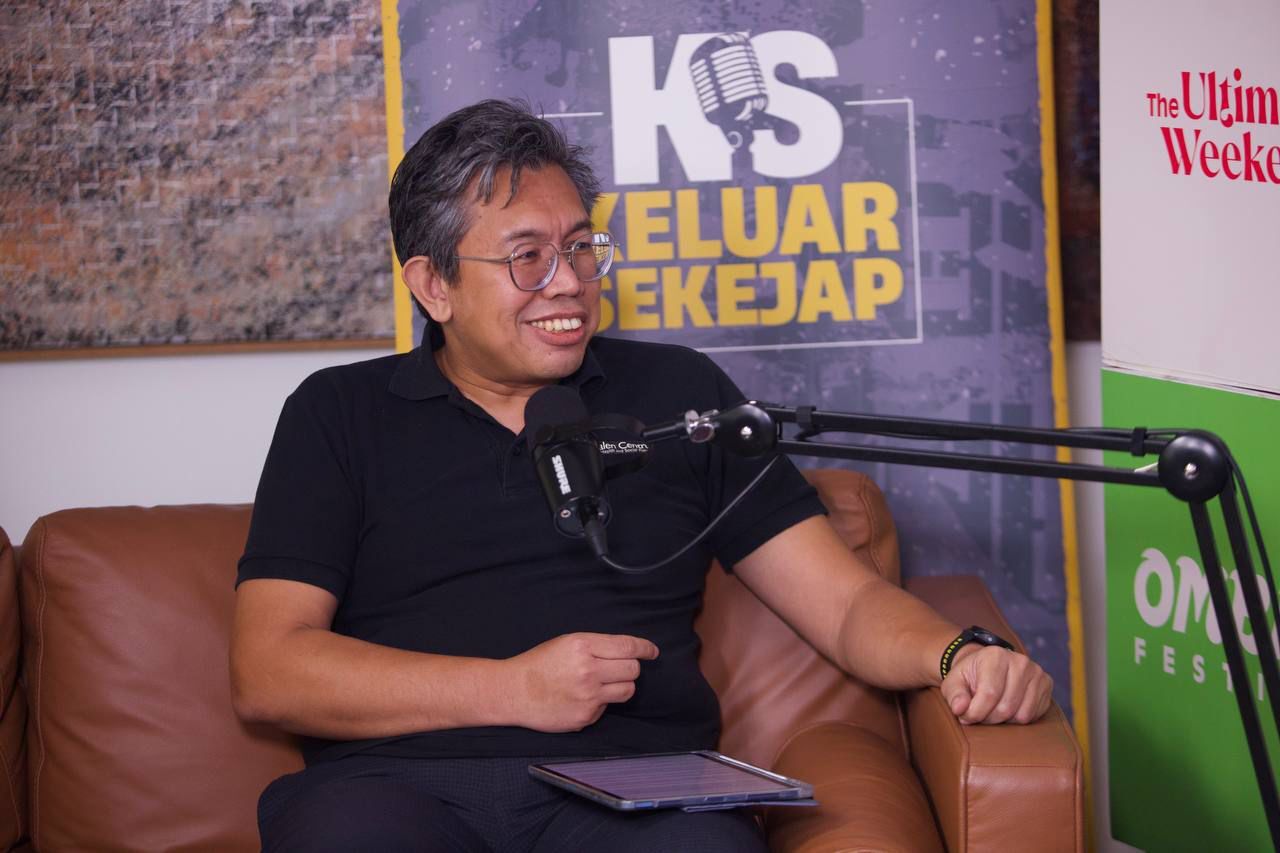
KUALA LUMPUR, August 15 — The Galen Centre for Health and Social Policy has poured cold water over public anxieties that Rakan KKM will end up privatising the public health care system.
On the Keluar Sekejap podcast aired last Friday, Galen Centre chief executive Azrul Mohd Khalib cited concerns from critics that the new private health care service by the Ministry of Health (MOH), which has yet to launch in select government hospitals, would enable paying patients to cut the queue.
“But the reality is that because of the modest services that may be provided due to limited capacity caused by real-life limitations, it may actually not even disrupt anything,” said Azrul.
“The reality is that we need manpower to give that kind of service. We must ensure that there is volume and that the amount of money generated makes sense.”
Keluar Sekejap co-host Shahril Hamdan quipped, “People are angry because of the inequality, but in the end, nothing’s going to happen or rather, they won’t be able to achieve their objectives or desired structure.”
“Exactly,” replied Azrul.
Azrul questioned Rakan KKM’s business model, pointing out that private hospital group KPJ Health Berhad had a very small profit margin by recording only RM57 million net profit out of RM971.8 million revenue in the first quarter of this year.
“So what kind of revenue are we expecting from Rakan KKM that would enable it to cross-subsidise or to buy new equipment?” he said.
Azrul also cited the Auditor-General’s 2017 report that found that the full-paying patient (FPP) programme, at its peak in 2017, generated just RM20 million revenue from 10 FPP hospitals, averaging at RM2 million per hospital.
But many of those government hospitals have since shut down their FPP service due to specialist shortages, he said.
Azrul further questioned the scope of services that Rakan KKM plans to provide and how much money it could make if it only provided minor orthopaedic operations like trigger finger procedures.
“This means that patients can wait for a year; it’s not life-threatening,” said Keluar Sekejap co-host Khairy Jamaluddin, who is also a former health minister.
“But think about it, what kind of returns are we expecting?” said Azrul.
Shahril concurred with Azrul. “Yeah, trigger finger.”
Rakan KKM Isn’t ‘Premium Economy’ Because People Arrive At Different Times
Azrul disputed the “premium economy” label for Rakan KKM, pointing out that all passengers on an airplane, regardless of class (business, premium economy, or economy), will arrive at their destination at the same time.
“This isn’t ‘premium economy’ because although everyone will arrive at their destination at different times. So the problem is, what does ‘premium economy’ for Rakan KKM look like?”
In relation to arguments by proponents of Rakan KKM that the MOH’s new private health care service would only operate after hours, at night or weekends, Azrul acknowledged that medical equipment like MRI machines had “excess capacity” by not being used after 7pm.
Shahril, however, said Rakan KKM operating after hours was still unfair to non-paying public patients, even if their queue during regular hours would supposedly not be affected.
“If I were to hear this, I might think that this means that you can actually use it [the machine]. So in the end, it’s not that there’s excess capacity, but you just don’t want to do it. It’s only when I give you money that you’re willing to do.
“As a B40 person, I would still feel that it’s unfair, KJ, even though you say that my queue won’t be affected. But in fact what you’re really saying is that I don’t actually even have to wait for six months.”
Khairy explained that if the government could pay health care workers for overtime or night shifts, then Rakan KKM wouldn’t be necessary in the first place. Azrul similarly said Rakan KKM must compensate workers to operate these medical equipment after hours.
“We’ve commoditised that capacity,” said Khairy.
“That’s the only issue. This excess capacity should have been underwritten by the government as part of universal health care. But because there’s no money, if there is excess capacity – there may be for radiologists, but I’m not sure about OT (operating theatre) – it’s commoditised and privatised for radiologists.”
RM6 Billion From National Health And Social Insurance At 1.25% Contribution
Azrul suggested that the government implement a national health and social insurance scheme that doesn’t only fund health care, but also aged care.
Implementing it at 1.25 per cent contributions from employees and employers – the same rate as Social Security Organisation (Socso) contributions, which Azrul said people barely notice on their pay slips – would generate revenue of RM6 billion every year.
In contrast, Rakan KKM will be lucky to make revenue of RM50 million or profit in its first year, according to Azrul.
“We can use EPF (Employees’ Provident Fund) or Socso as a platform to collect this RM6 billion,” he said.
He explained that the annual RM6 billion revenue from the national health and social insurance scheme would complement the government’s allocation for health care.
“The RM6 billion will enable us to afford the things that we say we can’t afford – better salaries for our specialists, better pay for our nurses and doctors, modernisation of our dilapidated infrastructure,” said Azrul.
Khairy said when he was health minister in August 2021, he had sought to increase public health care funding, solely from government allocations, to 5 per cent of the country’s gross domestic product (GDP).
“My idea was, I get to 5 per cent within five to 10 years, by hook or by crook. Some ministries have to suffer lah,” he said.
Khairy explained that it is only after the government’s tax-based allocation for health reaches 5 per cent of GDP that he would feel comfortable implementing a social health insurance scheme.
“If people want to insult me, that’s fine. I’d tell them, I’ve increased the budget from RM45 billion to RM90 billion. This is what we’ve done. But we can’t sustain it, so you’ll have to pay a little,” said the former health minister.
Shahril backed Azrul’s proposal for a national health and social insurance scheme, saying that even if Khairy were to be prime minister or finance minister, it would be extremely difficult to figure out which ministries, schools, or roads to cut.
“Rakan KKM is a good effort,” Azrul concluded.
“I hope it has a positive disruption on the health care system. You start with pilots and there will be ups and downs or false starts. What’s important is to learn from it and if it does not work, we find a different way.”
Azrul said it was impossible for health care in the upper middle income country to be fully funded by taxation revenue, citing the excessive burdens from an “increasingly sick” population with non-communicable diseases (NCDs) and ageing amid a tax base that is too narrow.
“We are facing an existential threat to our health care system,” he said.


