

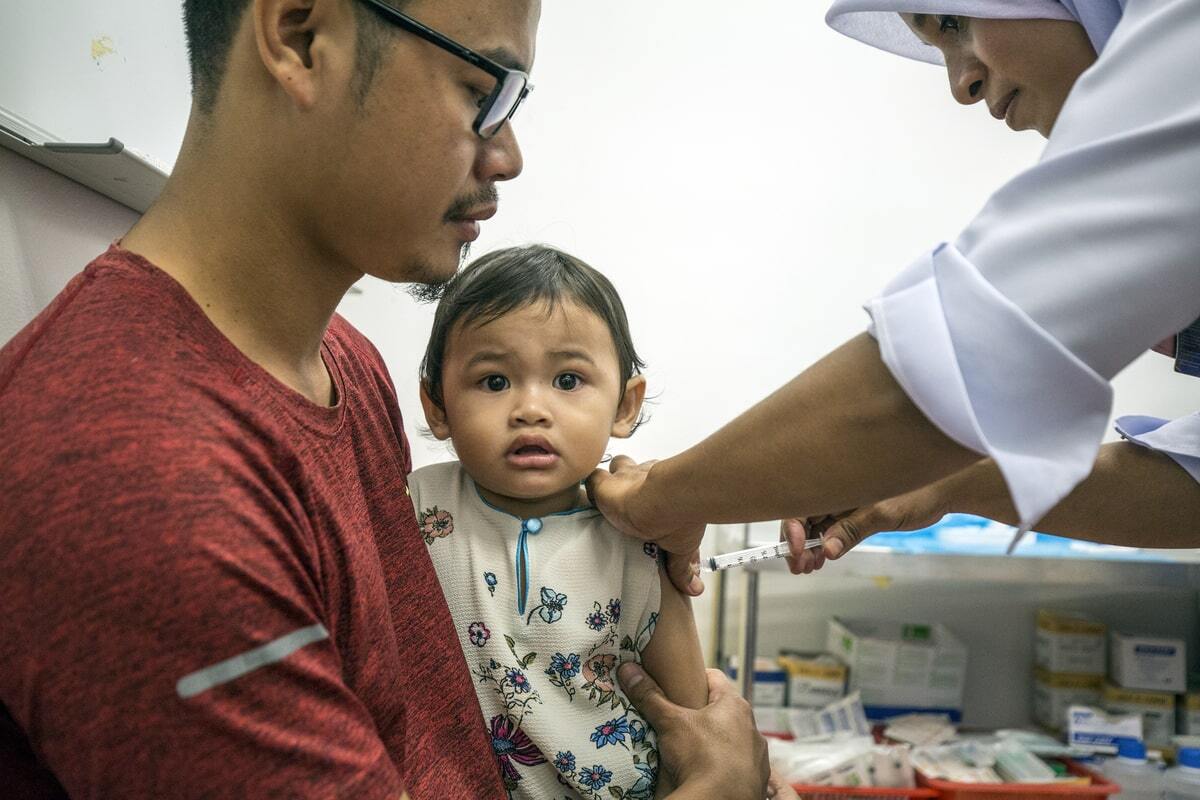
KUALA LUMPUR, August 4 — The Ministry of Health (MOH) has launched a nationwide measles-rubella supplementary immunisation activity (MRSIA) campaign for children aged under five years to get a third dose.
The campaign, which will be implemented from today until October 12, targets children aged 6 to 59 months who were born between August 1, 2020 and January 31, 2025.
“The main objective is to increase immunisation coverage and provide early protection to prevent further transmission,” the MOH’s disease control division said in a statement last Saturday.
According to the MOH, Malaysia’s measles, mumps, and rubella (MMR) immunisation coverage exceeded 95 per cent annually on average, including last year.
However, only 62 per cent of districts achieved 95 per cent MMR coverage in 2024. The number of measles cases nearly doubled from 2,002 cases in 2023 to 3,791 cases last year.
The number of measles outbreaks also rose to 231 in 2024 from 112 the previous year.
About 44.1 per cent of measles cases involved children aged below five years, whereas 28.9 per cent involved non-citizens, where 84.3 per cent were never vaccinated.
Three deaths from measles were reported last year, involving unvaccinated non-citizen children aged eight months, three years, and 17 years.
Under the National Immunisation Programme (NIP), the MMR vaccine is given at age 9 months and 12 months. In Sabah, an additional measles vaccine dose is given at 6 months of age.
“MOH urges parents and guardians to immediately bring eligible children to receive an additional MR dose for free. Appointment dates will be sent via MySejahtera or one can also make their own appointments through the app,” said the MOH’s disease control division.
“Eligible children can be brought for walk-ins to public health clinics. MOH outreach teams will also go down to the ground in schools, community centres, and remote areas.”
Nationwide MRSIA Rollout Unjustified, Says Public Health Medicine Specialist
An anonymous public health medicine specialist in the MOH – who claimed to speak on behalf of public health medicine specialists who lead district health offices and government health clinics – told CodeBlue last month that they were opposed to the MRSIA campaign that targeted the majority of children aged six to 59 months regardless of their previous vaccination status or local measles risk.
This includes children who have already received two doses of the measles-containing vaccine at 9 and 12 months of age.
The public health medicine specialist said MRSIA is typically indicated when vaccination coverage is low or when there is a heightened risk of measles transmission or an outbreak.
But under the current directive, health care workers are reportedly required to vaccinate nearly all children, regardless of existing coverage levels or local measles incidence.
“We were initially asked to conduct a measles risk assessment (MRA) to identify high-risk localities—but this has now been rendered meaningless as we are ordered to vaccinate even in low-risk areas,” the public health medicine specialist wrote in an email to CodeBlue, prior to MOH’s press statement Saturday.
“Scientific evidence shows that two doses of MMR vaccine are generally sufficient to provide lifelong immunity. A third dose is only recommended in outbreak situations or areas with low coverage. The World Health Organization (WHO) does not recommend routine administration of a third dose, but may consider it in certain outbreak scenarios.
“Given the marginal benefit of a third dose in already fully vaccinated children, we are concerned that potential vaccine-related adverse effects may outweigh any added protection.
“In the current climate where workforce shortages are a constant issue, channeling resources towards mass vaccination in low-risk areas seems irresponsible. Instead of spending millions on unnecessary vaccines and logistics, wouldn’t it be more prudent to invest in strengthening our health care manpower?”
The public health medicine specialist stressed that they supported the use of vaccines that they noted have eradicated deadly diseases like smallpox and continue to protect people from measles, pertussis, diphtheria, and other infectious diseases.
“I strongly urge the public to continue getting vaccinated,” the person said.
“However, my concern lies specifically with the unjustified nationwide rollout of MRSIA. It risks wasting valuable time, manpower, and resources, while providing negligible benefit and possibly even harm. Supplementary immunisation activities like this should only be implemented based on clear epidemiological justification.”
The public health medicine specialist also claimed that the number of vaccines given to health care workers were about 100-fold more than what they needed according to the initial risk assessment of high-risk localities, and that they have been instructed to finish them.
“Imagine the problem that we health workers will face – the struggle to justify the need for additional vaccine to parents and at the same time, the higher-ups will push us to finish the vaccine stock.”


