


The Covid-19 pandemic plunged Malaysia into a health care crisis, leaving behind a trail of dark memories lingering till today. Nationwide Movement Control Orders (MCOs) and spiraling death tolls defined those years.
As a health care worker actively managing Covid-19 patients, I witnessed the fragility of life up close. I carry stories of loss that remain etched in my mind—patients I couldn’t save despite my efforts.
These moments echo the words of French surgeon Henri Marie René Leriche: “Every surgeon carries about him a little cemetery, in which from time to time he goes to pray, a cemetery of bitterness and regret, of which he seeks the reason for certain of his failures.”
For me, it’s not just a surgeon’s burden but a health care worker’s reality. Each death felt like a personal failure, a haunting question of whether I could have done more.
Working on the frontlines also meant living with fear. Managing Covid-19 patient in my former workplace—Tuanku Jaafar Seremban Hospital—then at Penjara Jelebu followed by Port Dickson Hospital, I was constantly aware of the risk of contracting the virus and passing it to my loved ones.
The daily death toll updates from the Director-General of Health, often exceeding hundreds at the peak, made me dread the possibility that a friend or family member might become just another statistic. Thankfully, that fear never materialised, but the anxiety was a constant feeling.
At the height of the pandemic, health care workers across Malaysia made immense sacrifices. Among them, contract doctors and other temporary health care staff bore a particularly heavy load. Deployed to Covid-19 treatment centres, many were uprooted from their homes and sent to unfamiliar places to battle the virus.
The working hours were grueling—sometimes stretching beyond 24 hours—spent in stifling personal protective equipment (PPE) that left us drenched in sweat and physically exhausted.
Despite the uncertain futures that loomed over them, these contract doctors toiled tirelessly, driven by a sense of duty to the nation. They gave their all, not for personal gain, but because the country depended on it.
Initially, the nation hailed them as heroes. Social media buzzed with gratitude, and leaders praised their dedication. Yet, beneath the applause, a harsh reality persisted: their futures remained uncertain.
The contract system—introduced by the Barisan Nasional government in December 2016 as a stopgap measure to manage an oversupply of medical graduates—offered no job security or clear career progression.
Unlike their permanently employed counterparts, contract doctors were denied benefits like paid study leave, housing loan eligibility, and equitable wages. Leaders were offering merely lip services, with empty promises and no concrete long-term plans for the doctors.
Between December 2016 and May 2021, only 3.4 per cent of the 23,077 contract medical officers were granted permanent appointments in the Ministry of Health after completing their five-year tenure.
By mid-2021, with Covid-19 cases soaring and the health care system at the tipping point, the frustration reached its limit. Enough was enough.
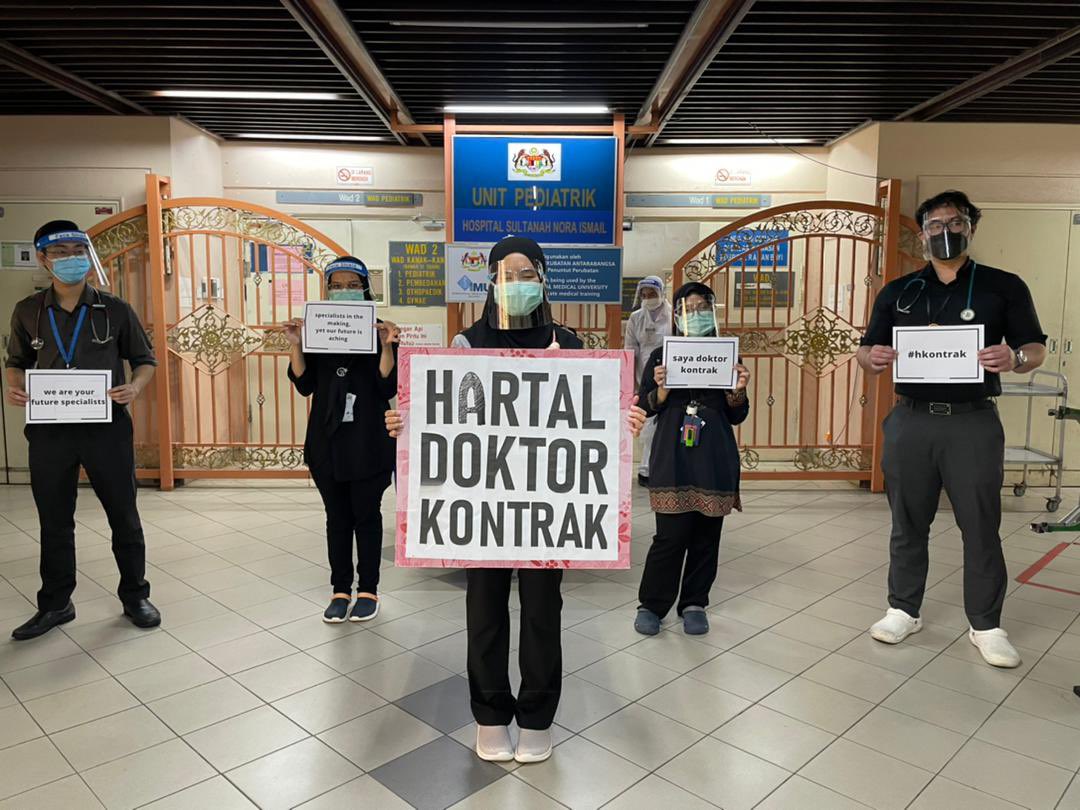
That’s when Hartal Doktor Kontrak (HDK)— rooted in the Gujarati term “hartal” for mass protest—emerged. Led by my dear friend Dr Mustapha Kamal and a group of determined contract doctors, HDK was born out of desperation and resolve.
They refused to let their voices be ignored any longer. After months of planning amidst a raging pandemic, they organised a nationwide protest on July 26, 2021. It was a bold move, especially during a crisis when every health care worker was needed, but it was a calculated one.
The strike was peaceful, lasting few hours in most places, ensuring patient care wasn’t compromised—a testament to their oath to “do no harm.”
Despite not receiving backing from mainstream doctor groups and associations, HDK remained firm in their demands: permanent positions for all contract medical officers and transparency in the selection criteria for such posts.
The timing couldn’t have been more critical. Malaysia reported record-high cases—13,215 on July 15, 2021—hospitals were overflowing, and health care workers were burning out. HDK’s message was clear: a broken system couldn’t sustain a nation in crisis.
Their persistence paid off. Three days before the strike, on July 23, 2021, then-Prime Minister Muhyiddin Yassin announced a significant update. Contract doctors would receive benefits equivalent to permanent officers, including eligibility for scholarships, fully paid study leave, and special medical leave.
It wasn’t the full abolition of the contract system they’d hoped for, but it was a monumental shift—the most substantial policy change since the system’s inception in 2016.
For years, contract doctors had felt lost, unsure if they could pursue specialties or build stable careers. This announcement offered a lifeline, a glimmer of hope amid the chaos.
The impact of Hartal Doktor Kontrak didn’t end with Covid-19. Post-pandemic, HDK has remained a vocal advocate for systemic health care reform in Malaysia. In January 2025, they challenged the controversial “Waktu Bekerja Berlainan” (WBB) shift system—a policy mandating 45-hour workweeks that included exploitative 18-hour shifts without on-call allowances.
HDK condemned it as a “governance failure,” arguing it compromised both doctor welfare and patient safety. Their demands for its withdrawal and for inclusive stakeholder consultations underscored their ongoing mission: to ensure health care workers are treated as professionals, not mere cogs in a machine.
They’ve also pushed for increased on-call allowances and tackled issues like workplace bullying and toxic work cultures.
Reflecting on it now, Covid-19—despite its devastation—had a silver lining. It birthed Hartal Doktor Kontrak, a movement that could prove to be the most pivotal turning point in Malaysia’s health care history.
The pandemic exposed the cracks in the system, and HDK seized that moment to demand change. Their fight isn’t just for doctors; it’s for the future of public health care—a system that serves all Malaysians.
As someone who lived through those dark days, I see HDK as a beacon of resilience, proving that even in the worst of times, collective action can spark lasting progress.
Dr Muhammad Yassin is currently a second year anesthesiology master trainee and a strong supporter of health care reforms. He is also spokesman for Hartal Doktor Kontrak. This article is part of a special CodeBlue series marking the fifth anniversary of the World Health Organization declaring Covid-19 as a global pandemic on March 11, 2020.
- This is the personal opinion of the writer or publication and does not necessarily represent the views of CodeBlue.


