

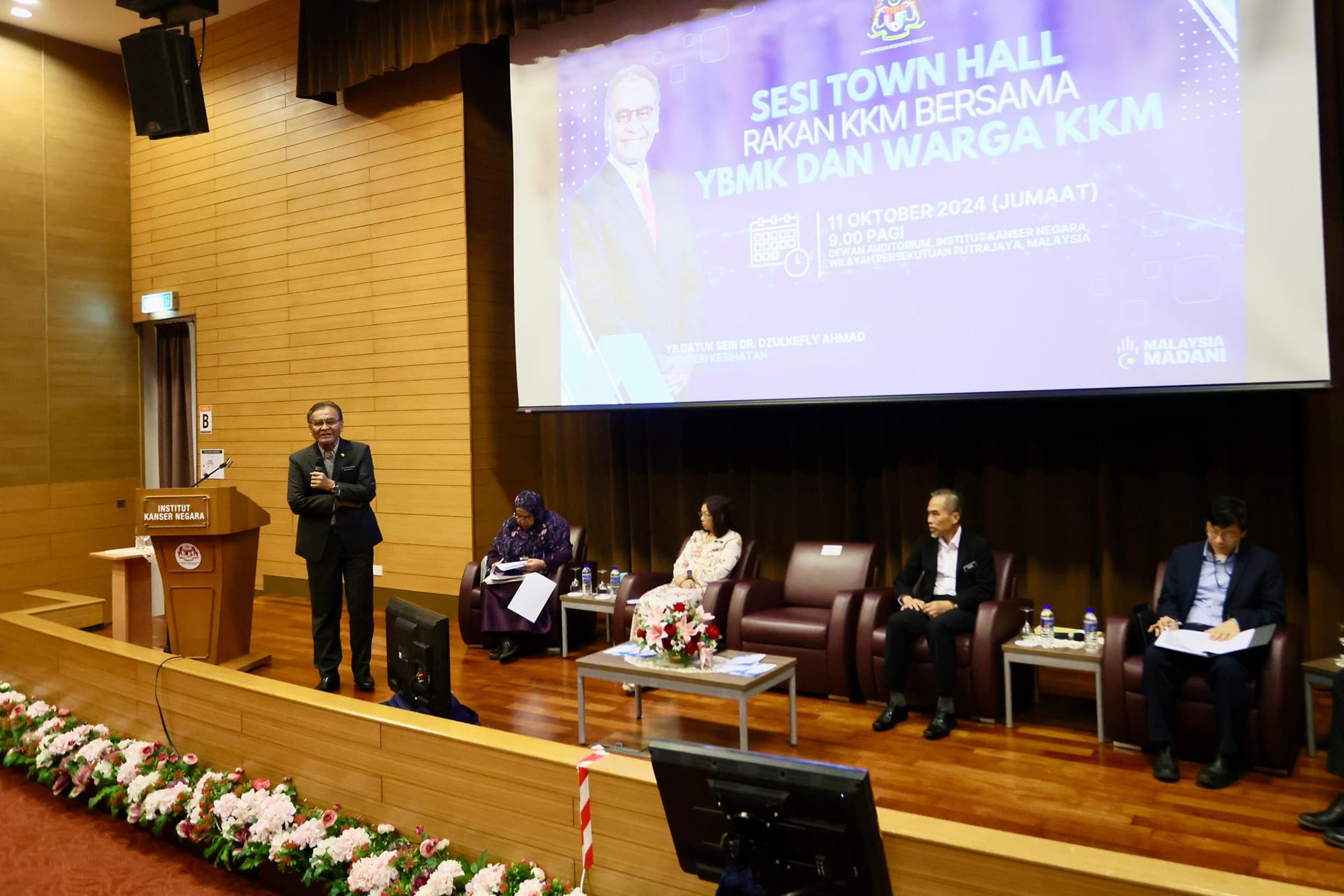
KUALA LUMPUR, Dec 16 — The Ministry of Health (MOH) plans to benchmark private hospital bills against the new Rakan KKM programme in its bid to regulate private hospital charges.
CodeBlue understands that the MOH will pilot the diagnosis-related groups (DRG) payment model in Rakan KKM – the so-called “premium economy” wing of government hospitals that will charge patients above cost – by June next year before mandating it for private hospitals.
“The pricing that we use – in terms of how much will be charged to the patient under Rakan KKM – can be used as a reference price for the charges in private hospitals,” an MOH official, who is familiar with the DRG process, told CodeBlue on condition of anonymity.
“But of course we understand that there are elements like profit margin etc. in private hospitals that will need to be taken into consideration.”
Rakan KKM has yet to launch. Cyberjaya Hospital is one of five MOH hospitals identified for the programme.
CodeBlue pointed out that private hospitals operate on very different cost structures than government hospitals, with the former having their own costs from capital expenditure, human resources, and procurement of not just drugs, but also medical equipment and other supplies and services.
Private hospitals often provide the latest medical equipment and therapies that are not listed on the MOH’s drug formulary. Their health care workforce, such as specialist doctors or nurses, is also paid far higher salaries than the public health service.
Rakan KKM – which doesn’t plan to build an entirely new hospital, but simply utilises existing MOH facilities – has the benefit of using supplies and services from MOH procured at the government level, as well as health care professionals working in the ministry.
Another crucial difference is the cost of regulatory compliance for private hospitals to meet standards under the Private Healthcare Facilities and Services Act 1998 (Act 586) in a “bureaucratic maze” of regulations. MOH hospitals and public health clinics are exempt from Act 586.
“Rakan KKM’s DRG will be priced to correspond to as much as actual costs in MOH, plus a marginal profit margin. So this would be a baseline where private hospitals’ DRG could use,” the MOH official told CodeBlue in response.
Under the DRG model, hospital cases are categorised into groups based on diagnoses and procedures. This system establishes standard payment rates by providing a fixed amount for each group, rather than itemising individual charges. Hospitals must operate within this predetermined budget that is negotiated in advance between payers and hospitals.
Currently, private hospitals in Malaysia operate on a fee-for-service model, in which private health care providers are paid based on the amount of services delivered.
Under Act 586 – which the government intends to amend next year to enforce DRG payment models – private hospitals are simply required to list every single charge in long, itemised bills to patients. Only doctors’ fees are capped under Schedule 13 of Act 586.
Switching to DRG means that hospitals will no longer be required to itemise every charge in a bill (for example: drugs, medical and surgical supplies, the use of medical equipment or instruments, the use of an operating theatre, imaging, lab investigations etc.), but to simply state the total charge for the procedure or treatment.
The MOH official, who spoke to CodeBlue, also maintained that the ministry does not yet plan to enforce drug price controls in the private sector, but to continue with its medicine price display mandate for private hospitals and general practitioner (GP) clinics next year.
“At present, we are only advocating for the display of drugs at outpatient in private hospitals, as well as at the GPs. We are not talking about any form of price control. The display could be in the physical form or could also be in electronic form, such as an iPad or uploading on their website.”
The MOH’s move to control private hospital charges that have long remained unregulated (aside from doctors’ fees that have stagnated for more than a decade) followed Prime Minister Anwar Ibrahim’s recent announcement in Parliament on a proposed amendment to Act 586 to mandate the DRG model.
Anwar’s remarks were made in response to the public furore over a surge in health insurance premiums. Both the insurance industry and Bank Negara Malaysia (BNM) insist that raising premiums is necessary to maintain the sustainability of insurers, due to a high claims rate and medical inflation.
The insurance industry and central bank also allege “different and non-transparent” charges by private hospitals. BNM told parliamentarians in a briefing last Tuesday that patients with guarantee letters are billed 286 per cent and 158 per cent higher than insured pay-and-claim patients for dengue and pneumonia treatment respectively.
BNM’s presentation slides did not elaborate on whether its comparison was adjusted for factors like severity of disease or length of stay.


