

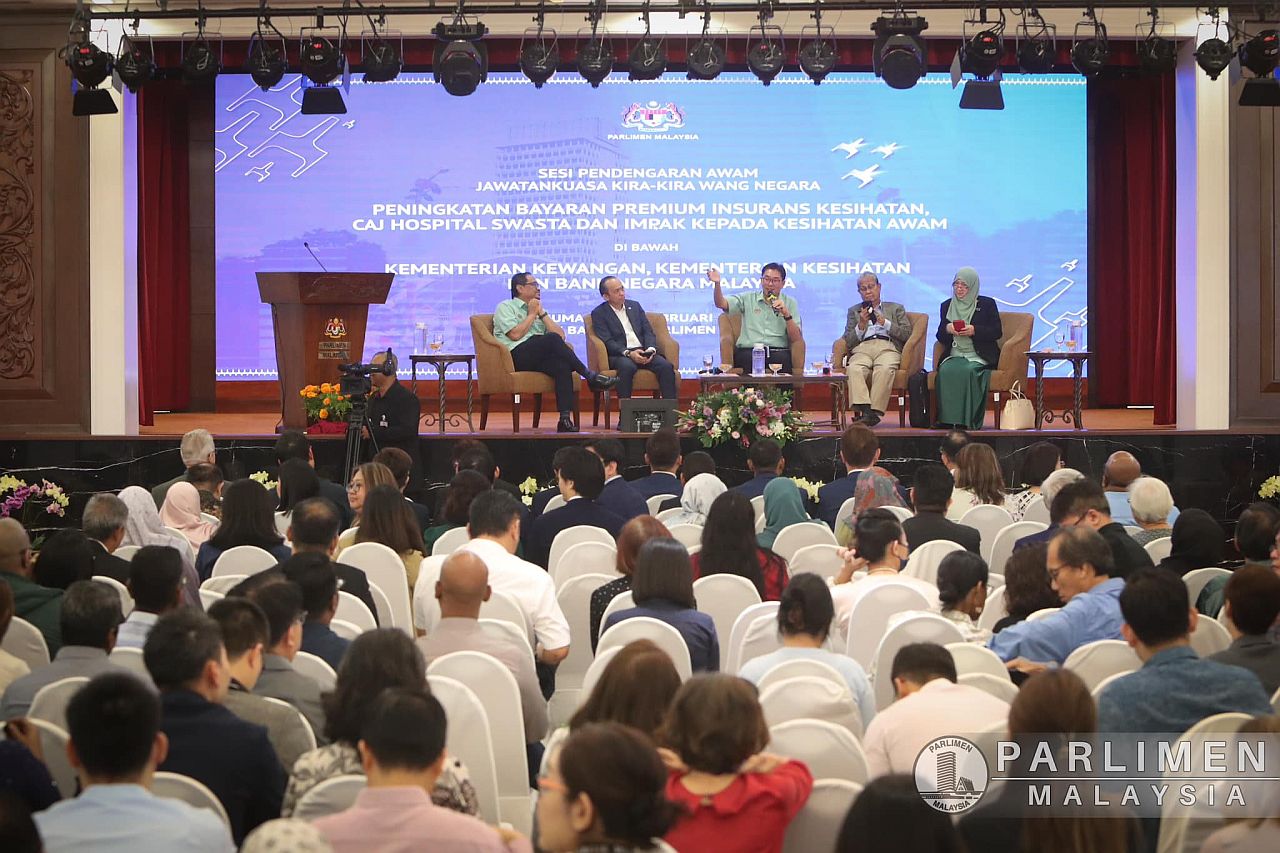
KUALA LUMPUR, Feb 21 — Parliament’s Public Accounts Committee (PAC) heard testimonies from over 50 speakers today in a public hearing on private health care costs, where concerns were raised over rising health insurance premiums and private hospital charges.
The three-hour session, attended by over 550 participants, was the second PAC hearing following its first in Penang that drew nearly 200 attendees. This marks the first time a parliamentary committee has held a public hearing.
Today’s session, moderated by Bayan Baru MP Sim Tze Tzin, saw participation from several lawmakers, including Betong MP Richard Rapu, Kubang Pasu MP Ku Abdul Rahman Ku Ismail, Shah Alam MP Azli Yusof, Kapar MP Dr Halimah Ali, and Seputeh MP Teresa Kok.
Representatives from Bank Negara Malaysia (BNM), the Ministry of Health (MOH), the Life Insurance Association of Malaysia (LIAM), and the General Insurance Association of Malaysia (PIAM) were also present.
The town hall was packed, with about 25 people lining up at any given time to speak. A total of 51 participants took the floor. At one point, Sim urged brevity, cautioning that if each speaker took five minutes, the session would last 37 hours.
‘Insurers Ignoring BNM’s Interim Measures’

Many participants at the town hall claimed that health insurers were not complying with BNM’s interim cap of 10 per cent on premium hikes.
A retiree from Subang Jaya said his insurance premium increased by approximately 50 per cent from RM2,108 to RM3,163 since 2022, despite having no source of income for the past eight years.
“The fact that the regulator approved such an increase is beyond my imagination,” he said, adding that BNM’s interim measures were ineffective in easing the burden, particularly for senior citizens.
He also criticised the absence of a refund option for policyholders. “When I asked my insurer about a refund, they said there was none because BNM’s interim policy does not mention refunds,” he said.
Another retiree, Cheah Tuck Win of the Malaysian Coalition on Ageing (MCOA), claimed that the 10 per cent cap only applies to those aged 60 and above with basic insurance plans.
“One of BNM’s interim policy states that repricing of premiums for those over 60 will be suspended for a year, right? But my insurer—one of the biggest in Malaysia—told me it only applies to the ‘lowest’ plan. Is that what BNM intended? If it’s for those above 60, then it should apply regardless of the plan,” he said.
“The interim measures are not good enough.”
After the town hall, PAC did not say how it would address the issue with the central bank, stating only that the matter would be discussed in closed-door proceedings.
Premium Costs Surge In Later Years
Insurance specialist Ravinder Singh, who is co-founder and chief commercial and marketing officer of AQM Technologies, said the bulk of insurance premiums are paid in the last 20 years of a policyholder’s life.
“My son is 27. I calculated his total premium payments from age 0 to 80, and it comes up to RM300,000. What’s alarming is that 70 per cent of this amount—over RM200,000—is paid between the ages of 60 and 80. What it means is you pay 70 per cent of your hospital charges in the last 20 years of your life. That is scary,” Ravinder said.
Ravinder warned that most people over 60 would struggle to afford health insurance and be forced to rely on public hospitals instead.
One elderly participant shared his experience: “I paid RM2,600 for my insurance premium 15 years ago. Based on my age bracket this year, I should be paying RM8,000, but last year I was already paying RM15,000. Then I got another letter saying it will go up to RM22,000. I’m at retirement age, and I’ve been forced to work just to pay my insurance.”
Exorbitant Private Hospital Charges
Malaysians also highlighted price disparities between insured and uninsured patients in private hospitals, as well as the high cost of medication and procedures.
Ravinder said his nephew’s appendicitis treatment last November cost RM37,000 for a two-and-a-half-day stay at a private hospital in Petaling Jaya.
“This hospital in PJ has a self-playing piano in the lobby and an aquarium that takes up a third of the space. We don’t need that. What we need is two-star luxury, with three-star prices. No more five-star, six-star luxuries.”
Peter Woo, a Segambut resident, claimed that he was charged more as a self-paying patient than insured individuals.
“My son was diagnosed with acute appendicitis three weeks ago. The general surgeon estimated it would cost about RM25,000. I thought that was steep, but expected maybe RM15,000 to RM20,000,” he said.
“But because it was urgent, we went ahead. It was a normal laparoscopic appendectomy with no complications. My son stayed for three nights, and the bill came to RM33,000. Even the surgeon was shocked. I checked with the hospital management and found that an insured patient was charged RM25,000. I don’t understand why self-paying patients pay more.”
Other Grouses
Representatives from consumer, insurance, and pharmaceutical groups proposed various measures, including:
- Price caps for private hospital charges, medicine, and equipment.
- A transparent price list for procedures, akin to a “coffee shop” menu.
- A regulatory body to oversee insurance and private hospital pricing.
- A National Health Insurance scheme for at least basic coverage.
- Cost reduction by switching from branded drugs to generics.
- Healthy eating options/ culture as part of preventive medicine.
Many attendees appreciated the public hearing. One participant remarked, “Although we are not MPs, we feel like one today.” However, some argued such hearings should be the norm rather than a reaction to public outcry.
“The elephant in the room is the failure of regulatory bodies—not just BNM, PIAM, and the Ministry of Finance (MOF), but Parliament itself. MPs represent the people, yet the people’s voices aren’t heard,” one participant said.
“This should be organised earlier, not just when there’s backlash. That’s always the way—when something goes wrong, the public complains, and only then things are taken seriously. We shouldn’t be reactive.
“There should be a PAC that proactively looks into major issues and engages the rakyat, not just when problems arise. Only then will engagement be sincere, rather than just a box-ticking exercise to say, ‘we’ve engaged the public.’
“Engage the public, get their feedback, and policies will be easier to implement.”
PAC To Hold Closed-Door Hearings Next
At a press conference after the public hearing, Sim said PAC will hold at least 10 closed-door sessions with up to 100 personnel from relevant ministries, government agencies, private hospitals, insurance companies, and various associations.
The sessions, expected to take hours per meeting, will conclude by July. PAC aims to submit its report and recommendations in time for the next parliamentary sitting from June 23 to July 31.
“With PAC’s recommendations, we hope the government will take the necessary steps to amend or introduce a new bill by the end of the year and pass it next year,” Sim said.
“I see a need to reform the ecosystem. That’s why PAC has initiated this process to get the ball rolling and resolve these issues.”
Kapar MP Dr Halimah said public awareness exceeded expectations, with attendance at today’s town hall hitting over 500.
“We hope this awakening and awareness from the public, consumers, and all stakeholders will push the government to prioritise health system reforms. We cannot allow crisis after crisis—where people exhaust their savings, retirees have no income, and families struggle. This must be a government priority.”


