

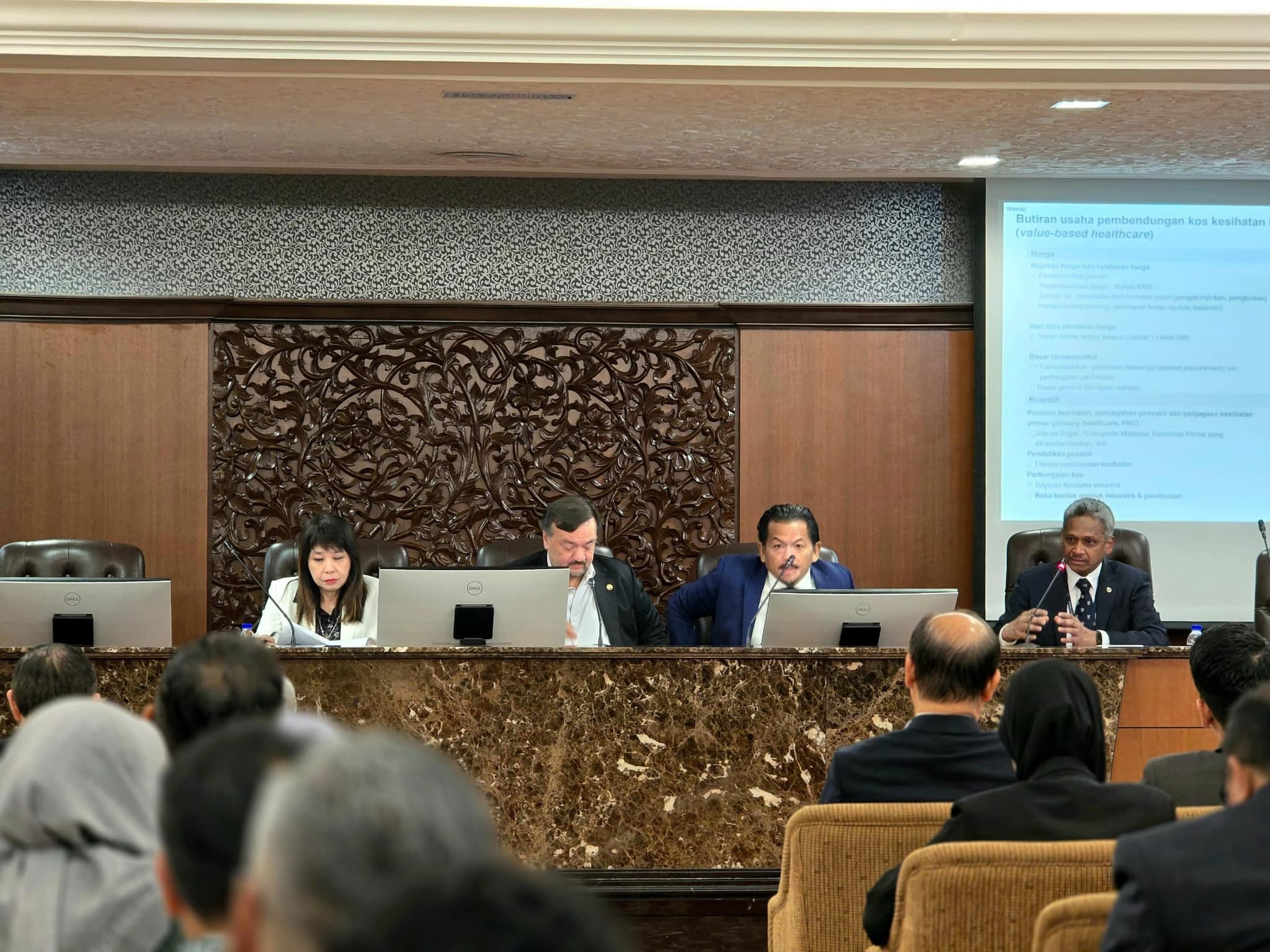
KUALA LUMPUR, Dec 11 — About six in 10 revised medical and health insurance and takaful (MHIT) policies had premium increases of up to 20 per cent this year, said Bank Negara Malaysia (BNM) and the Ministry of Finance (MOF).
In 2024, among affected policies, higher premiums by less than 20 per cent hit 61 per cent of policies, premium increases of between 21 and 40 per cent applied to 30 per cent of policies, premium hikes from 41 to 60 per cent hit 5 per cent of policies, and premium surges of above 60 per cent affected 4 per cent of policies.
“The revision of MHIT premiums is still not commensurate with the high claims rate,” according to presentation slides by BNM and MOF at a closed-door briefing for the government backbenchers club (BBC) in Parliament yesterday.
The slides, as sighted by CodeBlue, noted that cumulative medical claims cost inflation was reported at 56 per cent from 2021 to 2023, far exceeding the 20 per cent growth in MHIT premiums.
In that period, cumulative medical cost inflation was reported at 47 per cent, lower than the 56 per cent cumulative MHIT claims cost inflation. The ratio of claims hit 101 per cent to 111 per cent for the period of 2018 to 2023, excluding pandemic years.
“In general, premiums are revised once every three years if MHIT claims continue rising.”
According to the presentation by BNM and MOF for parliamentarians, the cost per hospital visit to private hospitals increased about 22 per cent from RM8,800 in 2020 to RM10,700 in 2023. The frequency of claims rose from 6.8 per 100 policyholders in 2020 to 8.6 last year.
“The higher usage of treatment in private hospitals causes the continued increase in MHIT claims,” said the presentation by BNM and MOF. “The continued rise in prices and treatment frequency leads to bigger medical bills.”
The central bank and MOF also highlighted “different and non-transparent medical charges” by private hospitals, citing the different bills for insured patients using guarantee letters (GL) versus those who pay and claim from their insurance.
For dengue treatment, GL patients are charged RM4,978, about 286 per cent higher than pay-and-claim patients who are billed RM1,288. For pneumonia treatment, GL patients are billed RM6,859, about 158 per cent more than pay-and-claim patients who are charged RM2,654.
GL patients do not pay hospitals for treatment covered by insurance, whereas pay-and-claim patients must make payment first before claiming for reimbursement from their insurer.
Hospital supplies and services (HSS), which BNM and MOF described in their slides as “high”, comprise 59 per cent to 70 per cent of private hospital bills. HSS includes lab and imaging, drugs, nursing, and medical equipment (for example, ventilators and dialysis machines), among others.
These HSS components generally contribute about 70 per cent and 59 per cent of a total hospital bill for non-surgical and surgical treatments respectively.
BNM and MOF said in their presentation that for next year, gross medical inflation is estimated at 15 per cent for Malaysia, exceeding the estimated 11.1 per cent Asia Pacific average and projected 10 per cent global average.
“Malaysia recorded high medical cost inflation. Health challenges contribute to rising medical costs: the increase in non-communicable diseases (NCDs), the emergence of new and old infectious diseases, ageing demographics and mental health issues, technological advances in health services, climate change and its impact on the ecosystem, and salaries for the health care workforce.”
Priorities: Rakan KKM, Drug Price Transparency, Strategic Purchasing

BNM told parliamentarians that it would work together with the Ministry of Health (MOH) to control medical inflation by transitioning private hospitals to value-based health care. Value-based health care involves paying health care providers based on patient outcomes, rather than the amount of services they deliver.
Current priorities include the recent launch of Rakan KKM, the “premium economy” wing of government hospitals under the MOH, to “compete” with private hospitals; increasing drug price transparency; and strategic purchasing to reduce health care costs in the public and private sectors.
The central bank and MOF’s presentation proposed pooled strategic purchasing between public and private health care providers and transitioning to diagnostic-related groups (DRG) payment models.
Prime Minister Anwar Ibrahim told the Dewan Rakyat yesterday that the Private Healthcare Facilities & Services Act 1998 (Act 586) will be amended next year to regulate private hospital charges by mandating DRGs to replace the current fee-for-service payment model. Schedule 13 of Act 586 only controls specialist doctors’ consultation fees and their fees for various procedures.
When asked in Parliament if the government would impose a moratorium on next year’s increase in medical insurance premiums, Anwar, who is also finance minister, said there will be no moratorium, but an “interim, reasonable, and small increase.”
DRG involves paying a fixed amount based on the complexity of the case, rather than itemising each charge. Hospitals receive a set amount (e.g., RM25,000 for a knee replacement surgery) – which is pre-negotiated between the payer and the hospital – and manage their resources within that budget.
On health care pricing, BNM and MOF’s presentation cited drug price transparency at the retail level. The MOH previously announced a drug price display mandate for both private hospitals and general practitioner (GP) clinics that will be enforced next year.
Drugs, however, generally comprise only a fraction of hospital bills. For example, based on Life Insurance Association of Malaysia (LIAM) chief executive Mark O’Dell’s bill of nearly RM19,000 for a minor hernia surgery last May at a private hospital in Kuala Lumpur, medication was charged at about RM2,607, just 14 per cent of his total bill.
Other hospital charges included consignment supplies; equipment or instrumentation; gases supply; imaging; lab investigation; medical and surgical supplies; nursing care; nursing procedure; operating theatre; room and board; and doctors’ charges, among others.
BNM and MOF also proposed creating a central database to collect and standardise data through codes on MHIT claims.
Their presentation noted that the central bank’s copayment mandate has already come into force; BNM has also proposed improving the design of MHIT products.
This includes encouraging innovations in MHIT products with more sustainable premiums and “judicious” usage, such as a basic health insurance/takaful plan, appropriate coverage limits, selected services or hospital networks, copayment features, and incentives to promote a healthy lifestyle and disease prevention.
“Improve the offering of appropriate alternative MHIT plans that meet the needs of policyholders at the same or lower premiums,” said the presentation slides.
BNM and MOF touted portability for medical plans to enable policyholders to change insurance providers; flexible premium payment plans or different coverage plans for affected consumers, including retirees; and drug price transparency.
Yesterday’s internal briefing for MPs was held by Bank Negara governor Abdul Rasheed Ghaffour, Finance Minister II Amir Hamzah Azizan, and Deputy Finance Minister Lim Hui Ying. Neither Health Minister Dzulkefly Ahmad nor Deputy Health Minister Lukanisman Awang Sauni were present at the briefing.


