

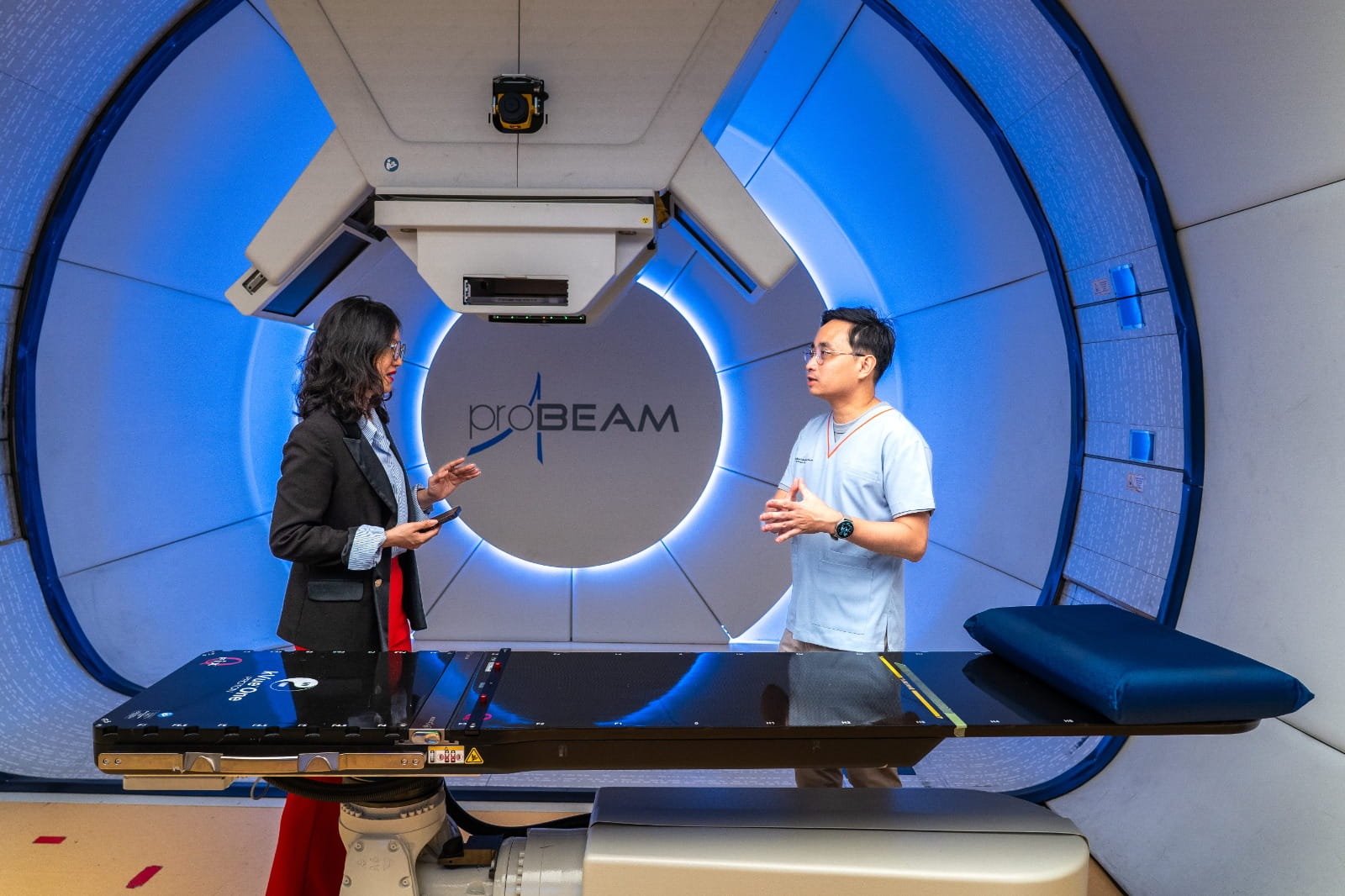
SINGAPORE, Nov 23 — For Malaysian cancer patients weighing their treatment options, proton beam therapy is emerging as an alternative to conventional radiotherapy, say two Singaporean radiation oncologists who regularly treat patients from Malaysia and the region.
But the precision treatment isn’t right for everyone; it is most beneficial for patients with tumours in hard-to-treat areas, where it can offer long-term remission with fewer side effects than conventional radiotherapy.
Proton beam therapy, currently available in the region only in Singapore and Thailand, is commonly used to treat head and neck cancers, brain tumours, paediatric cancers, sarcomas, lung and chest tumours, gastrointestinal cancers, prostate cancer, and cases requiring re-irradiation.
At a SAM podcast hosted by CodeBlue editor-in-chief Boo Su-Lyn here last September 17, Proton Therapy SG medical director and senior consultant radiation oncologist Dr Shaun Ho explained that conventional radiotherapy uses penetrative X-rays or photons that go past the cancer, but proton therapy delivers radiation to targeted tumours without reaching healthy tissue because protons have mass.
Raffles Hospital senior consultant radiation oncologist Dr Brendan Chia pointed out during the podcast that because surrounding organs are spared with proton therapy, radiation dosage can be increased for certain tumours.
“When we talk about radiotherapy broadly, oftentimes the patients that we treat with proton therapy are those where we are often giving treatment with an intent to cure. These patients are usually fairly fit to be able to go through this kind of intensive treatment because we’re aiming for a cure,” said Dr Ho.
Although proton therapy can be used for all tumours, Dr Chia explained that the treatment is especially beneficial for paediatric cases to avoid a risk of secondary cancer from radiation.
Besides young children, certain cancers affecting critical organs like the brain can also be better treated with proton therapy.
“When you use proton therapy, you can reduce the dose to the surrounding brain structures. That way, you can reduce some of the side effects from radiation like fatigue, poorer cognition, and overall, it leads to a better quality of life for patients after they’ve gone through radiation treatment,” he said.

Dr Ho stressed that not all cancers require proton therapy and that it isn’t a uniform upgrade over conventional radiotherapy, but the cancers that benefit most from proton therapy are tumours located in critical areas like nasopharyngeal cancers, throat cancers, or skull-based tumours, besides the brain.
“Also, in general, if you want to treat a larger volume, proton therapy has more benefits,” he added, citing cancers of the esophagus that encompasses a very long area in one’s food pipe.
“If the area you need to treat is very long, you might not be able to do it safely with conventional radiation because you might have excess radiation doses to the lung or heart. With proton therapy, you can really minimise the side effects or damage to the lung or heart.”
Certain lung cancers, which extend from the neck down to the diaphragm, can also be better treated with proton therapy than standard photon X-rays to get radiation doses to the desired targets.
Patients with liver cancer can also benefit from proton therapy because their livers often already have poor baseline function due to hepatitis or cirrhosis. “If you want to give radiation which can control that cancer, you may run into the risk of damaging the liver itself. So if you want to treat liver cancer, oftentimes proton therapy might be a good alternative to conventional radiotherapy,” said Dr Ho.
Cancer patients who need treatment of an area near fertility organs at reproductive age can similarly benefit from safer proton therapy that reduces radiation doses to the ovaries or testes.

Singapore’s Ministry of Health regulates proton therapy with a pre-approved list of conditions; the treatment can’t be prescribed for all cancers.
Proton therapy is generally used for stage one to three cancers or locally advanced cancers, rather than uncontrolled cancers all over the body, because “we plan to cure them”, said Dr Ho.
“Usually, we reserve proton beam therapy for patients who are likely to have a good or meaningful enough prognosis to fully benefit from the lifelong benefits of using proton therapy.”
However, certain very early stage cancers might not benefit from proton therapy either, such as some types of early breast cancer for which conventional radiotherapy works just as well because the breast is a “superficial” structure of the body.
On the other hand, proton therapy might be more appropriate for advanced breast cancer that requires treating lymph nodes in the chest.
Dr Ho added that proton therapy might also be unsuitable for patients with incompatible implants within the treatment area, such as after spine surgery. “If there’s too much uncertainty, you run the risk of overshooting or undershooting the target because you can be precisely off target if it’s not done properly.”
“In general, the larger the area you need to treat and the higher the dose you need to give, then the more likely you are to benefit from proton therapy,” he said. “If you have very early stage cancer or a tumour that’s very small or superficial that’s nowhere near anything important, then you might not see very much meaningful benefit from proton therapy.”
Beyond Survival, Better Quality Of Life

Beyond five-year survival rates, which generally depend on the type of cancer and its stage, radiation oncologists stressed that proton therapy can significantly improve quality of life.
For head and neck cancers, such as nasopharyngeal cancer commonly seen in ethnic Chinese, radiotherapy affects salivary glands because these organs are quite sensitive to radiation and are very close to where doctors need to treat, even as the cancer responds well to radiation.
“With proton therapy, we can spare the salivary glands more and that way, we can reduce the dryness that the patient will have throughout the rest of their life,” said Dr Chia.
Radiation also affects one’s oral cavity, tongue, and tastebuds, which can leave patients with a permanent decreased sense of taste. Even after a year or longer, some patients might only recover 60 per cent to 70 per cent of their sense of taste, making them less able to appreciate food and drink, or become non-tolerant of alcohol or spicy food.
“These are the late side effects of radiation that proton therapy tries to reduce the risk of, or at least reduce the severity of dryness of mouth and taste changes that can affect a patient’s quality of life,” said Dr Ho.
“You might survive just as well with normal radiotherapy. But how do you quantify a patient’s ability to enjoy his food and his drink in the decades to come?”
Conventional radiotherapy for head and neck cancers can also cause dental problems over the years due to radiation doses to the jawbone and teeth. If dental extractions are needed, cancer survivors will face a higher risk of infection.
“With proton beam therapy, you can drop the dose to the jawbone and the teeth to a negligible amount. So patients get a lot less dental complications. Another thing is that a lot of patients with head and neck cancers, especially nasopharyngeal cancers, get chronic sinusitis. With proton therapy, you reduce the dose to the sinuses by a lot, so the risk and severity of chronic sinus problems is much lower,” said Dr Ho.

Dr Chia recalled treating one of his early proton therapy patients, a woman in her 30s with a large brain tumour. While conventional X-ray radiotherapy often leaves brain cancer patients unable to work due to fatigue and cognitive side effects, she was able to resume strenuous activity, including rock climbing, just weeks after treatment.
Though Dr Chia found the case striking, he stressed that this was an individual outcome rather than a typical or guaranteed result of the therapy.
The length of proton therapy treatment depends on the area of the body treated, cancer stage, and what doctors intend to do with the patient, which can be six to seven weeks for brain or neck cancers or three to four weeks for liver or prostate cancers.
Proton Therapy Isn’t Experimental, Patients Come From Malaysia, Among Others

Dr Ho said he has received patients from Malaysia, Indonesia, Vietnam, the Middle East, and even Australia and New Zealand because proton beam therapy in the region is only available in Singapore and Bangkok, Thailand.
Dr Chia has similarly received patient referrals from oncologists in Malaysia and Indonesia.
“A lot of times after the patient does their proton therapy, they will have to go back to their treating oncologist where they’re from. So it’s good to have the communication with the treating oncologists, and we like to get them involved as well, so we know we can get the history better and the plan for the patient as well,” he said.
Malaysian patients can also raise proton therapy directly with their treating oncologist, who can advise on referral to a centre offering the treatment.
According to Dr Ho, Malaysian patients from Kuala Lumpur or Johor Bahru sometimes opt for daily cross-border commutes, given that outpatient proton therapy can span three to seven weeks depending on the cancer type. To manage costs, they may base themselves in Johor Bahru, where furnished studios and one-bedroom apartments rent significantly below Singapore’s short-term rates.
Outside peak hours, the commute remains manageable. A late-morning trip via the Second Link, for example, can take just 45 minutes or less each way. Cross-border travel is expected to become even more accessible and affordable once the Johor Bahru–Singapore Rapid Transit System (RTS Link) begins service in 2027.
A complete course of proton therapy in Singapore typically costs between SG$40,000 (RM127,946) and SG$70,000 (RM223,905) before taxes, with more complex cases potentially running higher. Actual cost depends on the individual treatment plan and is confirmed only after consultation.

Insurance policies in Malaysia may cover advanced or regional cancer care. Addressing common misconceptions, Dr Ho stressed that proton therapy is not an experimental treatment, but an established, clinically recognised therapy approved for cancer care in Singapore.
Proton therapy is actually decades’ old, but the technology has vastly improved over the years.
“The initial versions of proton therapy were not as precise. As technology improved, the type of proton beam therapy has also evolved. So with better imaging and better technology, proton beam therapy now is very different from proton therapy 10 or 20 years ago,” said Dr Ho.
“In terms of the facilities, we have more compact solutions now because previously, proton therapy used to require a very large footprint.”

Proton therapy, which only arrived in Singapore three years ago, has been available in the United States, Europe, China, South Korea, Japan, and Taiwan for years. Badminton star Lee Chong Wei underwent proton beam therapy in Taiwan in 2018 for early-stage nose cancer.
Dr Ho pointed out that Australia and New Zealand have national programmes in which their governments fund overseas proton therapy for certain cancer types.
“We work with government doctors in Australia and New Zealand to clear administrative hurdles so that their patients can come to Singapore to receive proton therapy and then go back.”
Dr Chia urged Malaysian patients to discuss proton therapy as an option.
“I think it’s important to work with your oncologist because ultimately, even if you get treatment here, you will be following up with them back in Malaysia,” he said.
“As a local practising doctor, before we had proton therapy, even though we knew protons existed overseas, we didn’t really discuss that option with patients because it’s just not available locally.
“But now, the world is very well connected, Singapore is easily connected. We’re building the RTS Link. The connection is going to be even better. So I think it’s worthwhile to explore that as an option now with your patients if you feel that it may be beneficial for them.”


