

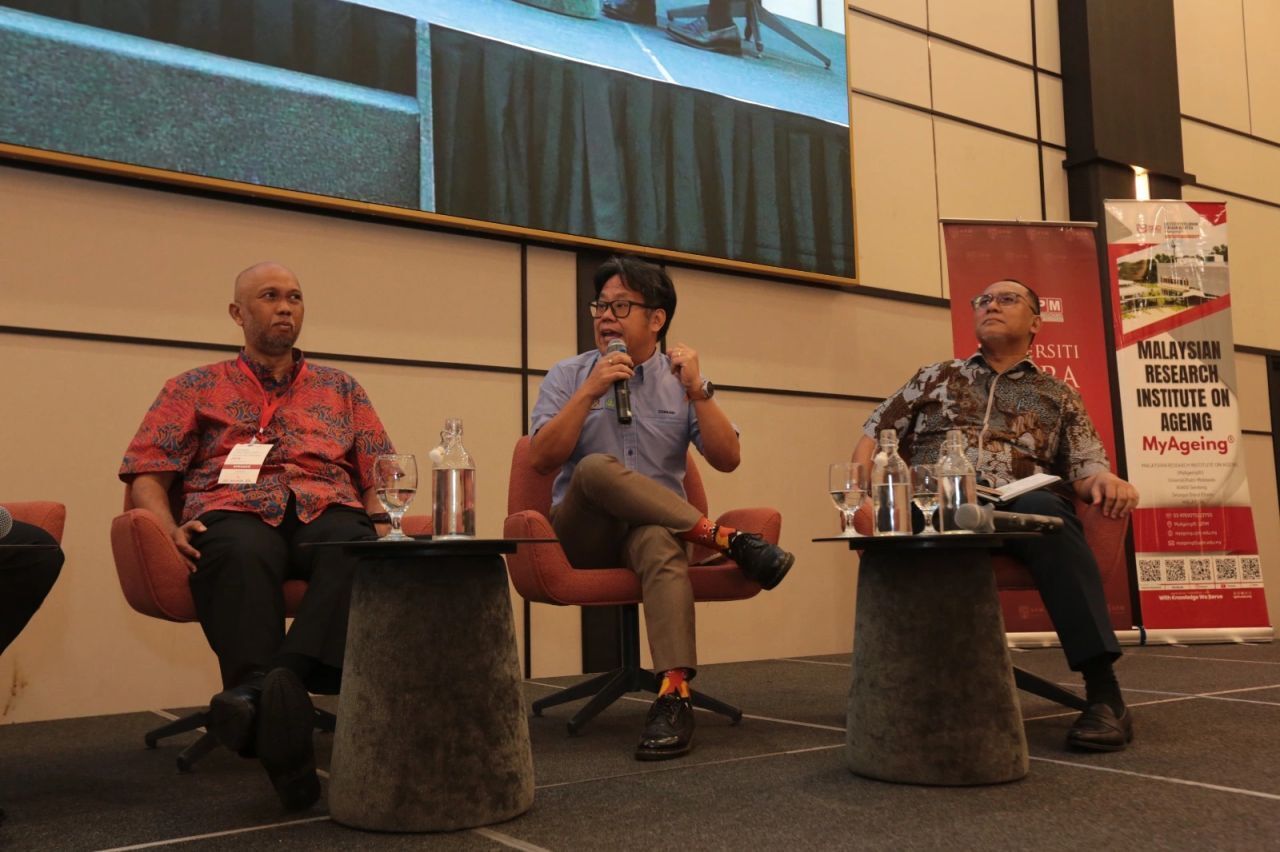
KUALA LUMPUR, Oct 28 — Public resistance to mandatory Lindung 24/7 contributions highlighted the difficulty of getting Malaysians to pay into a social protection scheme they might never need, said the Social Security Organisation (Socso).
Socso deputy chief executive officer (strategy and corporate) Edmund Cheong Peck Huang said the backlash, including people calling the scheme puaka (wicked or evil) on Threads, reflected what he saw as growing individualism.
“I’m seeing a trend that Malaysians are being more individualistic,” Cheong said at the Long-Term Care Financing Dialogue 2026 on October 21. “Many Malaysians will say, why should I contribute to a pool for someone who did not take care of himself?”
He said people tend to assume that accidents, illnesses, or unemployment won’t happen to them, making it difficult to persuade Malaysians to contribute towards a shared insurance pool.
“When I wake up in the morning, I put my seat belt on and I go to work, I don’t plan to get into an accident,” Cheong said, describing this as “positive bias”. People similarly do not expect to be diagnosed with cancer during a routine health check-up or suddenly lose their jobs.
In July, the Cabinet decided to make Lindung 24/7, Socso’s non-employment injury scheme, voluntary following public opposition to mandatory contributions. The scheme was introduced to extend social protection to accidents occurring outside working hours and unrelated to employment.
However, Cheong believes a national long-term care insurance scheme may be more easily accepted by the public because ageing is inevitable, unlike accidents, illnesses or job losses.
“With long-term care, I would say it’s easier because all of us would get old,” he said.
The challenge, however, is to build public trust in an institution that can remain financially sustainable for decades, given that contributors might pay into the scheme for 30 years before needing care for themselves.
“Today I’m paying for the neighbour, today I’m paying for someone else’s grandfather, but one day, some random Malaysian will be paying for me,” Cheong said.
He said contributors needed confidence that the institution managing the scheme would have the track record and infrastructure to provide for them when they eventually needed long-term care.
Heading Towards ‘Big Mac’ Generation
Despite the prospect of greater public acceptance, Cheong said long-term care financing would still require mandatory contributions through a social insurance programme, rather than relying on voluntary insurance or individual savings.
“It’s called solidarity. Are we ready for solidarity?” he said, explaining that a large pool of contributors would spread financial risks and keep contributions affordable.
“If the pool is small, only 200 people are willing to contribute, it’s probably going to cost us RM1,000 a month. But if you can get every Malaysian in under a mandatory scheme, it can be RM20 a month,” Cheong said.
Long-term care support could include financial assistance for home renovations, such as installing ramps for people with mobility needs, as well as allowances to help cover care expenses.
Cheong said such support would be costly and difficult to finance through individual savings alone, as even the most prudent savers might not accumulate enough to meet their long-term care needs in old age.
The case for collective financing is becoming more pressing as Malaysia’s population ages and fertility rates decline, leaving fewer younger people to support older generations.
Cheong warned that working adults could face growing responsibilities towards multiple generations of family members, beyond the pressures already experienced by the sandwich generation, who support both their young children and ageing parents.
“We have been talking about the sandwich generation now, but we are heading towards the Big Mac generation. There’ll be two layers of patties that will need care,” he said.
Citing Department of Statistics Malaysia figures, Cheong said the national fertility rate fell to 1.5 children per woman aged 15 to 49 years in 2025, with 1.9 children per Malay woman, 0.7 children per Chinese woman, and 1.1 children per Indian woman.
He warned that the financial responsibilities of caring for ageing parents and grandparents could discourage younger Malaysians from having children, leaving future generations with an even smaller pool of people to support an ageing population.
“I’m more worried about the people who can give birth but don’t want to give birth. If they have to care for the elderly, they will not be able to afford children. So it’s a vicious cycle that we have to solve,” Cheong said.
Retirement Insurance Products Weren’t Popular
The insurance industry will struggle to develop sustainable long-term care products if financing is left entirely to private insurers and takaful operators, said Syarikat Takaful Malaysia Keluarga Bhd group chief executive officer Nor Azman Zainal.
He said designing an insurance product was relatively straightforward, but pricing long-term care coverage would be difficult because insurers had to estimate costs and risks decades into the future.
Nor Azman said the industry previously struggled to convince consumers to take up retirement products.
He cited an earlier life insurance product introduced in the late 1990s or early 2000s that was designed to be financed through Employees Provident Fund (EPF) savings, as well as a retirement product launched by a multinational insurer about 10 to 15 years ago.
Both failed to gain sufficient market interest.
The Life Insurance Association of Malaysia (LIAM) similarly warned in 2023 that elderly care insurance was not commercially viable for insurers because of the high cost of payouts as people become more likely to need care in old age.
LIAM recommended that Malaysia consider a model similar to Singapore’s CareShield Life, which automatically enrols eligible people in long-term care insurance.
“There is definitely a need. But the willingness or the will may not be there,” Nor Azman said at the dialogue, adding that voluntary participation meant few people were willing to pay for protection they might not need for years.
Nor Azman said a whole-of-nation approach involving the government and private sector would be needed to make long-term care financing work, citing Singapore and Japan as examples of countries with government-backed long-term care schemes.
“If you leave it entirely to the insurance sector or the takaful sector, we’re going to fail once again,” he said.
Applications For Socso Invalidity Pension Spike Before Age 60
Socso’s existing social protection system provides some long-term care support, but eligibility is largely tied to workers becoming disabled or unable to work before the age of 60.
Cheong said eligible workers who suffer qualifying injuries or develop invalidity before turning 60 can receive cash benefits, rehabilitation and medical care, with some benefits continuing for life. Dependants may also continue receiving benefits after the worker’s death.
However, people who first become sick or disabled after turning 60 may not qualify for equivalent protection, leaving a gap as Malaysia’s population ages.
“It’s sad to see that you need to lose an eye before the age of 60 to get protected,” Cheong said.
He also highlighted a spike in applications for Socso’s invalidity pension among workers aged 55 to 60, suggesting that some may be seeking to qualify for lifelong benefits before reaching the age limit.
Cheong warned that this could create a moral hazard if people misrepresent their health conditions to secure benefits, underscoring the need for a more sustainable system that protects those who genuinely need care without encouraging abuse.
He said Malaysia needed to reconsider how its social protection schemes were structured, rather than treating each programme in silos as a separate source of support.
“Social protection evolves,” Cheong said, pointing to countries such as South Korea, Japan, and Singapore, which have developed or expanded long-term care protection in response to ageing populations and changing social risks.
He said Socso had begun discussions on policy papers to explore how Malaysia could address the growing need for long-term care financing.

