

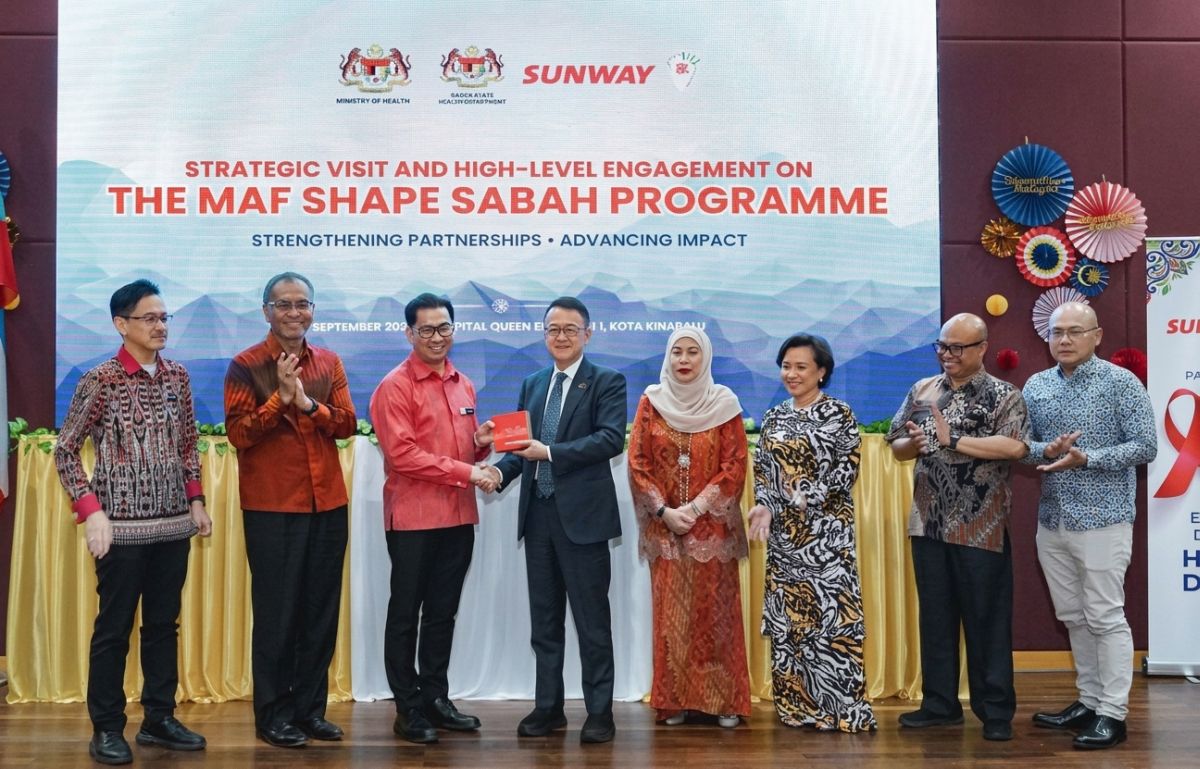
KOTA KINABALU, Sept 8 — As Malaysia works to sustain equitable health care access amid rising demand and increasing fiscal pressures, Health Minister Dzulkefly Ahmad and Sunway Group founder and chairman Jeffrey Cheah have highlighted a partnership model that is helping vulnerable communities stay connected to essential health care services.
During a visit to the Malaysian AIDS Foundation’s (MAF) Sabah Health Access Programme (SHAPE) at Queen Elizabeth Hospital 1, Kota Kinabalu, the two underscored how government, business, and civil society can work together to overcome barriers that prevent patients from accessing treatment, under the Public-Private-Community Partnership (PPCP).
The need is particularly evident in Sabah, where distance, poverty, and transportation costs can make accessing health care difficult even when treatment itself is available.
The challenge is illustrated by the experience of Misrin from Kota Belud. For every hospital appointment, Misrin travels approximately 230 kilometres door-to-door to Queen Elizabeth Hospital 1 for HIV treatment and follow-up care.
As someone who relies on irregular daily-wage income, the cost of transportation can be a significant barrier to staying on treatment. SHAPE was established to help patients like Misrin overcome precisely these barriers.
Founded by MAF in 2018 and supported through Sunway Group’s HOPE BORNEO Grant, the programme provides travel and transportation assistance to help people living with HIV attend hospital appointments and remain on treatment.
Since its inception, SHAPE has supported more than 2,500 beneficiaries across Sabah, and it has successfully put the PPCP model into action.
The Ministry of Health (MOH) provides clinical care, Sunway contributes corporate resources and funding, while MAF works directly with communities to address the socioeconomic barriers that can prevent patients from benefiting fully from available health care services.
MAF chairperson Prof Dr Adeeba Kamarulzaman said health care access extends beyond the availability of doctors, medicines and treatment.
“Health care does not begin and end at the hospital door. If a patient cannot afford the journey to treatment, the health care system has not fully reached them,” she said.
“As health care demands continue to grow, partnerships that bring together government, business, and communities can help close critical gaps and ensure health care investments reach those who need them most.”
Sunway’s support for SHAPE has also extended to Sarawak, where the programme has been strengthened by a RM2.25 million contribution from the Sarawak state government, making it the first state government in Malaysia to participate directly in a public-private-community partnership for AIDS-related services.
The impact is particularly significant in HIV care, where continuity of treatment is essential. People living with HIV who remain on effective antiretroviral treatment can achieve and maintain an undetectable viral load, enabling them to live healthy and productive lives.
Individuals with an undetectable viral load do not sexually transmit HIV, a principle known as Undetectable = Untransmittable (U=U).
By helping vulnerable patients remain connected to treatment, SHAPE contributes to Malaysia’s efforts to sustain HIV treatment outcomes, reduce HIV transmission and achieve the goals of the Ministry of Health’s National Strategic Plan to end AIDS by 2030.
As health care systems face growing demand and resource pressures, the experiences of Sabah and Sarawak point to a practical model for preserving equitable access by addressing barriers that health care services alone cannot solve.
“We should see SHAPE not simply as an HIV programme, but as a partnership model,” said Prof Dr Adeeba.
“The real question is whether this approach can be replicated wherever poverty, geography, transport costs or other socioeconomic barriers prevent people from accessing health care.
“The experience of Sabah and Sarawak suggests that it can. It shows how the government can remain firmly at the centre of health care delivery while businesses and communities help strengthen the system around it.”


