

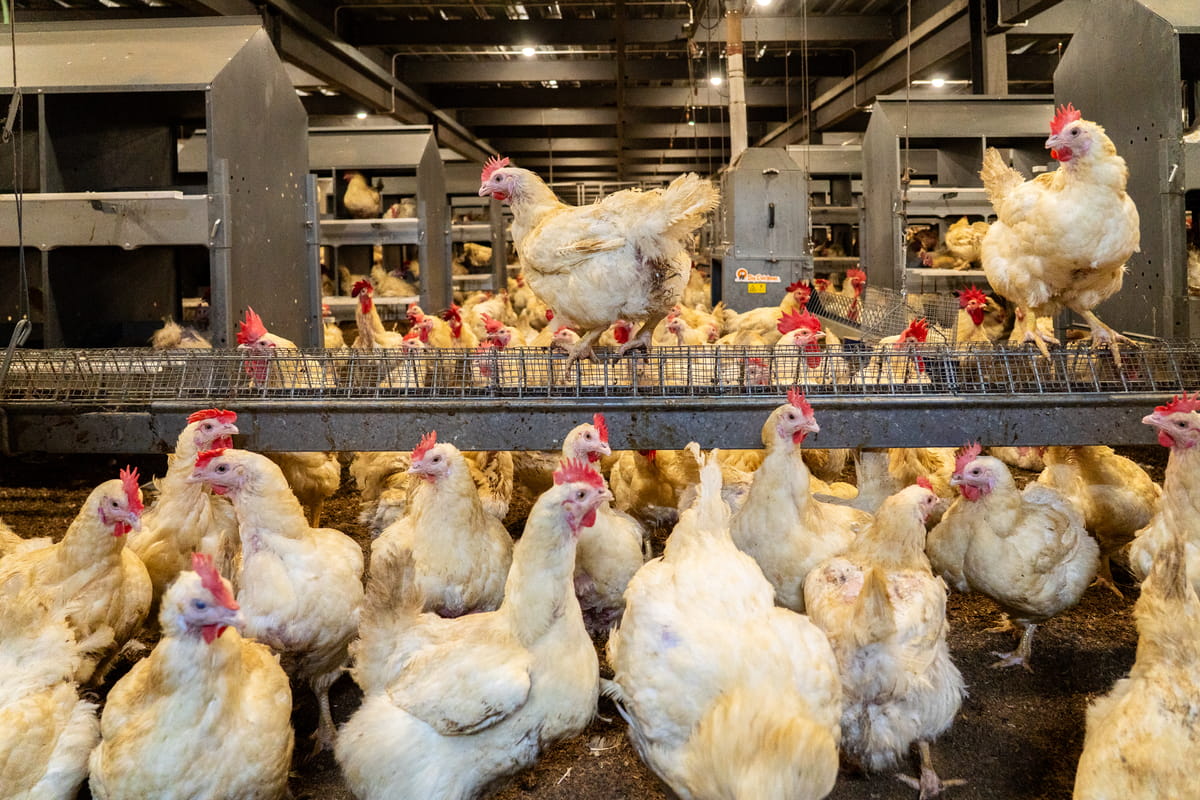
PUTRAJAYA, August 5 — Nearly three decades after Malaysia began promoting closed-house poultry farming to improve biosecurity, only about 8 per cent of Malaysia’s poultry houses have fully adopted the system.
Dr Zul Edham Wagiman, deputy director (non-ruminant section) of the Department of Veterinary Services’ (DVS) livestock industry development division, said efforts to persuade poultry farmers to move away from conventional open-house systems have changed from encouragement to necessity.
“I remember when I first graduated in 1998, I worked in the poultry industry for three years. We have been going around convincing farmers to convert from the traditional house to a closed-house system 28 years ago,” Dr Zul Edham said during his presentation at the Global Animal Production and Veterinary Industry Summit (Gavis) 2026 here on July 21.
“And fast forward after 28 years, we are still on the same page, trying to convince them to convert to a closed house first. But today the tone and urgency is different. It is no longer optional for us to convert to a closed house system. It has become a mandate.”
Malaysia does not have a nationwide legal requirement for poultry farms to adopt closed-house systems, although the federal government has encouraged the transition through tax incentives and biosecurity measures. Perak is currently the only state with a legislated enforcement timeline.
According to DVS estimates, Malaysia has about 16,316 poultry houses, but only 8 per cent of 1,579 poultry houses operate as fully closed-house facilities. “So this is a very, very weak or low number as compared to what we attempted to do,” Dr Zul Edham said.
Dr Zul Edham said the biggest hurdle was the gap between increasingly stringent regulatory expectations and what many poultry farmers, particularly small and medium-sized operators, could realistically afford.
“There is a big gap between the regulatory needs and the operational reality. We want the industry to evolve, especially in today’s challenging governance framework,” he said. “But the hard truth is that a massive chunk of our industry players, particularly small and medium-sized industries, don’t have the capacity and ability to do so.”
Industry figures illustrate the scale of the investment required. SLH director Terry Tan Chee Hee, whose company is expanding its closed-house operations in Penang, told CodeBlue in June that building a new poultry farm now costs more than RM10 million, up from RM5 million to RM8 million before the Covid-19 pandemic.
Tan, who is also an adviser to the Federation of Livestock Farmers’ Associations of Malaysia (FLFAM), said smaller farmers were likely to face greater challenges because they had limited financial reserves to absorb rising costs.
Dr Zul Edham said the poultry industry was also facing mounting pressure from urban expansion, environmental regulations and competing land use.
“The population is exploding, the demand for housing and public infrastructure is running on steroids. This rapid expansion has caused a direct collision between industry growth and environmental protection.”
Dr Zul Edham said many poultry farmers simply could not afford to convert conventional poultry houses into enclosed, climate-controlled facilities. “The conundrum, the core issue, they simply cannot afford it. At least not immediately and perhaps without any forms of assistance,” he said.
He proposed gradual upgrades, soft-loan facilities, stronger farmer cooperatives, and fairer contract farming arrangements to help producers modernise instead of delaying the transition again.
Perak Faces First Major Test

The industry’s progress will soon be tested in Perak, where full enforcement of the state’s closed-house policy is scheduled to begin on January 1, 2027.
“All eyes are now on the state of Perak because the state government has set a deadline until the end of this year for all poultry farmers to transition to a closed-house system, with full enforcement to begin on January 1, 2027,” Dr Zul Edham said.
According to DVS data, more than half of Perak’s poultry houses have already adopted closed-house systems. However, 165 poultry houses, or 42.7 per cent, still operate under open-house systems, while another 15 use mixed systems.
“With time running short, we have only about five months to the deadline. We are not sure whether it is feasible or not, but we are hoping that the industry players can think of something come the deadline,” Dr Zul Edham said.
When asked whether farms had already shut down because they were unable to comply with the policy, he said none had ceased operations solely because they failed to convert to closed-house systems.
“To the best of my knowledge there are no houses being shut down for not being able to convert into closed houses,” Dr Zul Edham said. He said farms that had closed generally did so because of poor management or public complaints.
Biosecurity As National Defence
Dr Zul Edham said the push for closed-house farming reflects a broader shift in how Malaysia should approach biosecurity.
“Traditionally we view biosecurity as a safety net, something we only think about when things go wrong. We must embrace biosecurity as a critical national defence infrastructure,” he said.
“This means designing a resilient protein supply chain that remains viable and fully productive and ready for trade even when the pathogens are circulating around.”
Dr Zul Edham said modernisation should focus on protecting and upgrading existing agricultural zones instead of relocating farms.
“Modernisation is not about starting over from scratch. It is about drawing hard lines around our current setups, locking them down against outside encroachment and upgrading them into biosecure enclaves,” he said.
Dr Zul Edham said DVS is reviewing regulations and preparing policy proposals, while the Ministry of Agriculture and Food Security is drafting the National Food Security Act to strengthen Malaysia’s long-term food security against global supply shocks.


