

PUTRAJAYA, June 5 — Poultry Salmonella control must keep pace with emerging multi-drug resistant serovars, experts said, as repeated detection of such strains in animals, meat, processing plants, or markets may signal wider food safety gaps.
Universiti Putra Malaysia (UPM) senior lecturer Dr Nur Indah Ahmad said repeated detection of less commonly prioritised Salmonella serovars, such as Brancaster, should not be treated as incidental without closer investigation.
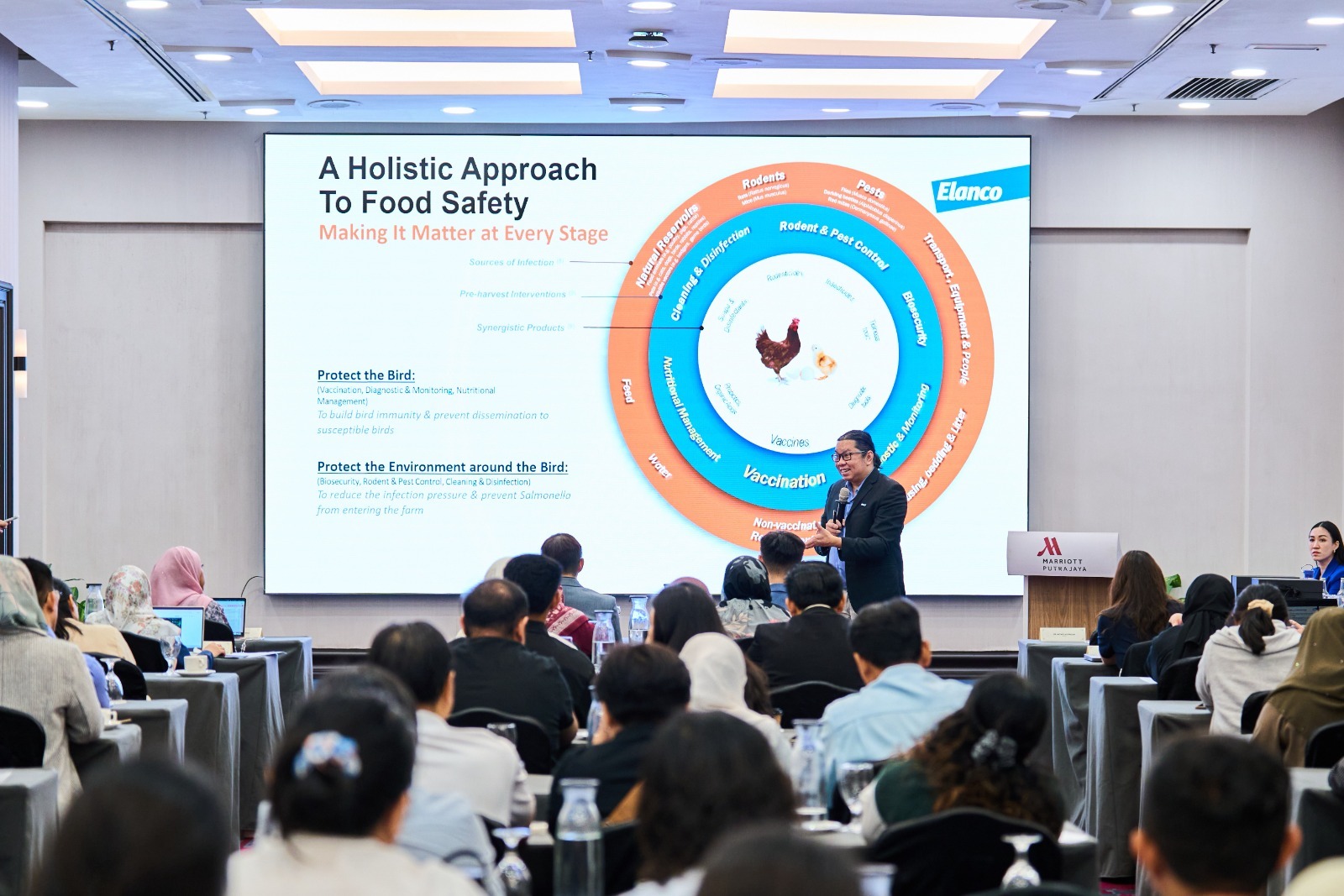
“If it keeps popping up in samples from animals, meat in the market, or processing plants, it might be indicative of something,” Dr Nur Indah told the Elanco Food Safety Symposium 2026 on May 20.
Salmonella is a group of bacteria that can cause foodborne illness in humans and disease in animals. Serovars, or serotypes, are variants within the Salmonella family.
Some, such as Salmonella Enteritidis and Salmonella Typhimurium, are major foodborne serovars that can infect humans through contaminated food, including poultry meat and eggs, typically causing diarrhoea, fever, stomach cramps, nausea, or vomiting.
Others, such as Salmonella Gallinarum and Salmonella Pullorum, are more adapted to poultry and can cause serious disease, mortality, reduced egg production, and farm losses.
In Malaysia, Salmonella has been detected in poultry and chicken meat in multiple studies, with commonly reported foodborne serovars including S. Enteritidis and S. Typhimurium.
A 2025 veterinary study on animal-based food products reported S. Enteritidis as the most common serotype in poultry meat, followed by S. Typhimurium, while a separate Department of Veterinary Services (DVS) study in central Peninsular Malaysia found that chicken meat accounted for nearly half of Salmonella isolates in animal food products.
The findings suggest that Malaysia’s poultry-related Salmonella risk is not confined to a single strain. While better-known serovars remain important because of their food safety relevance, experts said emerging serovars may also require attention if they are repeatedly detected or found to carry traits linked to human disease or antimicrobial resistance (AMR).
Dr Nur Indah said repeated detection could justify a revised surveillance focus and specific budget allocation for targeted testing, investigation, and control measures.
The senior veterinarian said findings from farms, meat, processing plants, and markets should also be compared with public health data to determine whether the same serovars are appearing in human infections.
“That is why the importance as well to see whether, from the public health side, is it happening? Is it also something of their concern?” Dr Nur Indah said.
The presence of an emerging Salmonella serovar in poultry does not automatically mean it is causing human disease. But if the same serovar is also found in human patients, it may suggest a possible food safety or zoonotic link that warrants closer investigation.
Dr Nur Indah cited Salmonella Brancaster as one emerging concern, saying the serovar carried virulence factors, or disease-causing traits, as well as resistance genes linked to multiple antimicrobial classes.
“Brancaster is one of the strains that we are quite worried about because not only does it have virulence factors, meaning that it can potentially cause severe infections in humans, but it also has the ability to be resistant to at least five different types of antimicrobial drugs,” she said.
Malaysian researchers have previously studied Salmonella Brancaster isolates from chickens, including their virulence gene profiles and antimicrobial susceptibility, indicating local scientific interest in the serovar’s potential public health relevance.
Still, Dr Nur Indah cautioned that carrying resistance genes does not necessarily mean those genes are active in every isolate.
“The word ‘potential’ is there because most of the isolates carry the DNA for it; they have the resistance genes. But whether those genes are expressed or not is still a developing area,” she said.
In simpler terms, a bacterium may carry the genetic code for resistance, but further testing is needed to determine whether that resistance affects treatment.
Salmonella Risks Vary By Country
Elanco Malaysia Sdn Bhd technical lead for poultry vaccines Asia Pacific Dr Nicholas Phuah said the poultry industry should be cautious if emerging serovars continued to appear over time, noting that Salmonella threats vary by country.
“As an industry, we probably want to be careful because if it keeps popping up over the years, it’s something that we want to keep an eye on,” said Dr Phuah, a trained veterinarian.
He said the next major Salmonella challenge was difficult to predict because dominant serovars differ across regions. He cited Salmonella Infantis as a concern in the United Kingdom and Salmonella Minnesota in Brazil.
“If you ask what the next major Salmonella challenge is, it’s impossible to answer because there are 3,700 different strains,” Dr Phuah said.
“At least half can infect warm-blooded animals. That’s why we always recommend a holistic approach. You cannot just target one serovar,” Dr Phuah said.
AMR occurs when bacteria and other microbes no longer respond to medicines that were previously effective. In food-producing animals, resistant bacteria can emerge through repeated or inappropriate antimicrobial use and may spread through animals, food, people, and the environment.
Resistant E. Coli Shows Wider AMR Pressure
Dr Nur Indah said the concern was not limited to Salmonella.
ESBL-producing E. coli detected in poultry was also “quite worrying”, she said, referring to E. coli bacteria that can produce enzymes that break down certain important antibiotics. ESBL is short for extended-spectrum beta-lactamase.
E. coli commonly lives in the gut of humans and animals, but resistant strains can signal wider antimicrobial pressure in a farm or environment. “Even one is actually worrying because it’s another level of resistance profile,” Dr Nur Indah said.
Dr Nur Indah said resistance was also commonly seen against fluoroquinolones, a class of antibiotics used in both human and veterinary medicine. In poultry, this included resistance to marbofloxacin and enrofloxacin, which are used to treat bacterial infections in animals.
“If you test against marbofloxacin, or even enrofloxacin, it’s quite common to see red,” Dr Nur Indah said, referring to colour-coded antimicrobial susceptibility results showing resistance.
She said similar resistance patterns had also been observed in cats and dogs, suggesting that the problem was not confined to poultry or chicken meat.
“This is just from poultry, from chicken meat. We’re also seeing it in cats and dogs. So it’s everywhere, not just in poultry products or animals,” Dr Nur Indah said.
Asked whether Malaysia had local data showing resistance percentages for commonly used antimicrobials in poultry-associated Salmonella, Dr Nur Indah said the DVS had conducted One Health integrated AMR surveillance involving E. coli and Salmonella isolates across humans, animals, and environmental water samples.
She said the first phase of the work had been completed, with the next stage looking into resistance mechanisms, including carbapenem resistance. Carbapenems are a powerful class of antibiotics often reserved for serious infections.
However, it was unclear whether the first phase report had been published or made publicly available. She said research studies could provide some data but national-level surveillance would offer a more systematic picture of resistance patterns.
Salmonella Control Must Start Early
Dr Phuah said Salmonella control was difficult because chickens that become colonised, meaning the bacteria have settled in their gut, may carry the bacteria for life, even if they do not shed it continuously.
“Once they colonise the intestines, they are there for life,” Dr Phuah said. “Whether they shed depends on a few factors. Stress is probably one, but throughout their lives, they are transient shedders, meaning they shed Salmonella from time to time.”
Colonisation means the bacteria have established themselves in the bird’s gut. Shedding refers to bacteria being released, usually through faeces, which can contaminate the farm environment or food chain.
Dr Phuah said reducing stress, improving housing and ventilation, and maintaining gut health could reduce shedding, but would not remove the risk entirely.
“If you reduce stress, yes, that will probably help reduce shedding,” he said. “But it depends on the bird’s general health, housing parameters, and ventilation – keeping the bird as comfortable as possible and the intestine as healthy as possible. That reduces the risk, but it’s still a risk.”
Dr Phuah said farms should investigate the full production chain when Salmonella is detected, instead of automatically blaming hatcheries or breeders.
“If your chicks arrive at the farm negative, and they still test negative in the first couple of weeks, but you detect Salmonella in the fifth or seventh week, that is not from the hatchery. It’s from your environment,” Dr Phuah said.
“But if, let’s say within the first seven days, you do get an increase in Salmonella, then it is possibly from the hatchery.”
Even then, he said, farms should examine both hatchery and farm conditions. “If you get Salmonella early, you have to look at your farm as well as the hatchery.”
Antibiotics Aren’t A Long-Term Fix
Experts also cautioned that antibiotics were not a sustainable long-term solution for Salmonella control.
Dr Nur Indah said antibiotics were generally not used to treat Salmonella in humans unless clinically indicated, as inappropriate use could drive resistance.
“Most of the time in humans, antibiotics are not indicated for Salmonella,” she said. “Using antibiotics to flush Salmonella from the system can trigger the bacteria to develop resistance.”
She said repeated antimicrobial use could also remove normal gut flora, or beneficial bacteria in the intestine that help prevent harmful bacteria from taking hold.
“Antibiotics can remove the good bacteria, and the normal flora basically acts as a barrier that prevents Salmonella from penetrating. So it could potentially happen,” Dr Nur Indah said.
Dr Phuah said antibiotic treatment for Salmonella in poultry was most likely to work only when birds were very young and the bacteria remained in the intestines.
“We actually use antibiotics for Salmonella only when the birds are really young,” he said. “When the birds are still being colonised, and Salmonella is still in the intestines, that’s when antibiotics will actually work.”
He said antibiotics may no longer be effective once certain Salmonella strains enter the system or become intracellular, meaning they can survive inside the body’s cells.
“When certain Salmonella goes into the system, because some of these Salmonella are intracellular, antibiotics don’t work,” Dr Phuah said. “So Salmonella control has to be very early. You shouldn’t continuously use antibiotics to control it.”
Dr Phuah said antibiotic use in previous decades may have suppressed visible bacterial disease in poultry, but tighter controls on antibiotic use had since revealed underlying disease burdens in some countries.
“The use of antibiotics during the 80s and 90s unfortunately made a lot of diseases invisible,” he said.
Dr Phuah added that several Southeast Asian countries saw a drop in Salmonella Gallinarum and Salmonella Pullorum cases in the 1980s and 1990s, but cases later increased after antibiotic use was tightened through measures such as feed antibiotic bans and prescription requirements.
“What we are seeing now is an increase in cases,” Dr Phuah said. “The thing is, we have fewer bullets because resistance has unfortunately built up. There has not been any new molecule for the animal industry for a long time, so we have to be very careful.”
Dr Nur Indah said responsible antimicrobial use was necessary to preserve antibiotics for when they were truly needed.
She said One Health, which recognises the links between human, animal, and environmental health, must also be translated into daily farm practice through staff training, biosecurity, and antimicrobial stewardship.
“Whatever you’re doing at the farm is not just for the sake of doing your work, but it’s also going to impact the health of people outside – your consumers, your customers – and also the environment,” she said. “Advocacy is a huge part of the One Health movement.”


