

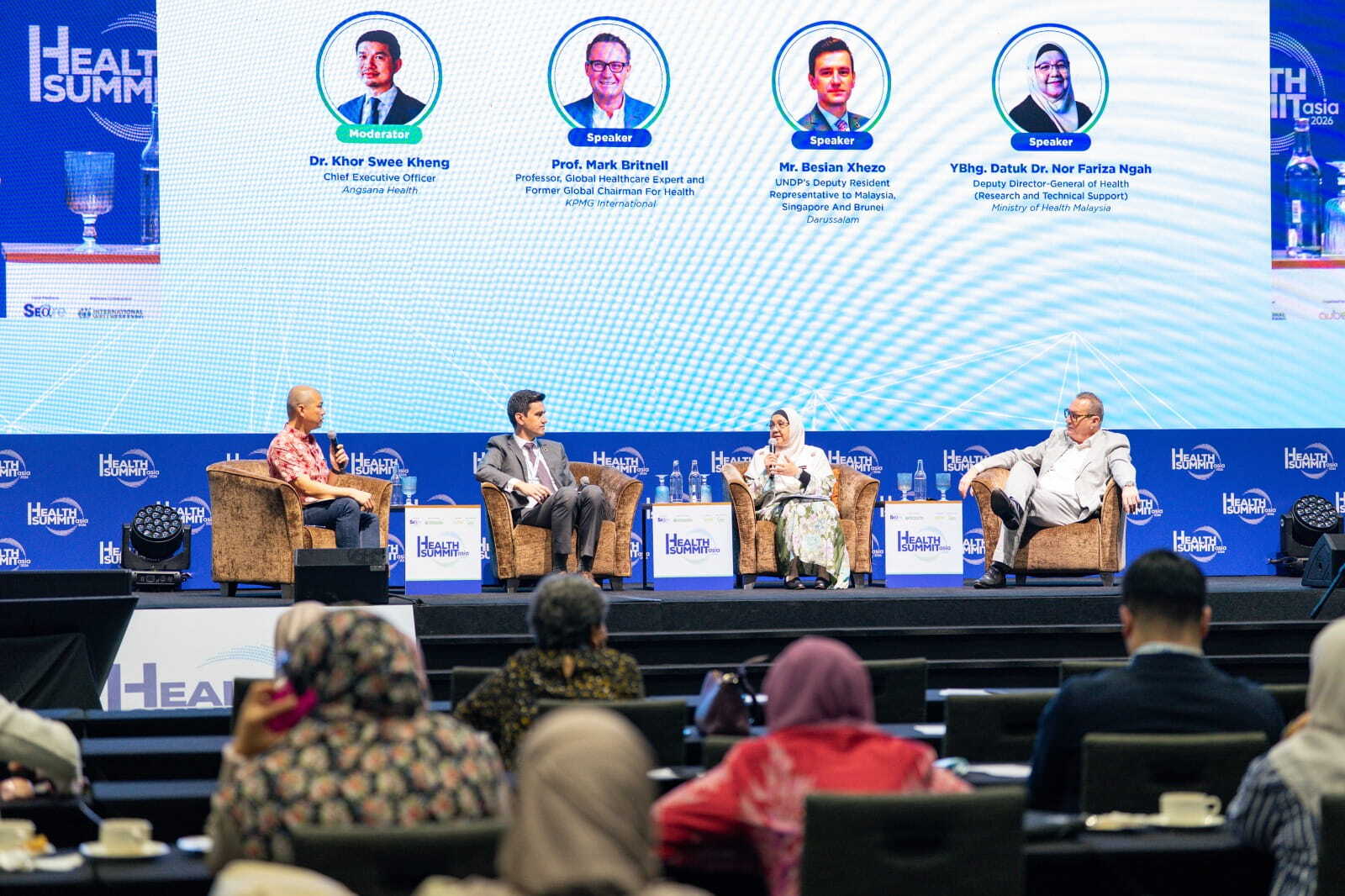
KUALA LUMPUR, June 16 — Malaysia should expand micro-credentialing and decentralised training programmes to build its health workforce faster and improve access to care in underserved areas, said a Ministry of Health (MOH) official.
Deputy director-general of health (research and technical support) Dr Nor Fariza Ngah said conventional training pathways for doctors and nurses take years to produce qualified personnel, creating challenges in meeting immediate workforce needs.
“So these are my personal ideas. What we need to do is to have a decentralised [system] and train non-physicians to do the job,” Dr Nor Fariza said at the Health Summit Asia 2026 conference here last May 21.
“Because let’s say we are talking about increasing productivity, as you’ve mentioned, to get one physician it takes about five years in Malaysia, another five years to become a specialist so 10 years altogether. For the nurses, three years or up to four years. So it takes time.”
Dr Nor Fariza suggested short training programmes for selected health care tasks as an interim measure to address workforce shortages, while larger numbers of doctors and nurses are being trained.
“What we need to do to fill in the gap, while we train more doctors and nurses, is by having a short course so that they can do things in remote areas and do teleconsultation at the same time,” she said.
“Of course, we are not talking about substandard care. We must make sure the training is there, the quality is there so that whether they are in a remote area or in an urban area, they are still getting the best treatment.”
Dr Nor Fariza, who is a senior consultant ophthalmologist, pointed to ophthalmology services as an example, where optometrists, who are not medical doctors, are being trained to take on expanded clinical roles.
“So, for example, what we are doing for our ophthalmology is to train our optometrists to become clinical optometrists so that they can do our primary eye care. They can give specialist care in remote areas.
“If anything, they can refer to us either through phone conversation or they can refer the patient (to a main MOH hospital). So this is where the patient can get specialist care nearest to their home,” Dr Nor Fariza said.
Her remarks were echoed by Professor Mark Britnell, global health expert and former global chairman for health at KPMG International, who said micro-credentialing could help health systems match skills to specific tasks more efficiently.
Micro-credentialing generally refers to short, targeted training programmes that certify specific competencies, allowing workers to perform defined tasks without completing a full professional qualification.
“For those of you may not be aware of the phrase ‘micro-credentialing’, at the moment, if you think about how professions are trained, if you go up a doctor training scheme or a nurse or a physiotherapist, the patient needs to travel horizontally, not vertically,” Britnell said.
“And essentially, you match skills and tasks to the jobs that are required and then instead of trying to train for three or four years, you micro-credential, people get paid more money and you find that more patients can be seen.”
Britnell said Malaysia’s health care system remains heavily centred on traditional professional hierarchies, which may limit opportunities to redesign care delivery.
“So this is a big issue for you, I think, because you have, understandably so, a very traditional, medically dominated model of care. I know this because of the training schemes we (the UK) gave the world and we’re trying to unlearn these now, respect them, but unlearn them,” he said.
The proposals come amid concerns that Malaysia’s health workforce challenge is not only one of shortages, but also the uneven distribution of personnel across the country.
Dr Nor Fariza cited workforce density disparities, noting that some urban areas have roughly one health worker for every 200 people, compared to one for every 700 people in rural Borneo.
The disparity reflects longstanding geographic and structural challenges in deploying health personnel, contributing to unequal access to care despite relatively better staffing levels in major cities.
In the United Kingdom, the power to prescribe medicines is decentralised to qualified non-medical health care professionals, including nurses, pharmacists, paramedics, and other allied health professionals. These are known as independent prescribers.
Even before UK law was changed to enable highly skilled paramedics to prescribe medicines in 2019, registered paramedics could already supply and administer a range of medicines for their patients – something which isn’t permitted in Malaysia.
The Malaysian Association of Medical Assistants previously called for minimum qualifications for registered PPPs to be upgraded to a Bachelor’s degree from the current diploma requirement in Malaysia.
Despite the deputy DG’s call for expansion of health care tasks to non-doctors, Health director-general Dr Mahathar Abd Wahab maintained last October that pharmacists were not authorised under various Malaysian laws to perform tasks like vaccinations.
Shortages of doctors have forced disruptions of services in at least three public hospitals in recent weeks, such as Raja Permaisuri Bainun Hospital’s (HRPB) cardiology service, Segamat Hospital‘s obstetrics & gynaecology (O&G) service, and Lahad Datu Hospital’s anaesthesiology service.
State-Based Training May Improve Workforce Retention
Dr Nor Fariza also proposed decentralising health professional education to encourage graduates to remain in their home states after completing their studies.
“Our problem now that we have in Malaysia is that for nursing, the people need to come to the centre. So this is where they are reluctant to come because they know that they might not be able to go back to their state once they finish,” she said.
“Why don’t we maybe reduce the entry qualification a little bit and have multiple states to do the training so that once they graduate, they stay in the state. So the interest is more there.”
She cited Sarawak’s medical education initiatives as an example of how local training and service bonds could help retain health professionals.
“I think for doctors now, what Sarawak is doing is that they are giving free for all the medical students that study in Sarawak, but they have a bond so that they don’t leave Sarawak once they graduate. So they will be serving Sarawak for at least seven years,” Dr Nor Fariza said.
Britnell said workforce development should also extend beyond doctors and nurses to include community workers and citizens, creating clearer pathways for people to enter and advance within the health sector.
“I would have a very strong training scheme that links community workers as well, these could be patients or citizens, all the way through to the highest professor,” he said.
“And I think that is a way in which you get movements of people to think about health care as being a community asset.”


