

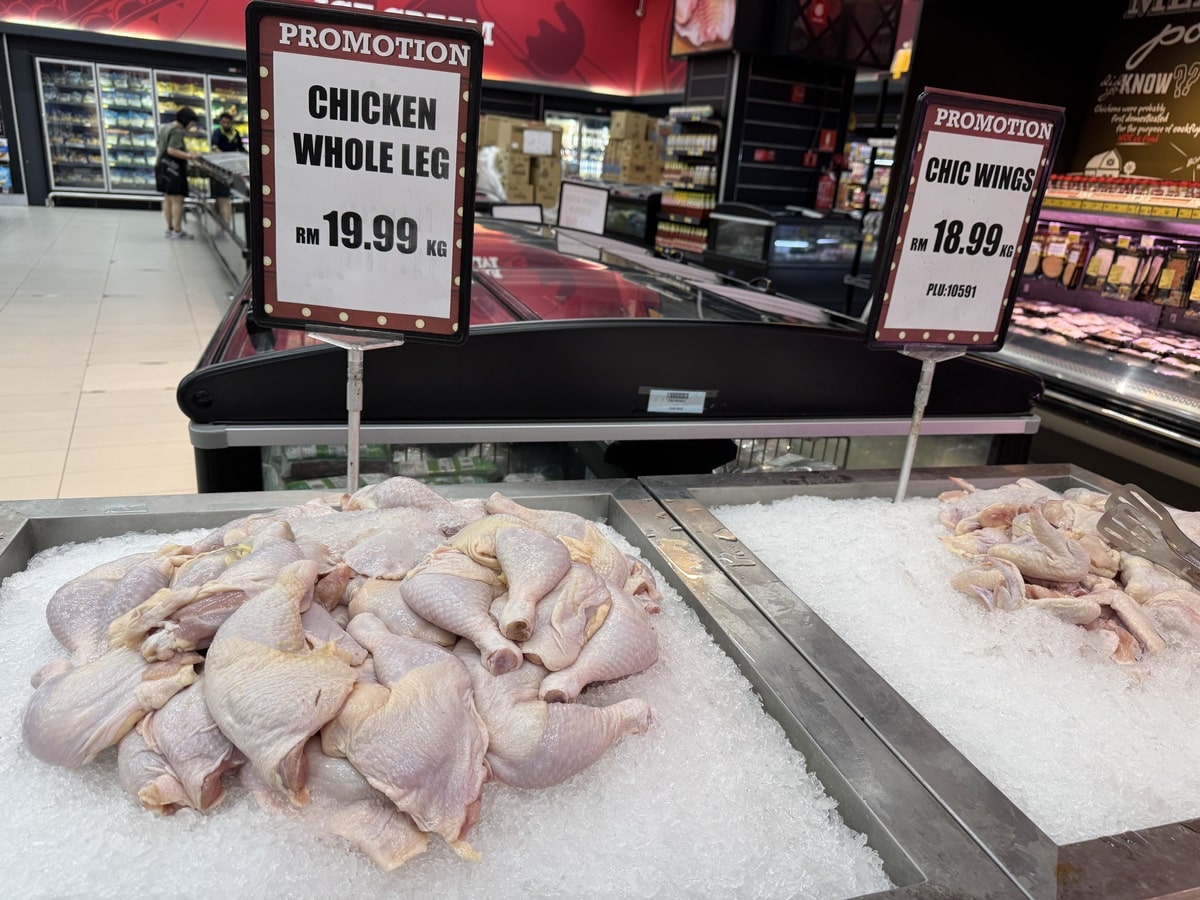
KUALA LUMPUR, April 16 — Malaysia’s poultry industry is being squeezed by what producers describe as a “perfect storm” of rising costs, forcing some farmers to cut production and delay chick placements, the Malaysian Poultry Association (MPA) said.
Feed prices have climbed sharply in recent weeks, the group said, alongside simultaneous increases in electricity, water and fuel costs that have pushed farm overheads higher than expected.
“Feed costs have surged significantly. In Peninsular Malaysia, prices are around RM160 to RM170 per bag, while in Sabah and Sarawak, they have reached about RM185 per 50kg,” MPA told CodeBlue in a statement on Monday.
Animal feed reportedly used to cost RM125 to RM135 per 50kg sack in the peninsula, and RM140 to RM160 in East Malaysia, before the West Asia conflict.
“The increase is broad-based. In addition to feed, electricity tariffs, water tariffs and fuel prices have all risen at the same time, causing farm overhead costs to spike beyond expectations.”
The pressures are being amplified by Malaysia’s heavy reliance on imported feed inputs, particularly corn and soybean meal, leaving farmers exposed to global price swings and supply disruptions.
“Malaysia’s main issue is its almost 100 per cent dependence on imports for grain corn and soybeans,” the association said. “Unlike neighbouring countries such as Indonesia, which have extensive domestic corn cultivation, Malaysian farmers are highly exposed to global commodity price uncertainty and supply chain disruptions.”
Farmers are already feeling the strain. Members have reported delays in feed supply that are disrupting production cycles, while rising costs have forced many to scale back operations or postpone the placement of day-old chicks.
“Some members have had to use profits from other agricultural activities, such as palm oil, to cover losses in poultry operations,” MPA said, describing the industry as being in a “survival phase”.
The burden has fallen most heavily on small and independent farmers, particularly in rural areas such as Ranau, Kudat and Kota Marudu in Sabah, where higher logistics costs further inflate feed prices. Some have begun to temporarily halt operations as margins turn negative.
“Some small farmers are taking a ‘rest’ as they can no longer sustain the high input costs,” the association said.
Despite the surge in costs, farmers have so far held back from raising farmgate prices for chicken and eggs in an effort to protect consumers.
“Farmers are still trying to contain selling prices at the farm level for the welfare of consumers, even though input costs have risen sharply,” MPA said.
But the current situation – where, as the group put it, “all costs are rising except the price of chicken” – is unsustainable.
“Without strategic intervention to address input and utility costs, the stability of the country’s protein supply could face significant challenges in the near term,” it said.
MPA is calling for targeted support measures, including special rebates on electricity and water tariffs for livestock farms to ease daily operating costs, as well as revolving funds or accessible credit schemes to help small farmers manage cash flow and avoid exiting the industry.
The association said such measures are critical to sustaining smaller and independent producers, who play a key role in local food production and community-level food security.
MPA represents a broad cross-section of the poultry industry, including breeders, small and medium-scale producers, and backyard farmers, and serves as a collective voice for independent farmers who are often overlooked in the wider supply chain.
While the government has recently rolled out measures to cushion the impact of rising fuel costs – including expanding biodiesel use and increasing incentives for paddy farmers – similar targeted support for livestock producers facing higher feed and operating costs has yet to be introduced.
Agriculture and Food Security Minister Mohamad Sabu previously urged Malaysians, particularly those in landed homes, to grow their own vegetables as a buffer against global supply shocks.
FLFAM: Current Shock ‘Nothing’ Compared To Covid, Ukraine War
The Federation of Livestock Farmers Associations of Malaysia (FLFAM), which represents poultry and pig farmers, struck a more measured tone, saying the current impact of the Gulf crisis remains manageable compared to previous global shocks.
FLFAM advisor Jeffrey Ng Choon Ngee said the industry had faced far more severe disruptions during the Covid-19 pandemic and the Russia-Ukraine war, when feed costs surged sharply and production costs doubled.
“If you compare the current scenario versus the previous two events, it’s nothing,” Ng told CodeBlue when contacted.
During the early phase of the Ukraine war, Ng noted that global corn and soybean meal prices surged by nearly 100 per cent, doubling production costs for poultry farmers. Ukraine was a major corn exporter, accounting for about 15 per cent of global exports before the disruption.
Russia, meanwhile, is a major supplier of fertilisers such as urea, contributing to broader cost pressures across the agricultural supply chain. By contrast, current increases in corn and soybean prices are estimated at about 10 per cent.
“At the moment, we are trying our best to absorb the increase,” Ng said.
He added that chicken and egg supply remains ample, with the market currently in an oversupply situation that has kept prices low, in some cases below production cost.
Malaysia has historically maintained high self-sufficiency in poultry and eggs, with egg self-sufficiency exceeding 100 per cent in recent years, indicating surplus production, while chicken production has hovered around 90 per cent of domestic demand.
Ng said feed supply has not been significantly disrupted, as Malaysia sources corn and soybean from South America via the Atlantic rather than routes affected by tensions in the Gulf.
However, he cautioned that fertiliser-related disruptions could pose a delayed risk to feed costs, as the impact would only be reflected in future planting and harvest cycles.
“What we are seeing is that the acreage of corn planted is becoming higher and soybean slightly lower, but it is still too early to tell,” Ng said.
Recent United States Department of Agriculture (USDA) projections, however, indicate a shift in the opposite direction, with farmers expected to plant less corn and more soybeans, partly due to higher fertiliser costs, as soybeans require less fertiliser than corn.
For now, rising freight costs – up about 10 per cent – remain the main immediate pressure point, Ng said.
Meanwhile, the impact of diesel costs varies across farms, depending on how operations are structured and whether fuel use is subsidised.
While some transport segments are covered under subsidies, others – such as generators, tractors, and certain logistics operations – are not, resulting in uneven cost pressures across farms, Ng said.
This leaves production decisions largely to individual farmers, based on their financial position and outlook, with responses varying across the industry.
“This is a free market…producers will decide based on their own cash flow and view of the future,” Ng said, noting that while some farmers may scale back or reduce output amid losses, others may continue or even expand production depending on their expectations.


