

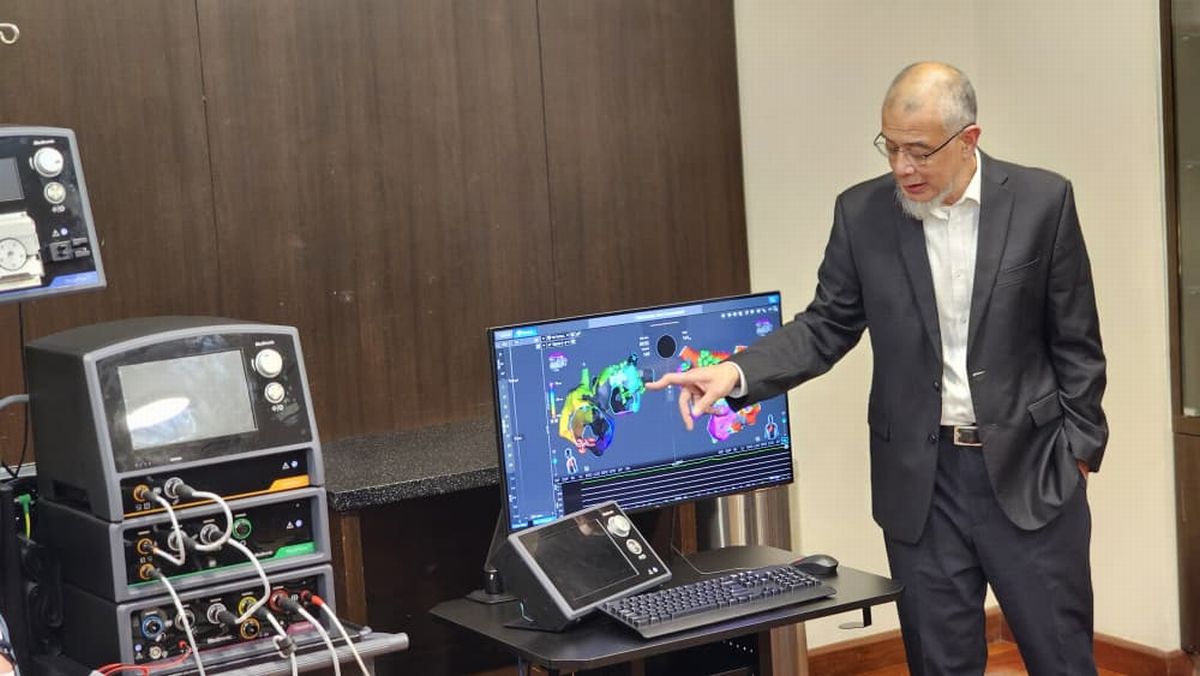
KUALA LUMPUR, March 5 — The National Heart Institute (IJN) has become the first hospital in Asia to use a new system to treat atrial fibrillation (AF), a common heart rhythm disorder that can lead to stroke and heart failure if left untreated.
The Affera Prism-2 system, developed by US-Irish medical device manufacturer Medtronic plc, is used to treat abnormal electrical signals in the heart. It allows doctors to map cardiac electrical activity in detail and then destroy (ablate) the small areas of tissue causing the irregular heartbeat within a single procedure.
“This is considered almost like a totally different way of treating atrial fibrillation compared to the old way, where you need multiple catheters,” said Dr Azlan Hussin, senior consultant cardiologist and clinical director of interventional electrophysiology and implantable devices at IJN, during a media briefing here on February 25.
“In this system, we just use one catheter to complete the procedure.”
The system combines mapping and treatment in one device, allowing doctors to identify abnormal tissue and deliver ablation without switching instruments. This may reduce procedural risks and improve efficiency.
The platform also allows clinicians to switch between two types of energy during the procedure – conventional heat-based radiofrequency and newer pulsed field energy – depending on what is safest and most appropriate for the patient.
“The ability to choose the energy source adds additional safety,” Dr Azlan said.
Atrial fibrillation affects more than 60 million people worldwide and is the most common heart rhythm disorder globally. It occurs when the heart’s upper chambers beat irregularly, reducing the heart’s ability to pump blood effectively. The condition increases the risk of stroke, heart failure, and repeated hospital admissions.
Since February 9, IJN has treated 11 patients with the system, with the youngest aged about 50.
“The procedures were done under general anaesthesia within one to two hours,” Dr Azlan said, noting that conventional procedures can take up to four or five hours.
All patients treated with the new system were discharged the following day without complications, he added.
IJN performs an estimated 400 to 500 atrial fibrillation procedures each year, with cases seen across a wide range of patients, including those with heart failure, post-surgical complications, and other cardiac conditions.
The national heart centre is currently using the system selectively, focusing on patients with more complex or recurrent atrial fibrillation.
“We are fairly choosy. We make sure that the patient requires that system,” Dr Azlan said. “The niche for this system would be the complex cases, such as multifocal or recurrent atrial fibrillation.”
While the technology can be used broadly for atrial fibrillation, certain patients may not be suitable. Dr Azlan said cases involving prior heart valve replacement with metal implants may present technical challenges.
IJN said it does not have a fixed target for the number of patients to be treated with the new system, instead determining its use based on clinical suitability. “We don’t have a target. We have a suitability index. If they are suitable, then we’ll use it,” Dr Azlan said.
The 11 patients treated so far include both government- and privately funded patients. Government patients at IJN receive subsidised care, although the cost of the new system was not disclosed.
It remains unclear how widely the technology will be made available to government-referred patients, who form a large share of IJN’s caseload. Dr Azlan declined to comment on whether the government’s mandate to switch to generics affects the use of the technology, saying the issue relates to pharmacology.
IJN chief clinical officer Dr Shaiful Azmi Yahaya said the adoption of the system marks a step forward in improving treatment outcomes for patients with complex heart rhythm disorders.
The introduction of the technology comes as atrial fibrillation cases continue to rise, driven by ageing populations and increasing cardiovascular risk.
The system is also being developed for use in other parts of the heart, including the ventricles, which may expand its use in more complex cardiac conditions in the future.


