

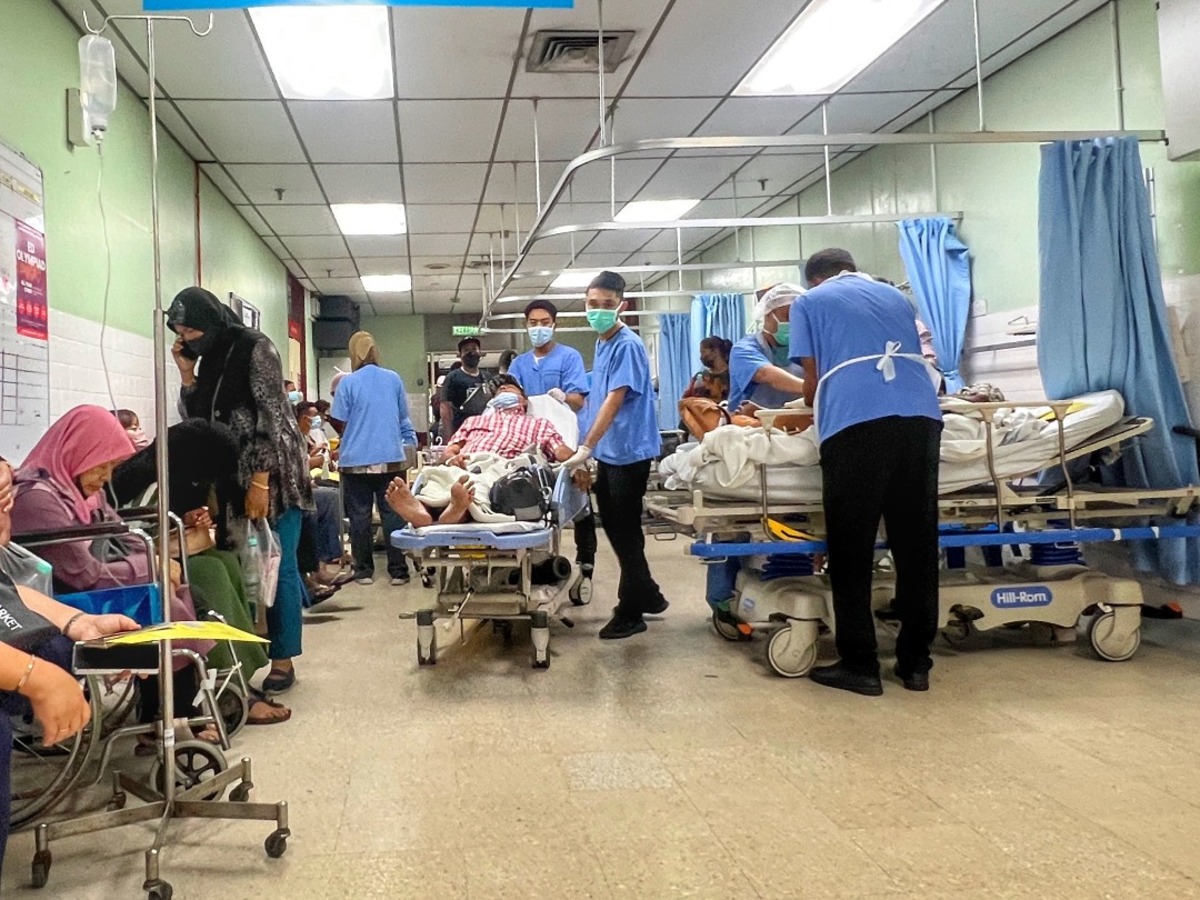
A social media post now circulating widely carries a blunt, angry message: it alleges that 12 government specialist doctors have left public service for a private hospital in Ipoh for salaries of RM70,000, and frames that departure as a betrayal of the poor.
The image is emotionally charged, and the claim should be treated as an allegation unless independently verified. But whether the precise number is right or wrong, the public anger it reflects is real, and it points to a deeper truth Malaysians can already feel in hospitals, clinics, waiting rooms, and emergency departments: our health workforce crisis is no longer a rumour, no longer a seasonal issue, and no longer something that can be managed through short memos and stopgap announcements.
What is most painful is not that Malaysia faces manpower pressures. Every country in the region does.
What is painful is that our neighbours are responding with visible, staged, long-horizon strategies, while Malaysia still appears trapped in a cycle of reactive firefighting, piecemeal management, and policy language that sounds structural but often lands as temporary patchwork.
Singapore, for example, is not pretending this can be solved in one posting cycle. Its leaders are openly framing health manpower as a key national agenda, with a stated need to grow the health care workforce by 20 per cent by 2030 to support expansion and transformation of the system.
Singapore is not just talking about recruitment; it is coupling recruitment with phased manpower planning, “nesting” staff into existing facilities before new hospitals open, role redesign, modular work-study pathways, and broader career development. It is also explicit about remuneration improvements and workplace safety (including zero tolerance for abuse), which are retention policies, not just headline policies.
The same country is also managing supply strategically. Reported data indicate Singapore’s registered doctor pool grew from 11,733 (end of 2014) to 17,582 (end of 2024), a nearly 50 per cent increase, while medical school intake has expanded over the decade, and recognised overseas medical schools were adjusted again to meet demand as the population ages.
In other words, they are actively calibrating both domestic training and external sourcing, rather than pretending one lever will solve everything.
Thailand, too, is confronting a shortage with a staged plan instead of slogans. A recent report describes a three-phase plan (immediate relief, foundation-building, sustainable expansion) after identifying doctor shortages across 36 provinces and 76 community hospitals.
The measures described are not perfect, but they show policy sequencing: benefits and welfare first, then system-building (allocation, budget planning, technology, regulatory alignment), then scaling and contractual benefits.
Thailand is also trying to improve attractiveness to public service through location preference, incentives, study leave, specialist training quotas, welfare and mentorship, and targeted deployment support for high-workload areas.
This is what planning looks like when a ministry accepts that workforce policy is both a numbers problem and a morale problem.
Indonesia, despite enormous geographic complexity, is moving with urgency on the production side and the specialist bottleneck. One reported initiative is a plan for 10 new universities focused on medicine, dentistry, pharmacy, and science/technology to expand long-term workforce supply, with collaboration ambitions and scholarship support.
Another reported initiative is the development of hospital-based specialist training to accelerate specialist production, especially for underserved and remote regions, prioritising doctors from areas without specialists and reducing tuition burdens.
Whether every target is achieved on schedule is secondary to the central point: Indonesia is treating medical workforce shortages as a national capacity-building project, not merely an HR file-management issue.
Meanwhile, Malaysia remains caught in a contradiction. We say we are committed. We issue statements about reform. We acknowledge “perennial” human resource problems.
Yet our own reported figures and public discourse show a system still garbled by unresolved fundamentals. CodeBlue has reported the Ministry of Health’s (MOH) own statement that only 53 per cent of house officer slots were filled nationwide (6,500 out of 12,198), leaving 5,698 vacancies, while MOH simultaneously emphasised that house officers are trainees and not “extra pairs of hands.”
Both things can be true – but a system with that vacancy level is telling you something deeper than a training philosophy issue. It is telling you the pipeline, the pull factors, the placement machinery, and the attractiveness of service are misaligned.
The same report notes the minister acknowledged supply decline and maldistribution, and spoke of transitioning from “stop-gap measures” to structural reforms, including phasing out the contract system and improving welfare.
These are the right words. But right words are not the same as institutional redesign. Malaysia has been hearing versions of this for years. If the machinery remains unchanged, the outcome remains unchanged.
Regarding the contract issue, the contradiction is even sharper. The Malaysian Medical Association (MMA) has publicly called for abolishing the contract system for new doctors, arguing that the original conditions that justified it (a glut of graduates and insufficient permanent posts) have changed, and describing the current arrangement as a burdensome, insecure pathway.
When a profession repeatedly tells the government that job insecurity and career uncertainty are driving attrition, and the policy remains only partially adjusted, it is no surprise that morale collapses and migration rises.
And the specialist crisis cannot be hidden behind general doctor numbers. CodeBlue has reported MOH data estimating a shortage of 10,798 specialist doctors in the public sector in 2025, with only 44 per cent of the required specialist workforce available (based on the cited projections), and shortages across all 25 specialties listed. That is not a staffing inconvenience.
This is a system risk. It affects referral chains, waiting times, emergency backlogs, perioperative capacity, rural service equity, and the credibility of universal access itself.
At the same time, Malaysia is watching neighbouring systems actively recruit our doctors. The Malay Mail has reported a Singapore recruitment drive interviewing Malaysian doctors in Kuala Lumpur, with a reported starting salary of S$110,000 (about RM385,000) a year excluding some benefits.
One may debate the exact impact of a single recruitment event, but no serious policymaker should miss the signal: regional competition for doctors is no longer subtle. It is organised, visible, and financially attractive.
So let us stop moralising the symptom and start fixing the system. If a good doctor leaves government service, the first question should not be “How disloyal.” It should be “What did the system fail to offer?”
Career certainty? Fair pay? Safe hours? Respect? Training progression? Subspecialty access? Family stability? Functional administration? Predictable transfers? Transparent promotions? A workplace where speaking honestly about staffing gaps does not trigger retaliation or witch-hunting against those who “cakap benar”?
Because if doctors who speak up are punished, the system does not become more stable. It becomes more dishonest. And a dishonest workforce governance culture is lethal in health care, where patient safety depends on frontline truth being heard early.
YAB Prime Minister and YB Minister, Malaysia does not need another round of fragmented “initiatives” announced in isolation. We need staged healthcare workforce reform with measurable outcomes – the kind of reform our neighbours are at least attempting in public view.
That means a true national workforce strategy in phases, not a collection of separate crises handled one department at a time.
It should begin with an immediate stabilisation phase, not as a slogan, but as a 6-to-12-month operational programme. This phase must focus on retention, not just intake.
The government should move decisively to end residual uncertainty in the contract pathway for new doctors entering service, standardise and accelerate permanent placement decisions, protect leave and welfare rights consistently, and introduce targeted hardship/retention incentives for high-burden hospitals and under-served regions.
Thailand’s willingness to pair shortage mapping with benefits, welfare, and study opportunities is a useful lesson here: staff do not stay because they are lectured; they stay because the job becomes survivable and dignified.
But stabilisation alone is not reform. Malaysia then needs a system rebuild phase. This is where we confront the engine room: workforce planning, distribution, training capacity, and administrative governance.
The MOH’s own reported acknowledgement of maldistribution and the recurring bottlenecks in placements should push us toward a single integrated manpower command model that links training intake, housemanship slots, medical officer (MO) placements, specialist training positions, and projected service demand at state and facility level.
Thailand’s “building foundations” phase explicitly includes allocation, budget planning, technology, and regulatory alignment; we should stop behaving as if these are optional back-office matters. They are the reform.
This is also where specialist and subspecialty reform must finally be treated as core policy, not an afterthought. If the reported public-sector specialist deficit is near 11,000, Malaysia cannot solve that with generic calls for patriotism.
We need a deliberate expansion of specialist training throughput, protected training posts, consultant teaching time, decentralised training capacity where safe and accredited, and a serious plan for high-need specialties.
Indonesia’s move toward hospital-based specialist training, whatever its implementation challenges, is exactly the kind of structural thinking Malaysia should study seriously: train closer to service need, reduce barriers, prioritise underserved regions, and shorten the lag between workforce planning and patient impact.
After that, Malaysia needs a sustainable expansion phase with long-term supply strategy. Here, Singapore and Indonesia both offer lessons in different forms: Singapore on calibrated intake, role redesign, and flexible training pathways, and Indonesia on expanding training institutions and scholarship-backed talent pipelines.
Malaysia should revisit medical education planning from end to end, including student uptake, training quality, internship transition, specialist pathways, and retention into public service. If fewer students are choosing medicine or fewer graduates are entering/remaining in the system, that is not simply a “youth attitude” issue. It is a market signal about perceived future conditions of work.
And yes, remuneration matters. It is politically tempting to speak only of vocation. But vocation does not pay rent, childcare, transport, exam fees, relocation costs, or the emotional price of repeated uncertainty.
When neighbouring countries offer substantially better packages, Malaysia must decide whether it wants to remain a training ground for export or a health system capable of retaining talent.
We do not need to match every foreign salary ringgit for ringgit. But we do need a compensation and allowance framework that is competitive enough, fair enough, and predictable enough that leaving is not the only rational choice. The public already understands this better than policymakers sometimes admit.
Above all, reform must be measurable. Not “we are committed,” but what outcomes by when?
- How many house officer slots filled, by hospital and state, each quarter?
- How long from graduation eligibility to placement?
- How many MOs converted to permanent service and in what timeframe?
- How many specialists added per specialty per year?
- How many resignations, by grade and geography?
- What is the retention rate after three and five years?
- What is the rural vacancy trend after incentive changes?
- What is the wait time impact in key specialties?
Singapore’s planning language is explicit about phasing and workforce targets. Thailand’s public communication is explicit about phases and red-zone shortages. Indonesia’s messaging is explicit about production gaps and structural training changes.
Malaysia must stop communicating reform as intention and start communicating reform as execution architecture.
This is the heart of the matter: Malaysia does not suffer from a shortage of statements. Malaysia suffers from a shortage of sustained, coherent implementation.
The nation does not need piecemeal management. The nation does not need stopgap measures presented as transformation.
The nation needs a health care workforce compact that remains committed beyond headlines, beyond election cycles, and beyond one minister’s term.
If we fail to act in stages now — visibly, seriously, and honestly — we will continue to lose doctors at both ends: young doctors who no longer see a future, and experienced specialists who no longer see a reason to stay.
And then the price will not be paid in viral Facebook outrage. It will be paid in waiting lists, delayed surgeries, preventable complications, exhausted staff, and public trust that is far harder to rebuild than any hospital building.
To the Prime Minister and Health Minister: please take a page from our neighbours’ playbooks, not to imitate blindly, but to finally govern this crisis as what it is: a national systems emergency requiring staged reform, institutional redesign, and outcomes that can be seen.
Malaysia’s doctors are not asking for miracles. They are asking for a system that is serious.
The author is a faithful government health care worker. CodeBlue is providing the author anonymity because civil servants are prohibited from writing to the press.
- This is the personal opinion of the writer or publication and does not necessarily represent the views of CodeBlue.


