

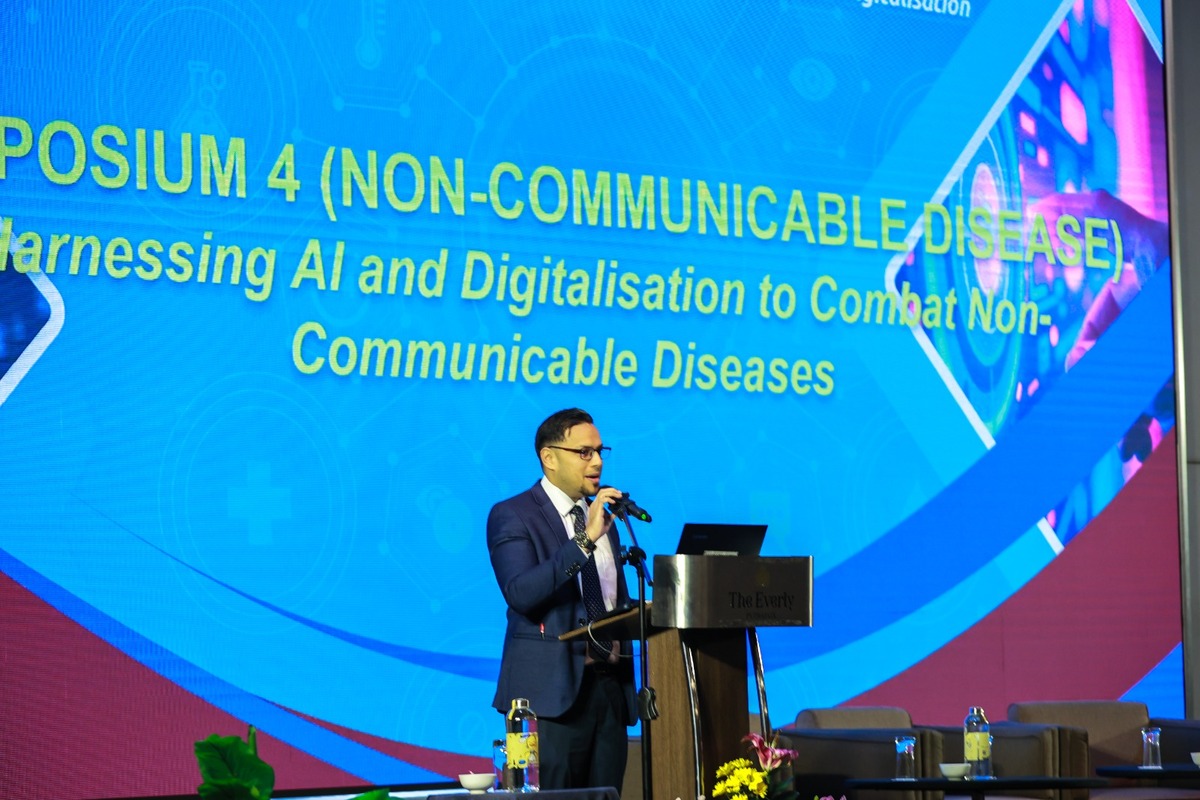
KUALA LUMPUR, Sept 29 — Dr Kishwen Kanna Yoga Ratnam, a public health physician at the Institute for Public Health, Ministry of Health Malaysia, has published the nation’s first peer-reviewed international scientific article to be transparently co-written with artificial intelligence (AI).
The article, published in Digital Health (SAGE Journals, 2025) and titled “Generative Artificial Intelligence in Public Health Research and Scientific Communication: A Narrative Review of Real Applications and Future Directions”, not only reviews the use of generative AI in research, but also embodies it.
Dr Kishwen openly used ChatGPT-4o as a collaborative partner in the writing process. Its contributions, ranging from thematic synthesis to language refinement, were transparently disclosed, ethically managed, and carefully verified.
“This work is both a study and a demonstration,” Dr Kishwen explained. “It shows that when used responsibly, AI can be a true intellectual partner in research, helping us work faster, communicate better, and reach wider audiences.”
What This Means
“The acceptance of this transparent writing style and knowledge synthesis by a reputable journal shows that the human–AI hybrid model is gaining credibility on the global stage. It suggests that such collaboration may soon become the new norm as long as it is declared, ethical, and competently applied.
Dr Kishwen’s review also highlights Malaysia’s forward-looking national agenda on AI. The paper cites the government’s “AI at Work 2.0” initiative, which embeds Google Gemini into civil service workflows while coupling it with structured training.
This strategy is a regional first: by combining access with capacity-building, Malaysia ensures that public servants are not only using AI but using it ethically, productively, and inclusively.
Why This Matters
Malaysia’s scientific community has long sought to balance innovation with ethics. By publishing the first transparently co-written AI-human article in the country’s public health landscape, Dr Kishwen has done more than contribute scholarship, he has set a precedent.
His work demonstrates that AI can be used not just as a subject of study, but as a co-pilot in knowledge creation, provided that human oversight and ethical standards remain uncompromised.
This opens the door for researchers to embrace innovation while also normalising the ethical use of generative AI in scholarly communication.
*To the best of my knowledge, this is the first publicly available peer-reviewed scientific article related to public health communications, that was published in a high index journal and transparently declared the use by a Malaysian public health physician,” said Dr Kishwen.
This article for CodeBlue was provided by Dr Kishwen.


