

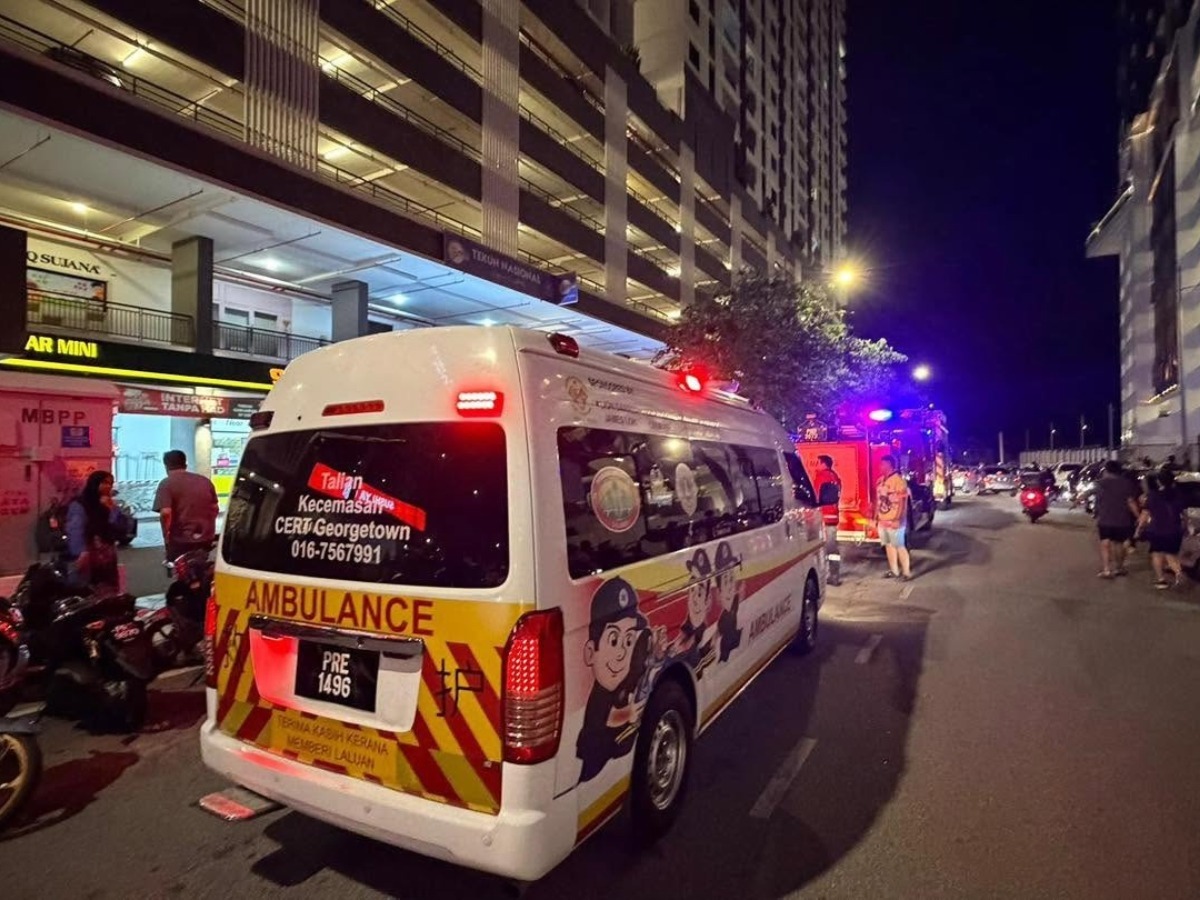
KUALA LUMPUR, Oct 27 — Penang has achieved the national ambulance emergency response target due to the state’s wide network of community responders, said a state executive councillor.
Penang state exco for youth, sports and health Daniel Gooi Zi Sen told CodeBlue that from January to September this year, 57.6 per cent of all Priority 1 emergency calls in the state saw ambulances arriving at the scene within 15 minutes, surpassing the national 50 per cent target. Nationwide, Malaysia reached just 34 per cent last year.
“Penang is the only state that hits the KPI in terms of ambulance arrival,” Gooi said at a Sihat Beyond The Clinic (SBTC) podcast aired last Wednesday.
“Geographically, we’re small, so it’s much easier. But the second part that contributes to us hitting the KPI is support from NGOs (non-governmental organisations),” he added, citing Sungai Ara Community Ambulance, Code Blue Rescue Team, and CERT Georgetown.
“These are community responders that work around the clock.”
When contacted for comment, Gooi told CodeBlue that besides Penang being a small state geographically, community responders are already located within the community, enabling them to respond quickly to emergency calls as opposed to public or private ambulances that depart from their respective hospitals.
He added that Penang’s community responders are trained in basic emergency response and supported by emergency physicians.
Besides ambulances, CERT Georgetown’s first-responders also use motorcycles, called Medic Bikes.
During the SBTC podcast, Gooi called for the enactment of a federal Good Samaritan Act to protect community responders in Penang. Unlike ambulances by private hospitals, community responders aren’t a licensed private health care service under the Private Healthcare Facilities and Services Act 1998 (Act 586).
“It’s to indemnify them. They’re afraid of an outcome they can’t predict when they act as first-responders. That’s a real-life concern coming from community responders,” he explained, adding that the Ministry of Health (MOH) has committed to the state government that the bill is in the pipeline.
Community responders in Penang, according to Gooi, started out during the Covid-19 pandemic. “But we didn’t stop after Covid. These groups kept on being active in our community, addressing distress calls.”
These NGOs raise their own funds to purchase ambulances.

Gooi also boasted about Penang having the highest coverage of automated external defibrillators (AED) devices across all of its five districts.
AEDs are portable, life-saving devices designed to treat people experiencing sudden cardiac arrest. The combination of CPR and early defibrillation is effective in saving lives when used in the first few minutes following a collapse from sudden cardiac arrest.
“Currently, we have 273 Public Access Devices (PAD) across the state. This excludes AEDs installed in private premises as all local councils in Penang have passed planning laws making installation of AED mandatory,” Gooi told CodeBlue.
When asked if Penangites were generally more aware and willing to respond to emergencies, Gooi said several organisations conduct training on basic life support in the state.
The state government collaborates with ZOLL Medical Malaysia on a “Future Heroes” CPR-AED training programme to train school students on CPR and usage of AED devices.
“Community involvement helps in making this achievable.”
Penang’s pre-hospital care and emergency response model mirrors Thailand’s community-based first-responder network.
The Thai Emergency Medical Services (EMS) system organises first-responders as a community-level EMS component, with first-responder training provided to health volunteers, police officers, firefighters, teachers, and community leaders. Collectively, they’re called community emergency volunteers, according to a 2021 study.
A 2012 article published by the Global Road Safety Partnership noted that Thailand had more than 14,000 ambulances, 100 helicopters, 1,000 boats and 120,000 trained personnel who are divided into 11,000 teams which respond to emergency situations throughout the country.
“Bystanders and village communities with minimal training working together with formal medical providers can deliver effective and sustainable pre-hospital care,” wrote the author, Deepa Pasupathy.

