

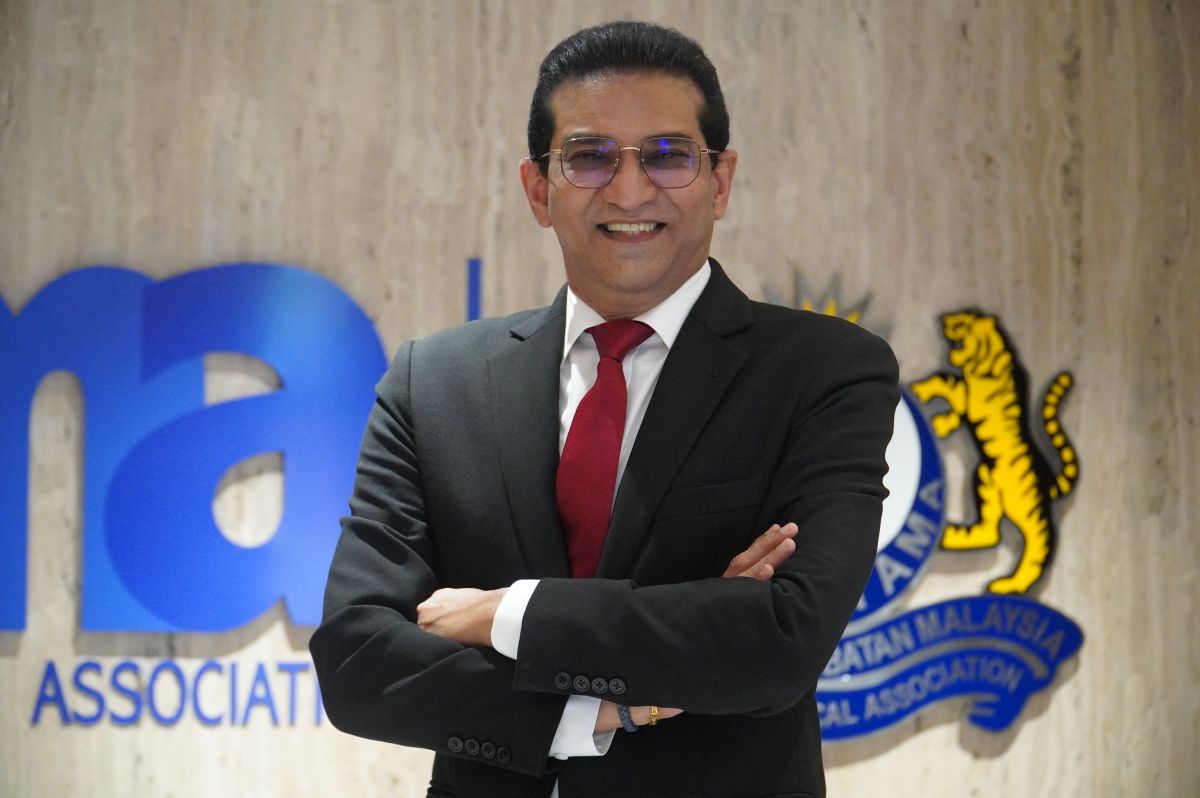
KUALA LUMPUR, Sept 14 — Retaining doctors in Malaysia’s public health care system will be the Malaysian Medical Association’s (MMA) top priority under its new president, Dr Sivanaesan Letchumanan, as the country grapples with growing health care demands and the need to strengthen its workforce.
Dr Sivanaesan takes over from Dr R. Arasu, who has just completed his term as MMA president.
In his inaugural speech at MMA’s Annual Banquet held in Ipoh last Saturday, he said that retaining doctors in the public sector is critical to ensuring continuity and quality of care, particularly as Malaysia faced increasing demands from an ageing population and the rising burden of non-communicable diseases (NCDs).
“The retention of health care workers, especially doctors in our public health care system, has to be one of our most urgent priorities.
“Training a doctor takes many years and requires significant investment. When experienced doctors leave the public system, we do not simply lose a member of the workforce.
“We lose their experience, expertise and the continuity of care they provide to patients,” he said.
Dr Sivanaesan said retaining doctors could not be addressed simply by increasing the number of medical graduates, adding that greater attention must be given to doctors’ career progression, working environments, professional development, and long-term prospects within the public health care system.
“We need to look at why doctors leave and what can be done to make staying in the public health care system a more sustainable and attractive career choice.
“Doctors want to know that there is a future for them within the system — that they can progress in their careers, develop their expertise and have opportunities to specialise and subspecialise,” he said.
He said a stronger focus on retention would also benefit patients, as an experienced and stable workforce was essential for delivering safe and effective health care.
“health care is ultimately about people caring for people. We need to ensure that the doctors and other health care workers who form the backbone of our public health care system are supported, valued and given a clear path to grow professionally.
“Retaining our health care workers must therefore be viewed as an investment in the future of Malaysian health care, rather than simply a human resources issue,” he said.
Remembering Health Care Workers Who Lost Their Lives In Sarawak
Dr Sivanaesan also expressed his deep sadness over the recent helicopter tragedy in Sarawak which claimed the lives of five people, including four health care workers who were on a Flying Doctor Service (FDS) mission to provide health care to communities in remote areas.
The victims were pilot Captain Zainol Afiq Bee Sham, medical officer Dr Ainul Baraah Kamaruddin, medical assistant Alexson Adit Henry, and nurses Debra Moset and Jessie Paya Jok.
The five were on board a helicopter which crashed near the Long Lellang Short Take-off and Landing Airport in Ulu Baram on Sept 8 while operating a Flying Doctor Service mission.
A minute’s silence was observed at the MMA Annual Banquet in memory of all five who lost their lives in the tragedy.
Dr Sivanaesan said the incident was a stark reminder of the risks faced by health care workers who travel to difficult-to-reach areas to ensure that people living in remote communities are not left without access to essential medical care.
“We must always prioritise and ensure the safety of our health care workers, particularly those who put themselves at risk to bring health care to people in areas that are difficult to reach.
“These health care workers are serving some of the communities that need them most. Their safety, welfare and working conditions must never be taken for granted,” he said.
He said the contribution of health care workers serving in remote and challenging environments should be recognised and matched with appropriate safety measures, resources and support.
Clearer Pathway To Specialisation
Dr Sivanaesan said a clearer and more structured pathway for doctors seeking to specialise and subsequently subspecialise would be another key priority during his term.
He said doctors continued to face challenges and uncertainty in navigating their pathway to subspecialisation, and addressing these issues would be important both for career development and workforce planning.
“We need a clearer, more predictable and sustainable pathway for doctors who wish to specialise and subsequently subspecialise.
“Doctors should be able to understand what opportunities are available to them, what the requirements are and how they can progress in their careers. If we can provide that clarity, it will also help us retain talented doctors within the Malaysian health care system,” he said.
Addressing Private Health Care Concerns
Dr Sivanaesan said the MMA would also continue to engage with stakeholders on issues affecting private health care, particularly those involving third-party administrators (TPAs) and insurers.
He said a sustainable private health care sector was important as it complemented the public system and provided patients with additional access to health care services.
Greater Role For Private GPs In NCD Management
Dr Sivanaesan also called on the Ministry of Health (MOH) to fully utilise the country’s private general practitioner (GP) network in the prevention, early detection and long-term management of NCDs such as diabetes, hypertension, and cardiovascular disease.
He said that Malaysia already possessed a significant but under-utilised health care resource in its private GP network.
“There are more than 11,000 private GPs nationwide, and this is a significant health care resource that remains under-utilised in managing NCDs,” he said.
“Private GPs are often located closer to patients’ homes, offering convenience and easier access for regular follow-up.
“For many patients, going to a nearby private GP clinic can be a more practical option than spending hours travelling to and waiting at a public health care facility.
“We should make better use of this existing network and integrate private GPs more effectively into our overall strategy for NCD management,” he said.
Digitalisation Timeline Moving Up
Dr Sivanaesan said the lack of a shared digital medical records system had long been a barrier to closer integration between the public and private health care sectors.
However, he expressed confidence that this could be resolved sooner than anticipated, paving the way for greater collaboration between the two sectors.
The MOH’s “One Person, One Record” initiative, expected to be launched within months, will enable patients to securely share validated digital medical records with private health care providers through time-bound, password-protected QR codes.
The rollout has been accelerated following the MOH’s recent memorandum of understanding with the Malaysian Communications and Multimedia Commission (MCMC), which increased the allocation for digital health infrastructure from RM650 million to RM1 billion.
“For years, the missing piece in integrating private GPs into NCD management was interoperable records — the ability for a public clinic and a private clinic to safely see the same patient history,” Dr Sivanaesan said.
“That barrier is now closing faster than many of us expected. If the One Person, One Record system launches on the timeline the ministry has outlined, there is no reason public-private NCD referral pathways need to wait for the full national EMR rollout in 2028 or 2029.
“The technical foundation for private GPs to participate meaningfully could be in place within the next year,” he said.
Dr Sivanaesan said the MMA looked forward to working with the MOH to ensure private GPs were brought into the design and rollout of the data-sharing system from the outset.
He said this would help ensure that the investment in digital health infrastructure translated directly into shorter waiting times and better continuity of care for NCD patients.
Preparing For An Ageing Population
Dr Sivanaesan also expressed concern over whether Malaysia was sufficiently prepared for the growing health care needs of its ageing population.
“As Malaysia’s population ages, the demand for health care will inevitably increase, and we need to ask whether our current system is ready for what lies ahead.
“We have to prepare not only for treating disease, but also for long-term care, chronic disease management, rehabilitation and the broader social needs of an ageing population,” he said.
He said the MMA would continue working with the government and other stakeholders to strengthen Malaysia’s health care system and ensure that the concerns of the medical profession were reflected in health care policy.
Dr Sivanaesan is a general practitioner with a special interest in family medicine. He holds a postgraduate Diploma in Family Medicine (DFM) from the Academy of Family Physicians of Malaysia.
Dr Sivanaesan has been practising community-based primary care at a clinic in Kota Damansara since 2010, caring for patients and families across generations.
His frontline experience has shaped his commitment to strengthening primary care and improving Malaysia’s health care system.
Dr Sivanaesan has been actively involved in medical leadership, professional advocacy, and public health through the MMA, beginning as a student member and subsequently serving in leadership roles at both state and national levels.
He was chairman of MMA Selangor, MMA honorary deputy secretary for two terms, and chairman of the MMA Private Practitioners Section from 2023 to 2024.
His leadership extends to national and state health care initiatives, including MADRAC, the Selangor State Public Health Advisory Panel, and as chairman of HRD Corp’s health care sectorial panel.


