

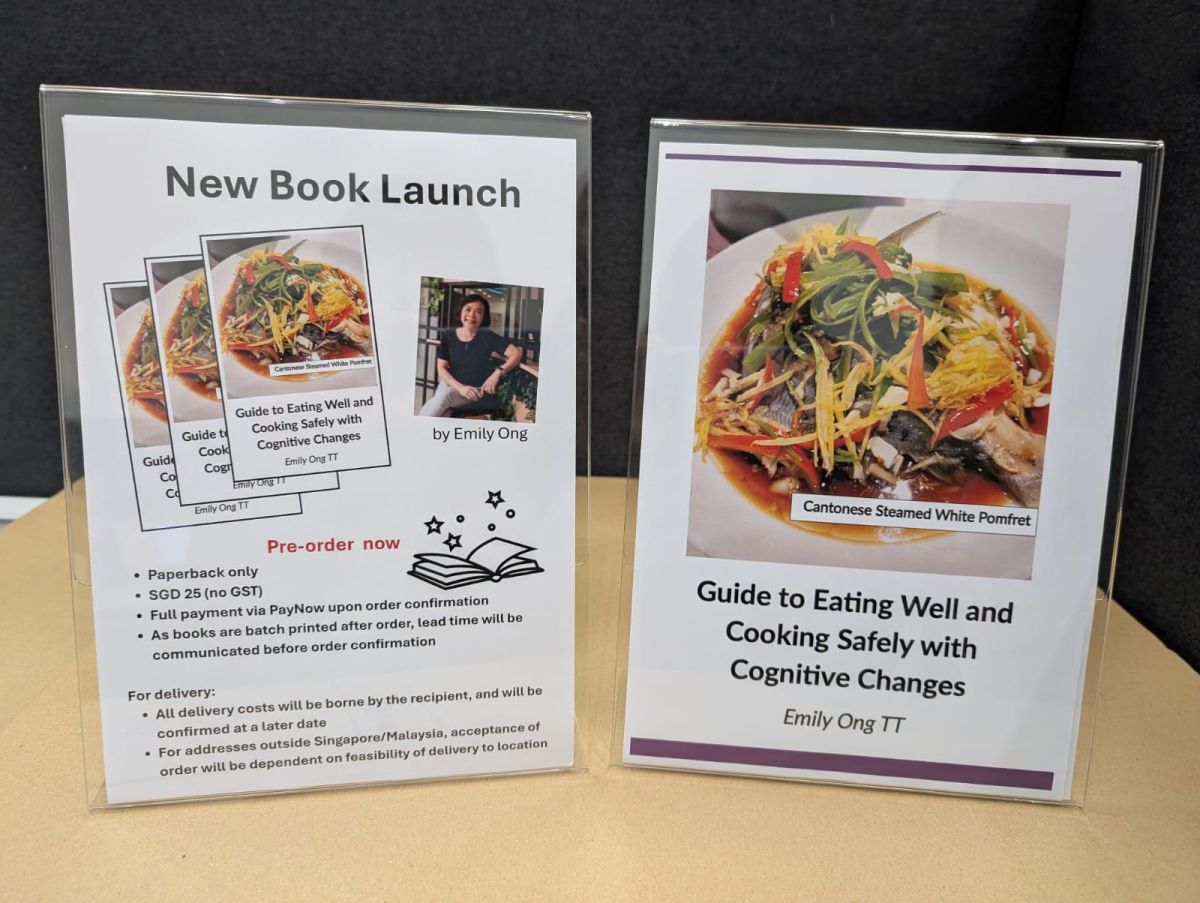
Emily Ong, a younger person living with mild cognitive impairment, recently published her book, Guide to Eating Well and Cooking Safely with Cognitive Changes. I celebrated this achievement with her and her husband over an authentic Yemeni meal.
Several days later, she emailed me to say that she hoped I would find the book a good read. My first thought was that the book was a practical resource for people living with cognitive changes to cook safely and to eat well. Its content, writing style, and format were rooted in lived experience.
Yet, I felt there was something more to her story. My thoughts went back to two words that kept twirling in my head as we talked over dinner: dignity and personhood.
For me, Emily expresses her personhood through writing, sharing her personal experience to support others, and using her voice to advocate for better dementia responses. Her contributions are recognised at national, regional, and global levels. She is thriving. That is what dignity looks like to me.
Then my thoughts turned to my late mother. She was diagnosed with Alzheimer’s disease at the age of 80. Although she continued to live a purposeful and meaningful life with dementia, many of her abilities started to diminish as symptoms progressed. Eventually, she needed increasing support with everyday activities. In her case, what did dignity look like?
My mother had a fiercely independent nature. With support adapted to her changing brain, she remained independent and engaged as much as possible.
For example, using bendable utensils and easy-to-grip cups, she ate on her own terms until her very last meal. She continued to read the Qur’an on her own with a digital Qur’an pen reader many years into her diagnosis. And until the end, her ability to express her thoughts and preferences was often remarkable and very much her.
I saw these achievements as expressions of dignity. I associated dignity with what she could still do, with her determination to remain independent, and with her ability to express forms of personhood that we tend to recognise and value.
Over time, I began to ask myself, what about the moments when she was not able to recognise me, or even herself? Or when she needed full support with personal hygiene? Or when she experienced continuous, involuntary drooling? What happened to her dignity in those moments?
As I continue to reflect on these questions, I have come to see things differently. Neither the adaptive utensils nor eating independently gave my mother her dignity. Nor did the one-to-one support I offered. She possessed it all along.
My support simply helped her express her independence, an important part of her personhood, and allowed me to honour her inherent worth.
Likewise, diminishing abilities did not take away her worth. Without realising it, I had associated independence, productivity, and socially valued abilities with dignity. My mother’s experience taught me otherwise. Flourishing is not a requirement for human value.
Dignity, as it has now become clearer to me, is a shared human worth that does not depend on what we do, contribute, or achieve. It cannot be earned through productivity or lost through dependence. However, it can be honoured or violated depending on how we treat one another.
This raises a larger question: if dignity matters in our relationships with one another, what would it mean to build communities and systems around the same fundamental principle?
A few days after I received Emily’s email, I attended the launch of The Future We Choose, a book written by Dr Kamal Azman. Having read his book and listened to him speak, I felt that we were asking similar questions: What kind of health system takes dignity seriously and ensures justice? What choices do we make so that no Malaysian is left behind? How do we create systems shaped with people, rather than merely for them?
Health Minister Dzulkefly Ahmad was also present at the book launch. He ended his reflections on the book with the question, “What type of society do we want to be?”
These questions took me back to my mother, whose experience has become one of the lenses through which I explore these ideas. Her experience showed me what is possible when we recognise that human dignity is inherent. It also helped me understand personhood better.
Dignity is universal but personhood, the way we express who we are, is deeply personal. My mother’s history, faith, and ways of being were her own. Others might share her habits, beliefs, and preferences, but she had her own unique stamp. Dementia changed some of the ways she expressed her personhood. It did not erase who she was.
Her journey reminds me that the way we express our personhood can change across time, relationships, and contexts. When this happens, what we need from others are conditions in which our dignity is honoured and who we are continues to be supported.
Emily’s experience of cognitive change is very different from my mother’s experience of dementia. Yet both of their stories remind me of the importance of the environments in which we live.
These environments can support or limit our ability to connect, participate, and express who we are. They can also enable us to live in ways that are meaningful to us.
But whether we are thriving or struggling, independent or fully dependent, our human worth remains intact.
This goes beyond cognitive changes. It applies to disability, ageing, and any situation where a person’s worth may become less visible because of what they cannot or can no longer do, or because their contributions are not socially valued.
Ultimately, how we understand dignity shapes how we build our relationships, communities, and societies.
This led me to think that perhaps the answer to the minister’s question lies in another question: what kind of society honours our inherent dignity, supports the changing expressions of who we are, and creates the relationships, communities, and systems in which we can live, participate, and thrive in ways that are meaningful to us?
We should not have to demonstrate productivity, independence or contribution for society to honour our dignity. That is what dignity looks like to me, and that is the future I hope we choose.
Sharifah Tahir is the founder and CEO of UMI-Dementia Care and Support Resource Center. Her work is shaped by 20 years of global public health experience and ten years as the full-time care partner to her mother who lived with dementia. She hopes for greater and better dementia responses.
- This is the personal opinion of the writer or publication and does not necessarily represent the views of CodeBlue.


