

KUALA LUMPUR, Nov 24 — mySalam made payouts for only over half of claims from 2019 to 2024, indicating that as many as 921,000 over claims were denied.
According to its recently published 2024 annual report, mySalam paid out just 54 per cent (1,088,400) of 2,009,500 total claims submitted nationwide in that six-year period, since the inception of the B40 takaful protection scheme for low-income Malaysians in January 2019.
The two million over claims submitted were for critical illness (CI) and hospitalisation benefit (HB), comprising 1,876,404 HB claims at 93 per cent and 133,096 CI claims.
mySalam paid out less than half (49 per cent) of CI claims at 64,826 out of 133,096 submitted from 2019 to 2024, suggesting that 68,270 claims were denied. The CI benefit is an RM8,000 lump sum payment once per lifetime upon diagnosis of one of 45 critical illnesses covered as of December 31, 2024. (The list of CI covered has since expanded to 50).
mySalam’s CI claims payout rate ranged from a low of 24 per cent in 2019 to a high of 63 per cent in 2023, before dropping to 60 per cent last year.
As for the hospitalisation benefit, mySalam paid out 55 per cent (1,023,574) out of 1,876,404 claims submitted from 2019 to 2024, indicating that 852,830 claims were denied.
On average, each HB claim approved by mySalam received RM320 payment. The hospitalisation benefit provides RM50 daily income replacement, up to 14 days or RM700 per annum, for overnight admission to a government, university, or military hospital.
According to its annual report, mySalam paid out RM846.5 million to about 1.1 million beneficiaries from 2019 to 2024, comprising RM518.6 million in CI and RM327.9 million in HB claims respectively. While the value of CI payouts exceeded HB payouts, the vast majority of claims approved was for HB at over a million.
Among the two million mySalam claims submitted, the biggest group of claimants came from Sarawak (302,316), followed by Sabah (238,147) and Selangor (217,910). mySalam’s report doesn’t provide a state breakdown of the 1.1 million claims approved and paid out.
Last month, the insurance and takaful industry touted an average 90 per cent claims approval rate for medical claims, far higher than the 54 per cent over six years in mySalam, a government programme. Medical plans are arguably more complex than CI or income replacement products too.

Even though mySalam’s FAQ states that beneficiaries can receive the maximum RM700 HB payout more than once, as long as their subsequent claim is made in another “certificate year”, mySalam’s annual report uses the same number (1,088,400) to denote the total number of claims paid out (both HB and CI), as well as the number of beneficiaries who received payouts.
This suggests that mySalam only approved one HB claim per person from 2019 to 2024; it’s unknown if the 1.1 million approved recipients indeed only submitted one HB claim each in that period.
Across Sarawak, Kelantan, Kedah, Johor, and Selangor – whose Covid-19 claims submission data were made known in mySalam’s annual report – the B40 health protection scheme only approved 52 per cent (254,102) of 484,305 Covid-19 claims submitted by the five states in total.
Covid-19 claims approval rates were the highest in Selangor (79 per cent), followed by Johor (60 per cent), Sarawak (56 per cent), Kedah (47 per cent), and Kelantan (40 per cent).
mySalam made Covid-19 claims payouts of nearly RM435 million for 483,821 recipients, the same number of claims approved nationwide, again indicating that only one claim was approved per person.
The RM435 million payout for Covid claims was drawn from the mySalam Fund (RM183.9 million) and a Social Fund [SF] (RM251.1 million). According to mySalam’s annual report, mySalam stopped funding its Covid-19 social fund in 2023.

Covid claims were for hospitalisation benefits of RM50 daily income replacement, up to 14 days, in the event that claimants were confirmed positive for Covid-19, or suspected Covid and quarantined in a Ministry of Health (MOH) quarantine facility or ordered for home quarantine.
During the Covid-19 pandemic, mySalam saw a 512 per cent spike in HB claims to 906,767 submitted in 2021 from 148,238 in 2020. Only 18 per cent of HB claims in 2021 (165,177) were paid out.
In 2022, a total of 448,836 HB claims were paid out, exceeding the 432,591 HB claims submitted. mySalam’s annual report does not explain this anomaly.
(The slideshow below is best viewed on desktop. Graphics can be downloaded from CodeBlue’s Facebook page).
Profile Of Approved mySalam Claims: Cancer Biggest Group Of CI Payouts

According to mySalam’s 2024 annual report, based on the 1,023,574 HB claims or beneficiaries approved from 2019 to 2024, those aged 30 to 39 formed the biggest group at 24 per cent.
About 58 per cent of approved HB claims came from those aged 40 years and above.
Among the 64,826 approved CI claims in that period, those aged 50 to 59 years formed 35 per cent, followed by the 60-65 age group (25 per cent) and the 40-49 age group (24 per cent, “indicating that the majority of cases occurred in the middle age until the golden years”.
All 1,088,400 approved CI and HB claimants were aged 18 to 65, as that is the eligible age range for mySalam that excludes older people, even though senior citizens tend to be in ill health compared to younger adults.
Cancer (CI-01) formed the biggest group of approved CI claims at 43.89 per cent, according to mySalam’s report, followed by kidney-related conditions (CI-06) at 26.76 per cent and heart-related conditions (CI-02) at 21.82 per cent.
mySalam has specific definitions of the 12 categories of 50 covered critical illnesses – mirroring commercial CI insurance/takaful products, including various exclusions – that may help explain its 49 per cent CI claims approval rate.
However, its hospitalisation benefit seems straightforward on paper, as mySalam recipients only need to to be admitted overnight in wards at any listed MOH, university, or military hospital to claim for income replacement. Yet, mySalam’s HB claims approval rate was only slightly better than CI at 55 per cent.
RM846 Million Payout Over Six Years From RM2 Billion Fund

According to its annual report, mySalam paid out RM846.5 million over six years – from the launch of the scheme on January 24, 2019 to December 31, 2024 – comprising RM518.6 million in CI and RM327.9 million in HB claims respectively.
If mySalam had approved all 133,096 submitted CI claims, instead of less than half, this would have doubled its CI payout to about RM1.1 billion.
The mySalam trust fund received an RM2 billion contribution from Singapore-based Great Eastern in exchange for not divesting 30 per cent of its shares to local investors under Bank Negara rules, after the programme was set up by the first Pakatan Harapan government, when Lim Guan Eng was then-finance minister.
The RM2 billion fund for mySalam – which had been repeatedly branded across administrations as a free-of-charge aid programme for low-income Malaysians – was meant for use over five years from 2019 to 2023.
But mySalam – under the management of the Ministry of Finance (MOF) and administered by Great Eastern Takaful Berhad (GETB) – has since been extended until next year under Budget 2026, with just less than RM1 billion paid out over six years until the end of 2024.
In a statement last August 16, GETB claimed that mySalam paid out RM1.25 billion to 1.74 million individuals as of July 31 this year.
In other words, mySalam purportedly made payouts of about RM403 million to some 652,000 people in just seven months, equivalent to nearly half of the RM846 million disbursed and 60 per cent of 1.1 million recipients over the preceding six-year period.
This also bucks the recent historical trend of claims submission and payouts, in which 433,000 plus claims were submitted from 2023 to 2024, much less approved, besides payouts of RM376 million in that two-year period.
According to its annual report, mySalam’s board of trustees includes chairman Johan Merican (Treasury secretary-general at MOF), Zahrul Hakim Abdullah (deputy secretary-general [finance] at MOH), as well as Mustaffa Ahmad and Jagjit Singh Nashatar Singh.
The Attorney-General’s 2019 report tabled in Parliament in 2021 found that mySalam lacked transparency and accountability, as MOF’s role in the scheme isn’t stated, nor reporting requirements to the Cabinet, Parliament, and other stakeholders.
mySalam’s annual report touted 11.4 million mySalam scheme members as of December 31, 2024, showing aggregate data on their marital status, OKU status, state, age group, and gender. One’s eligibility for various government cash assistance programmes like STR, BKM, BPR, BSH, and BR1M over the years means automatic eligibility for mySalam, subject to the age range of 18 to 65.
Of the 11,412,234 mySalam scheme members as of the end of 2024, assuming that all 2,009,500 claims made from 2019 to 2024 were submitted by them, this translates to an 18 per cent participation rate.
With a 54 per cent claims approval rate and only 1,088,400 recipients paid out from 2019 to 2024, this means that effectively fewer than one in 10 mySalam scheme members had received the “protection” touted by the government’s B40 takaful scheme.
“We understand that each claim processed isn’t just a number, but an affected life,” wrote GETB mySalam scheme department head Syuhaib Ithnin in a foreword for mySalam’s 2024 annual report.
GETB: Most Claims Denials Due To ‘Withdrawn Claims’, Insufficient Documentation

In a response to CodeBlue, GETB provided data on the reasons for mySalam claims denials.
For HB and SF claims, 57 per cent of denials were due to “withdrawn claims”, defined as claimants’ lack of response to follow-up requests by the takaful operator and voluntary cancellation.
For CI claims, 65 per cent of denials were due to insufficient documentation (34 per cent) and not meeting the CI definition (31 per cent).
GETB did not answer CodeBlue’s request for data on the purported claims approvals and payouts this year that far exceeded historical trends.
mySalam’s 2024 annual report expressed appreciation to the Malaysian Takaful Association (MTA) for assisting with technical guidance and operational support for mySalam, saying the industry body helped ensure that the “takaful practices used in this scheme are in line with Shariah principles and industry standards.”
MOF: Successful Claims Require ‘Proper Documentation, Due Process‘

MOF explained that the higher claims denial rates in the early years of mySalam might have been due to unfamiliarity among applicants, especially when the programme was new and free of charge.
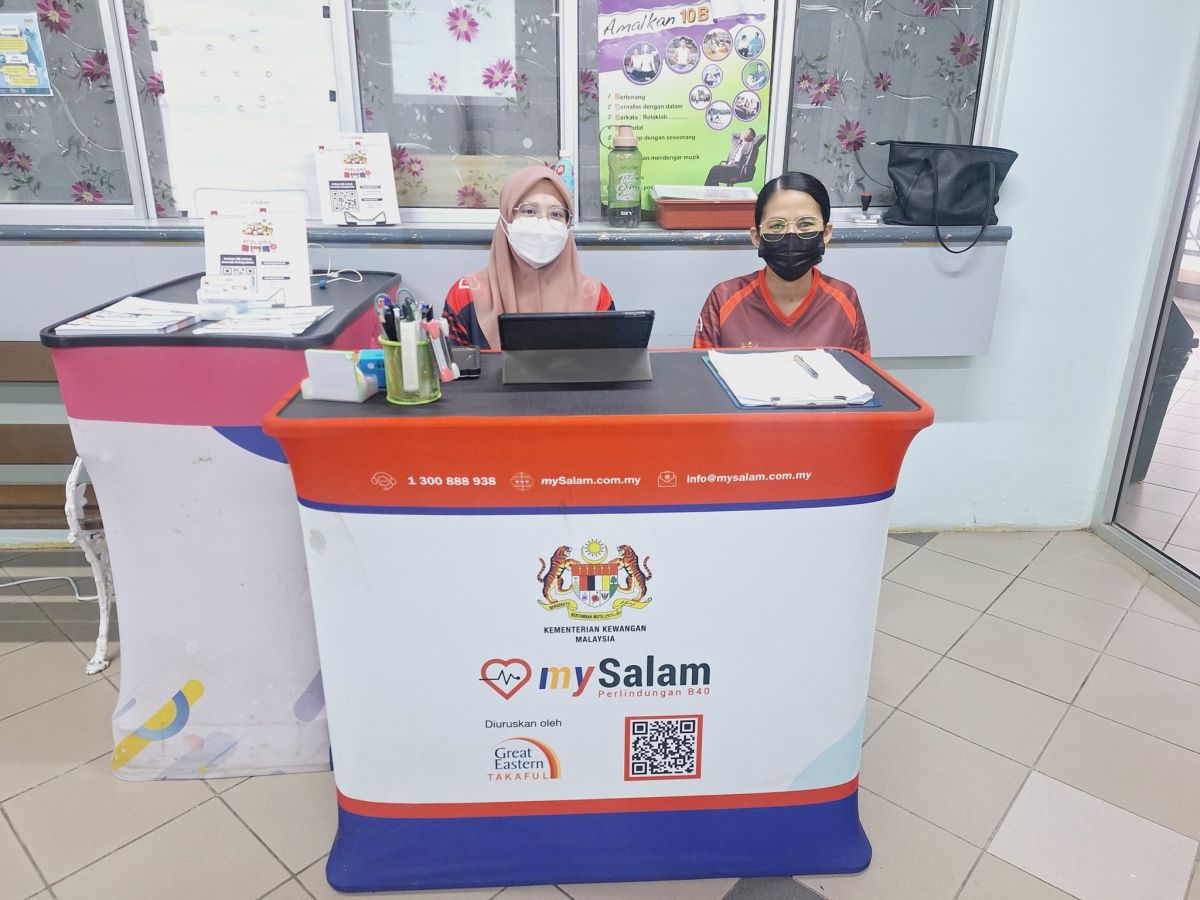
But the Madani government has since increased efforts to assist beneficiaries, with more than 140 mySalam kiosks covering the majority of public hospitals. Staff members at the kiosks help applicants to navigate the process and understand the criteria and documentations needed.
As a result, CI claims approval rates rose from 24 per cent in 2019 to 60 per cent in 2024. For HB and SF claims, approvals increased from 49 per cent to 86 per cent in the same period, which MOF said was broadly in line with the private insurance industry’s average payout rate.
“The majority of rejected claims stemmed from documentation gaps (such as not having a hospital discharge note) or misunderstanding of requirements (such as not having a diagnosis for one of the 50 approved critical illnesses), rather than the denial of valid claims,” said an MOF spokesperson in a statement to CodeBlue.
“The government recognises the need to strengthen public awareness of mySalam. While the scheme is intended to uplift B40 households, successful claims still require proper documentation and due process.
“By contrast, private insurance and takaful products benefit from agents who guide policyholders through submissions. Moreover, since such products are purchased, policyholders are generally more aware of their coverage, naturally resulting in lower rejection rates.”
In response to CodeBlue’s question about whether mySalam’s outcomes would give MOF pause on its planned basic medical and health insurance/takaful (MHIT) product – especially when Malaysians are expected to use their Employees’ Provident Fund (EPF) savings to pay the premiums – the ministry said there was no reason to suspend development.
“The early challenges encountered under mySalam largely reflected the growing pains of a fully subsidised scheme, where beneficiaries were unfamiliar with the requirements and documentation needed to support a claim,” said the MOF spokesperson.
“MHIT, by contrast, will be a purchased product, and experience shows that policyholders who buy coverage tend to have a clearer understanding of their entitlements and the supporting documents required. This alone is expected to lead to higher-quality submissions and, consequently, fewer denials.”
MOF said it would draw upon lessons from both the commercial health insurance sector and its mySalam experience in shaping the new MHIT product.
“This includes improving the clarity of definitions, simplifying processes, and ensuring adequate support for claim submissions from the outset. These refinements are precisely aimed at reducing the risk of disputed or unsuccessful claims.
“The MOF stays committed to designing and implementing MHIT in a way that strengthens accessibility, transparency, and fairness — without repeating the teething issues seen in the early phase of mySalam.”


