

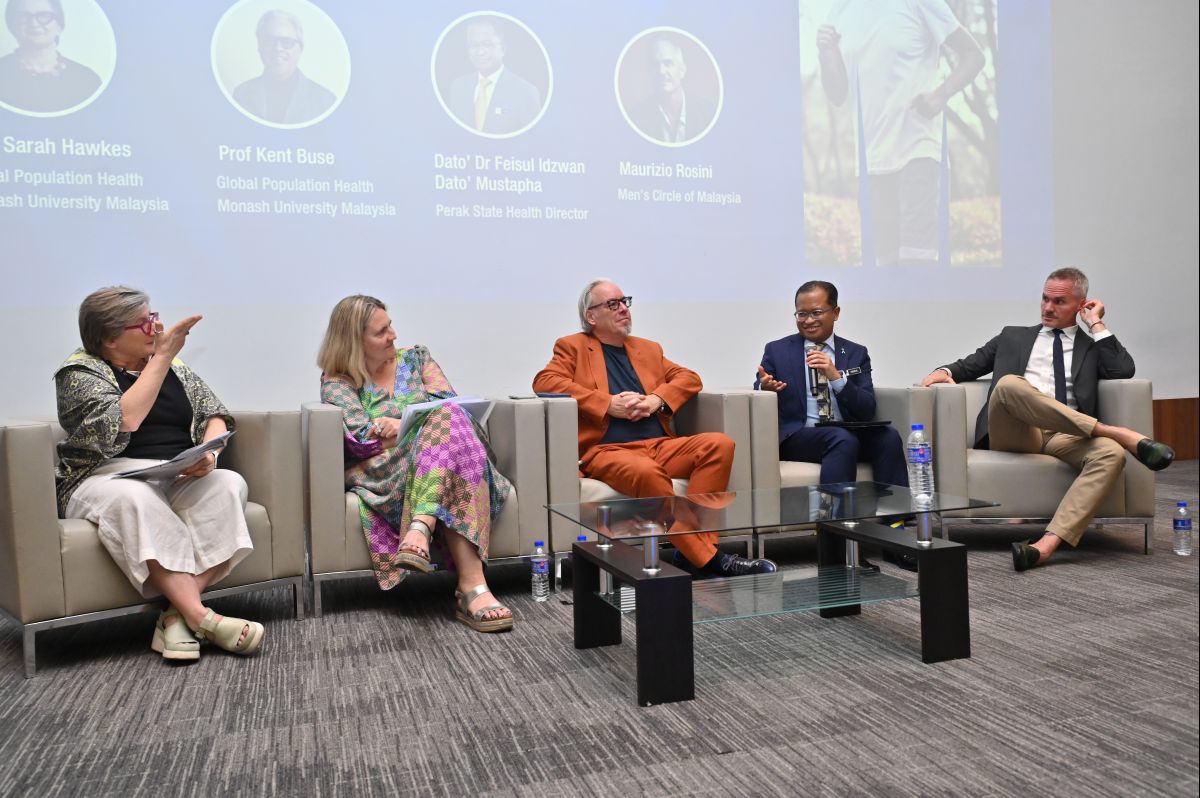
KUALA LUMPUR, Nov 26 — Malaysian men have a life expectancy of 73.2 years, nearly five years shorter than women’s 78.1 years, but the national average does not show which groups of men are most disadvantaged, Perak state health director Dr Feisul Idzwan said.
Dr Feisul said Malaysia’s men’s health policy must go beyond counting health screenings and awareness campaigns to demonstrate whether men are being diagnosed earlier, receiving appropriate treatment, and avoiding preventable deaths.
“A policy that treats all men as one population risks missing those with the greatest preventable disadvantage,” Dr Feisul said at the Malaysian launch of The Lancet Series on Men’s Health at Monash University Malaysia last Tuesday.
Globally, cardiovascular disease and cancer account for the largest share of the excess mortality among men compared with women, according to one of the three papers in the Lancet Series on Men’s Health.
Suicide, substance use, road traffic injuries, interpersonal violence and respiratory infections, including tuberculosis and Covid-19, also contribute to men’s poorer health.
The paper, which analysed global mortality and disability data from 1990 to 2023, also found that poor health outcomes are concentrated among marginalised men facing multiple disadvantages, including those experiencing homelessness, incarceration, mental illness, and low income.
Dr Feisul called for health surveillance data to be broken down by age, geography, and socioeconomic circumstances to identify men who remain undiagnosed, are not reached by health care services or face a greater risk of preventable illness and premature death.
Malaysia is among relatively few countries with a dedicated national men’s health policy. But “a national policy is a commitment, not yet a health outcome,” Dr Feisul said, cautioning that screenings and campaigns show activity and reach, not necessarily better health.
“Screening counts, participating facilities and campaigns show activity and reach – not necessarily improved health. Look beyond outputs to earlier diagnosis, appropriate care after abnormal findings, sustained treatment and follow-up, and prevention of illness and premature mortality,” he said.
Economic Insecurity Forces Men To Put Work Before Health

The Lancet Series also examines how poverty and insecure employment can leave men vulnerable to tuberculosis. In Africa, men in low-income, informal jobs may put off seeking medical care because taking time off work means losing a day’s wages, said Prof Sally Theobald of the Liverpool School of Tropical Medicine.
Theobald described how some men suppress symptoms with quick remedies so they can continue working, a practice referred to as “paracetamol masculinity”.
“In Africa, we looked at men in low-income, informal work, where a daily wage is never certain. Taking a day off to get checked can mean losing that day’s pay, even though they may face high exposure to tuberculosis on the job.
“They practice what has been referred to as ‘paracetamol masculinity’ by fixing their illness with a quick pill, in order to continue working,” she said.
More than one in four men who developed tuberculosis in the World Health Organization (WHO) African region in 2024 were missing diagnosis and treatment, the paper found.
Manosphere Profits From Vacuum In Men’s Health Policy

A separate paper in the Lancet Series, led by Prof Dr Sarah Hawkes, head of the Department of Global Population Health at Monash University Malaysia’s Jeffrey Cheah School of Medicine and Health Sciences, found that men’s health remains overlooked in policymaking, partly because men are often seen as socially advantaged, while gender-related health policies tend to focus on women.
The paper also found that no institution at national or global level has a clear mandate for men’s health, leaving policies rarely funded, implemented or evaluated.
“Our papers tell a single story. Men’s health has no institutional home: nobody frames it, nobody funds it and nobody answers for it. Where public institutions are absent, commercial ones move in. Yet in almost every country men die younger than women, often of preventable causes, and the heaviest burden falls on boys and men who are already marginalised. It is time to act,” Dr Hawkes said.
“Confront the power and politics that keep men’s health off the agenda, and reject the claim that men’s gains must come at women’s expense. Health systems that take gender seriously serve everyone better. That is gender justice for all,” Dr Hawkes added.
Dr Hawkes and fellow Monash University Malaysia professor Kent Buse, who is also director of programme development at the Jeffrey Cheah School of Medicine and Health Sciences, said commercial and ideological actors have stepped into the gap left by public institutions.
They described the manosphere as “a commercial ecosystem” that profits from young men’s insecurities. These online communities sell subscriptions, courses and investment schemes while offering men simple explanations for their difficulties, often encouraging them to blame women and feminism.
“The manosphere is not only a set of ideas. It is a commercial ecosystem. Outrage keeps boys online, and their attention is sold to advertisers. Young men are then sold subscriptions, unregulated products, courses, investment schemes, and even surgery.
“We need to treat the manosphere for the business model that it is; regulate what boys see and invest in what boys need – schooling, skills, mentoring, and real opportunities,” Buse said.
The authors describe the manosphere as a collection of online communities centred on ideas about masculinity, misogyny, and male victimhood.
They say it has been linked to mental health problems, particularly among young people, violence against women and girls, and discouraging boys and men from seeking help.

